

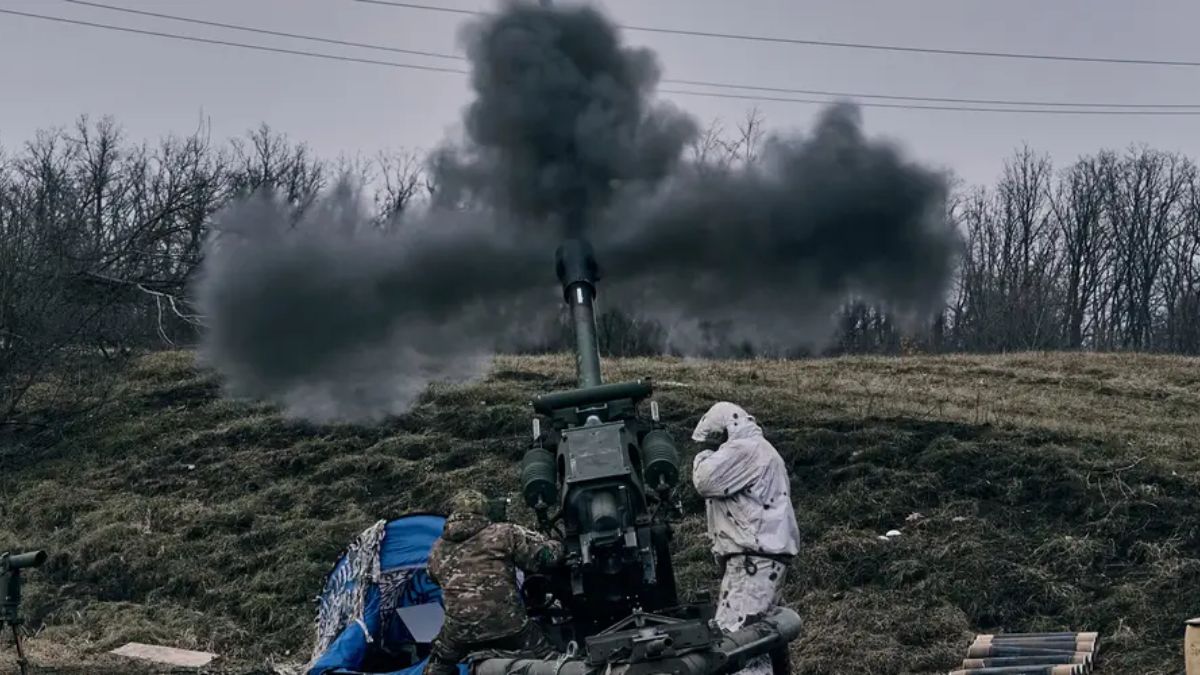
 "How wars and conflicts made arms manufacturers richer")
The global defence industry experienced its most profitable year on record in 2024, with the world’s 100 largest weapons manufacturers collectively taking in $679 billion from military-related sales.
New data released by the Stockholm International Peace Research Institute (SIPRI) on Monday shows that conflicts in Ukraine and Gaza, along with rising security concerns across multiple regions have resulted in unprecedented demand for ammunition, aircraft, drones, missiles, armoured vehicles and other defence systems.
While the revenue boom has brought growth to many companies, the report also reveals that manufacturers are wrestling with production delays, labour shortages and disruptions in sourcing critical materials — factors that have prevented even larger gains.
SIPRI’s latest assessment highlights how the global security environment has transformed the defence sector into one of the fastest-expanding industries of the decade.
Over the period from 2015 to 2024, revenues among the same set of top manufacturers climbed 26 per cent.
How US defence giants fared
The United States remains the largest hub for arms production by a wide margin. Out of the top 100 companies, 39 are American, and together they amassed $334 billion in revenue last year — almost half of all global arms sales.
SIPRI’s review shows a 3.8 per cent jump in earnings for US manufacturers in 2024, with nearly four-fifths of those companies registering year-on-year increases.
Despite this strong performance, several marquee American programmes continue to be plagued by bottlenecks. SIPRI emphasised that major US-led projects such as the F-35 fighter jet and the Columbia-class submarine are still hampered by persistent budget overruns and production delays.
These setbacks have not prevented the firms involved — including Lockheed Martin, Northrop Grumman, RTX (formerly Raytheon Technologies) and General Dynamics — from topping global rankings.
The United States remains the undisputed leader in high-end defence technologies, especially in stealth aircraft, long-range missile systems, guided munitions, naval platforms, and advanced sensors.
These capabilities place American manufacturers at the centre of multinational procurement efforts, particularly among countries looking to replenish stockpiles depleted by assistance to Ukraine.
That replenishment drive has been a key contributor to higher US sales. Countries supporting Kyiv — particularly Nato members in Europe — have been forced to place large orders with American defence contractors to rebuild their inventories.
As Ukraine’s battlefield requirements have expanded, demand for US-made missile defence systems, artillery shells, drones and monitoring equipment has risen in parallel.
Still, the SIPRI report notes that even large American companies have struggled to keep pace with the scale of orders, pointing to the systemic strain caused by multiple active conflicts and the simultaneous need to modernise national arsenals.
The US defence sector is adjusting by expanding production facilities, hiring more workers and negotiating long-term supply agreements, yet the industry remains under heavy pressure to reduce backlogs.
How Europe is arming itself
Excluding Russia, 26 European firms on SIPRI’s list achieved a 13 per cent overall rise in revenue, totalling $151 billion in 2024. This expansion is directly tied to the continent’s response to the war in Ukraine and to fears that regional security may deteriorate further.
Arms manufacturers across Europe have been tasked with accelerating output at a pace not seen since the Cold War. Several governments have dramatically increased spending on everything from artillery to air defence systems.
In particular, countries bordering Russia or those contributing heavily to Ukraine’s defence have pushed for faster deliveries and larger production runs.
Germany saw some of the most robust growth among major European states. According to SIPRI, the boom in German companies’ earnings — which reached gains of 36 per cent — is linked to Berlin’s large-scale efforts to reinforce the Bundeswehr after years of underinvestment.
This has translated into major contracts for firms like Rheinmetall, Diehl, Thyssenkrupp and Hensoldt.
These companies have been heavily involved in manufacturing armoured vehicles, ammunition, air-defence interceptors and components needed to replace what Germany has provided to Ukraine.
Some of the most dramatic changes within Europe were recorded in central and eastern countries. The Czechoslovak Group in the Czech Republic saw revenue skyrocket by 193 per cent, a growth rate unmatched by any other company in SIPRI’s top 100.
This extraordinary surge was partly due to a national initiative aimed at supplying artillery ammunition to Kyiv, a demand that soared throughout the year as Ukraine sought to counter Russia’s expanding firepower.
Ukraine’s own primary defence manufacturer, JSC Ukrainian Defense Industry, also experienced a 41 per cent revenue boost, reflecting the country’s efforts to maintain domestic production capabilities.
However, SIPRI cautions that Europe’s defence sector faces serious obstacles as it works to sustain this growth.
Researcher Jade Guiberteau Ricard stressed that “sourcing materials could pose a growing challenge”, telling AFP that companies must overhaul supply networks to avoid vulnerabilities linked to China’s export restrictions on critical minerals.
Before 2022, European aerospace leaders such as Airbus and France’s Safran relied heavily on titanium sourced from Russia. With that option no longer viable, supply diversification has become an urgent priority and has added extra cost pressure on manufacturers.
French, German and pan-European companies are also undertaking investments to expand factory capacity. Even so, the demand surge has created a situation where existing facilities remain insufficient to meet the immediate needs of European militaries.
Production timelines are being stretched, and governments are attempting to fast-track procurement procedures to secure available stock.
How Russian militarised economy is growing despite sanctions
Russia’s two major companies included in the SIPRI rankings — Rostec and United Shipbuilding Corporation — generated a combined $31.2 billion in revenue in 2024, representing 23 per cent growth over the previous year.
Rather than being driven by exports, as in the past, this increase stems from soaring domestic demand as Moscow prioritises its war in Ukraine.
SIPRI’s Nan Tian showed how deeply the Russian economy has been reshaped, saying, “The country has completely changed its priorities. The production has now, for the last three years, been geared to a war economy.”
He added that the country has funnelled resources into defence production at a scale rarely seen in modern times.
One of the most striking indicators of Russia’s war-driven industrial mobilisation is the dramatic increase in artillery shell manufacturing.
SIPRI reports that production of 152mm rounds rose from 250,000 to 1.3 million between 2022 and 2024 — a 420 per cent escalation. This output has played a central role in Russia’s sustained operations on the front lines.
Russia has faced persistent shortages of foreign-made electronics and aviation components due to international sanctions.
Despite the early assumptions that Moscow’s defence industry might collapse under such restrictions, Tian observed that this expectation has not materialised, noting that “the country has proven to be quite resilient to these various sanctions and economic issues.”
Yet SIPRI warns that Russia’s arms makers face serious internal pressures.
The shift to a wartime economy may limit Russia’s ability to revert back to a non-war footing even if the conflict ends, potentially reshaping its industrial base for years to come.
How China’s defence sector is faring amidst corruption allegations
Although global arms revenue grew overall, the Asia-Oceania region was the only one to register a decline, with earnings falling 1.2 per cent to $130 billion.
This was not due to decreased demand across the region as a whole, but rather the result of significant downturns in China’s defence companies.
Chinese arms manufacturers, eight of which appear in SIPRI’s rankings, recorded a 10 per cent drop in combined revenue — the sharpest fall experienced by any major arms-producing country last year.
Multiple corruption cases involving procurement officials disrupted major contracts, leading to delays or cancellations in 2024.
Nan Tian explained the decline to DW by saying, “Specifically, Asia and China, the reason for the decrease has been, there have been a lot of corruption allegations against Chinese arms companies,” adding that the suspensions and investigations had significantly slowed procurement cycles.
By contrast, firms in Japan and South Korea fared better.
Their revenue growth was aided partly by increased orders from Europe, where militaries have been seeking to diversify suppliers amid constrained capacity in US and European factories.
South Korean production of artillery systems, armoured vehicles and missile platforms has become particularly attractive to buyers looking for faster deliveries.
How West Asian companies reached new milestones
West Asia increased its representation on SIPRI’s list last year, with nine firms making the cut and collectively earning $31 billion. A substantial portion of this came from the region’s most prominent companies in Israel, which posted $16.2 billion in sales across three leading manufacturers.
That represents a 16 per cent increase, even as Israel’s actions in Gaza attracted significant criticism.
Israeli firms remain key suppliers of air defence systems, drones and precision-guided weapons — technologies that have seen elevated global demand.
Turkey also contributed to the region’s increased presence, with its defence companies expanding output in drones, missiles and armoured vehicles. However, Baykar, the maker of Bayraktar UAVs widely used in Ukraine earlier in the war, did not match its previous export performance to Kyiv in 2024.
How supply chains are dwindling
SIPRI’s list confirms that American firms maintain their dominant position at the top of the global rankings.
With the exception of BAE Systems, which is based in the United Kingdom, all of the top five are American. This marks the first time since 2017 that a non-US firm — BAE Systems — has re-entered the top five largest defence contractors.
Further down the list, the military division of Airbus ranks 13th, while Rheinmetall of Germany is positioned at 20th, reflecting their expanded roles in supplying European militaries.
The German-French alliance KNDS, combining Krauss-Maffei Wegmann and Nexter, sits 42nd.
It recorded a 40 per cent spike in new orders and a 14 per cent increase in revenue, driven by European demand for tanks, artillery and armoured vehicles.
Despite rising earnings, companies worldwide are contending with persistent supply chain strains. Manufacturers in Europe and the US have warned of elevated material costs, longer delivery timelines and shortages of specialised components.
One of the most significant disruptions has been the restructuring of titanium sourcing. Before the Ukraine war, Airbus and Safran depended heavily on Russian titanium.
Following geopolitical fallout, these firms have been forced to find alternative suppliers, incurring added costs and logistical challenges.
Additionally, China’s export controls on minerals critical for electronics and precision manufacturing have put pressure on companies like Thales and Rheinmetall.
These restrictions prompted both companies to caution that they may face higher expenses and potential delays as they overhaul procurement strategies.
Also Watch:
With inputs from agencies


 "Jaishankar warns misuse of biological weapons by non-state actors is no longer a 'distant possibility'")
 "In China, you can't even be angry over a fire that killed 151?")
 "Breaking News Live Updates: Lok Sabha adjourned for the day amid opposition's uproar over SIR")
 "Indian govt confirms GPS spoofing at Delhi airport; flights forced into backup landing modes")
 "Jaishankar warns misuse of biological weapons by non-state actors is no longer a 'distant possibility'")
 "In China, you can't even be angry over a fire that killed 151?")
 "Breaking News Live Updates: Lok Sabha adjourned for the day amid opposition's uproar over SIR")
 "Indian govt confirms GPS spoofing at Delhi airport; flights forced into backup landing modes")



