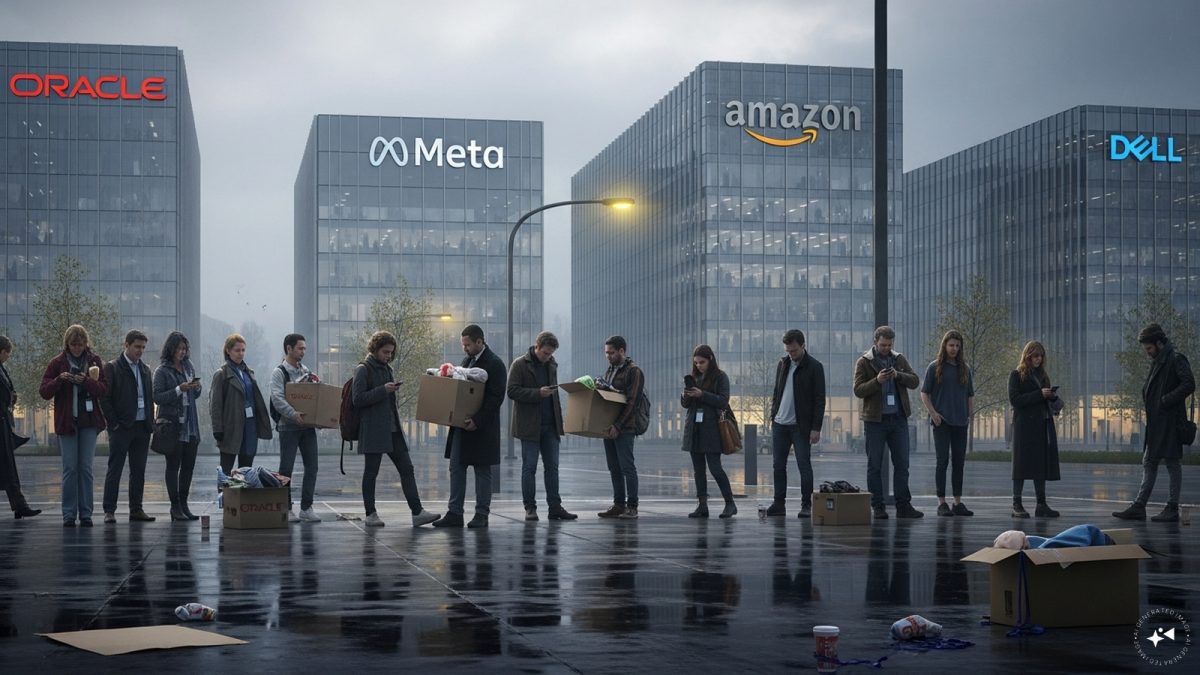
 "Tech layoffs in 2026, Oracle, Meta, Amazon, Dell and more companies cutting jobs")
The tech industry’s long-running obsession with growth has taken a sharp turn in 2026. Instead of hiring sprees, the year has been marked by sweeping job cuts, with some of the world’s biggest companies trimming their workforce at an unprecedented scale.
While layoffs are not new to the sector, the scale and speed of cuts this year stand out.
From cloud giants to gaming firms, companies are reshaping teams as they pour resources into artificial intelligence and automation. The result is a growing sense that the industry is entering a new phase, one where efficiency and AI capabilities take precedence over headcount.
Tech layoffs in 2026
Leading the wave is Oracle, which has reportedly cut around 30,000 jobs globally in what is being described as one of the largest single-day layoffs in tech history. As far as India is concerned, the company has laid off 12,000 employees.
The company cited organisational restructuring as it doubles down on its cloud and AI infrastructure business.
Amazon followed with approximately 16,000 layoffs earlier in the year, part of multiple rounds of job cuts as it recalibrates after pandemic-era expansion. The company also made reductions in its robotics division, signalling a broader effort to streamline operations.
Hardware giant Dell reduced its workforce by around 11,000 roles , focusing on cost control and limiting external hiring. Meanwhile, Block, led by Jack Dorsey, cut 4,000 jobs, attributing the move to the growing role of “intelligence tools” within the company.
Social media giant, Meta has also seen multiple rounds of layoffs . It reduced about 10 per cent of its Reality Labs division in January and followed up with further cuts across departments in March. Similarly, Atlassian eliminated roughly 1,600 roles , with leadership acknowledging that AI is changing the mix of skills required.
Other firms have taken similar steps. Epic Games cut over 1,000 jobs amid declining engagement and rising costs tied to its flagship title, Fortnite. eBay laid off 800 employees as it increased investment in AI.
Quick Reads
View AllAcross these companies, the reasoning varies from restructuring and cost-cutting to a more direct pivot towards AI-driven operations.
AI vs human jobs debate continues
The surge in layoffs has reignited debate over how artificial intelligence will reshape the labour market. Economists such as Anton Korinek have warned that increasingly capable AI systems could replace large segments of human work, potentially disrupting wages and economic stability within a relatively short timeframe.
At the same time, industry leaders offer a more balanced outlook. Sam Altman has suggested that while some roles may disappear, others will evolve, with workers becoming more productive alongside AI. A similar view is shared by Oren Etzioni, who believes the technology will enhance creativity and efficiency rather than eliminate jobs entirely.
Early research appears to support this mixed picture. Studies indicate that while AI has not yet significantly reduced white-collar employment, it is beginning to shift demand towards new types of work, particularly in AI-related fields. At the same time, routine and repetitive roles are increasingly at risk of disruption.
There is also growing evidence that companies are still figuring out how best to deploy AI, with its full impact on employment likely to emerge gradually. In the meantime, experts suggest that workers who adapt to using AI tools effectively may have a competitive advantage in the evolving job market.
As 2026 unfolds, one thing is clear: the intersection of AI and employment is no longer theoretical. It is already reshaping hiring decisions, corporate strategies and the future of work itself.