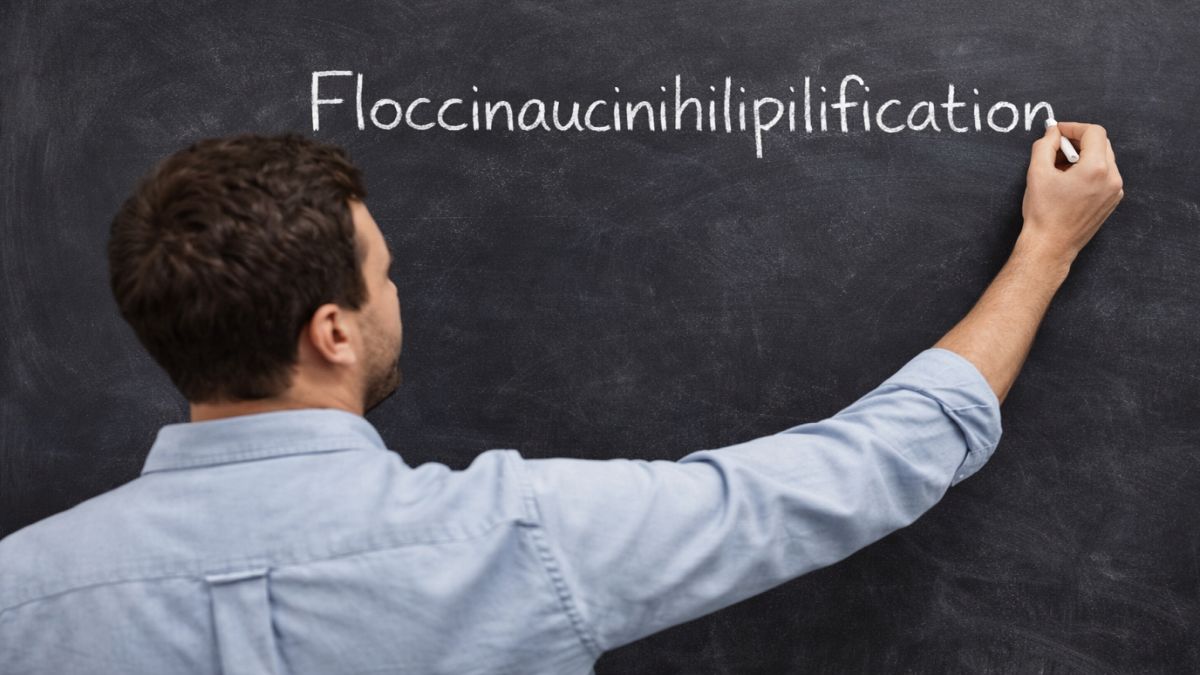
 "Floccinaucinihilipilification: The 29-letter tongue twister Delhi court used to dismiss Sitharaman defamation case")
Court orders often contain legal jargon and words that are rarely understandable by the common man. On Wednesday (April 1), the Delhi court proved this once again when it dismissed a criminal defamation complaint against Union Finance Minister Nirmala, calling it a floccinaucinihilipilification.
The court’s statement prompted many people to look up what this 29-letter tongue twister means.
We, at the Firstpost Explainers team, also got thinking — from the origin of this word to its meaning and usage.
Here is how you can use the word floccinaucinihilipilification in a sentence.
Delhi court, Sitharaman case, and floccinaucinihilipilification
On Wednesday (April 1), a Delhi court dismissed a criminal defamation case filed by Aam Aadmi Party leader Somnath Bharti’s wife, Lipika Mitra, against Union Finance Minister Nirmala Sitharaman.
Mitra alleged that Sitharaman made “defamatory, false, and malicious” statements about her husband, which were aired widely on news platforms on TV and YouTube, with the alleged objective of “tarnishing his reputation and damaging his electoral prospects” during the 2024 Lok Sabha elections.
Hearing the matter, Additional Chief Judicial Magistrate Paras Dalal of Rouse Avenue Court said, “From the entire material on record, this court is reminded of a rather unusual word, which can describe the present complaint as well as the entire proceedings. The word is ‘floccinaucinihilipilification’, which implies ‘something valueless or worthless’. The present complaint is nothing but the word stated above, wherein a valueless or worthless material has been stretched too long.”
“…this court fails to find that the necessary ingredients of criminal defamation are prima facie not made out. The press conference and averments made by the respondents are nothing more than political discourse amongst rival and competing parties,” it added.
The court further added, “The statements are nothing but political opposition and antagonism aimed at AAP and Indi Alliance. Nothing was aimed at the complainant Lipika Mitra, and there is no imputation against her. I do not see anything in this matter to proceed further, and I am denying cognisance.”
Meaning and origin of floccinaucinihilipilification
So, what did the court mean when it said the complaint was floccinaucinihilipilification?
This 29-letter word is described by Cambridge Dictionary as ‘the act of considering something to be not at all important or useful’. Oxford Dictionary describes it as the action or habit of estimating, regarding, or describing something as worthless or unimportant.
Essentially, while floccinaucinihilipilification may sound very lofty, it simply is used to dismiss an idea, claim, or object as having no value.
The word originated in 18th-Century England through the combination of four Latin words, which mean “of little or no value”: flocci, nauci, nihili, and pili.
Its early usage was largely humorous and intellectual, reflecting the linguistic creativity of scholars who enjoyed forming long, elaborate words with precise meanings.
Interestingly, floccinaucinihilipilification also holds the status as one of the longest non-technical words in English.
Use of floccinaucinihilipilification in daily language
While the Delhi court got people wondering about floccinaucinihilipilification, the initial buzz around the word was created by none other than India’s foremost wordsmith — Congress MP Shashi Tharoor.
In 2018, he popularised the word when he used it in a post on X, then Twitter, while introducing his new book, The Paradoxical Prime Minister.
My new book, THE PARADOXICAL PRIME MINISTER, is more than just a 400-page exercise in floccinaucinihilipilification. Pre-order it to find out why!https://t.co/yHuCh2GZDM
— Shashi Tharoor (@ShashiTharoor) October 10, 2018
The word once again caught people’s attention in 2021 when Tharoor engaged in friendly banter with Bharat Rashtra Samithi leader KT Rama Rao over Covid-19 medicine names. It started with Rama Rao, or KTR as he is popularly called, wondering why medicine names are so tough to pronounce.
On a lighter note, any idea who comes up with this unpronounceable names for meds? Posaconazole - Cresemba - Tocilzumab - Remdesivir - Liposomal Amphoterecin - Flavipiravir - Molnupiravir - Baricitinib. And the list goes on…,” he wrote on the social media site.
In another post, he added, “I suspect @ShashiTharoor Ji Pakka has a role to play in this.”
To this, Tharoor responded light-heartedly, “Not guilty! How can you indulge in such floccinaucinihilipilification, @KTRTRS? Left to me I’d happily call them ‘CoroNil’, ‘CoroZero’, & even ‘GoCoroNaGo!’ But these pharmacists are more procrustean.”
So, before you try to use floccinaucinihilipilification in your next conversation, here’s a guide to pronouncing the tongue twister: flok-si-naw-si-ni-hi-li-pi-li-cay-shun.
With inputs from agencies

 "Iran Israel War News Live: Iran warns against ‘vicious cycle’ of war and ceasefires, vows to continue fight")
 "‘Regime change not our goal’: Trump shifts Iran goalpost — with Ghalibaf in talks, Pahlavi in the wings")
 "Why is Iran targeting Gulf data centres? What does this mean for modern warfare?")
 "Did Obama send $1.7 billion in cash to Iran as Trump claims?")
 "Iran Israel War News Live: Iran warns against ‘vicious cycle’ of war and ceasefires, vows to continue fight")
 "‘Regime change not our goal’: Trump shifts Iran goalpost — with Ghalibaf in talks, Pahlavi in the wings")
 "Why is Iran targeting Gulf data centres? What does this mean for modern warfare?")
 "Did Obama send $1.7 billion in cash to Iran as Trump claims?")