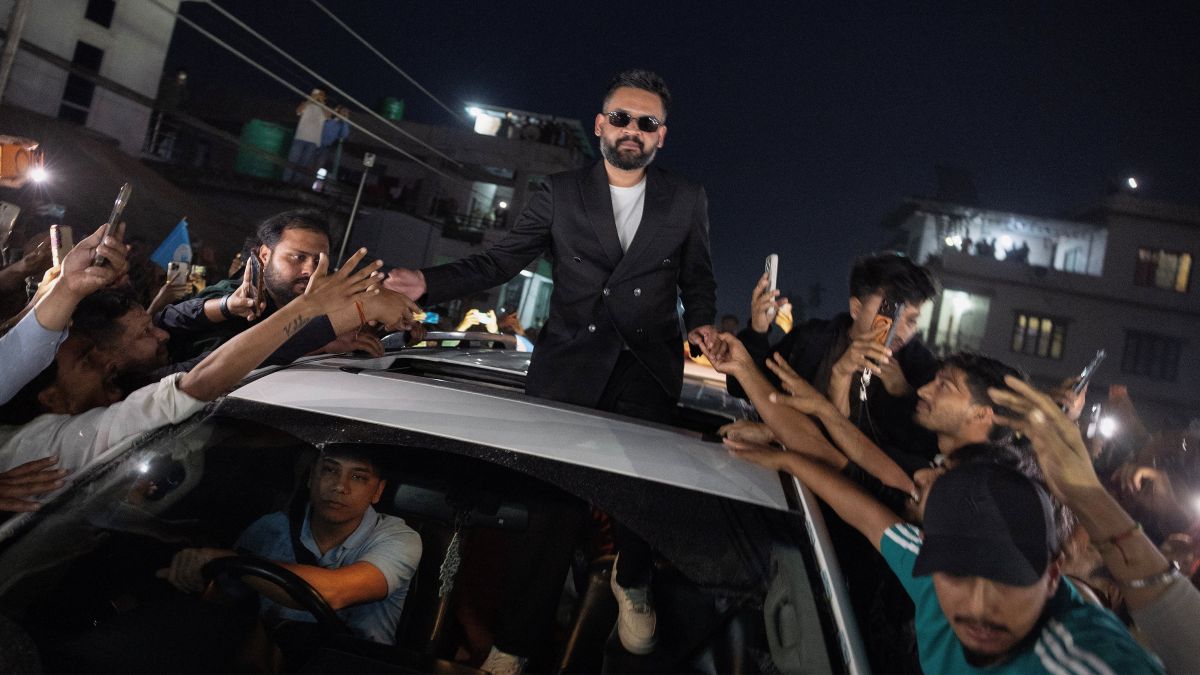
 "Balen Shah’s rise is a setback for old-guard politics, but can rebellion actually govern Nepal?")
On the morning of March 27, 2026, a 35-year-old man in black trousers, a matching jacket, a traditional Nepali cloth cap, and his signature black rectangular sunglasses walked into the President’s House in Kathmandu. Seven conch shells—chosen deliberately because the time 12:34 pm reads as 1234, believed in Nepali tradition to augur success—rang out as Balendra ‘Balen’ Shah was sworn in as the Prime Minister of Nepal.
The scene would have been unimaginable even five years earlier. Nepal’s political landscape had long been a closed circuit: a revolving door of Nepali Congress stalwarts, communist heavyweights, and Maoist-era veterans cycling through the prime ministership at a dizzying rate—14 governments in 18 years since the abolition of the monarchy in 2008. Yet here stood a structural engineer turned underground rapper turned Kathmandu mayor, now the leader of the Himalayan Republic, having just routed the four-time former Prime Minister KP Sharma Oli in Oli’s own longstanding stronghold constituency with a margin of nearly 50,000 votes.
Make no mistake, Nepal would never be quite the same again.
The Road to Singha Durbar
To understand how Balen Shah arrived at the prime ministership, one must first understand the earthquake that preceded his ascent—not a geological one, but a social and political upheaval that shook Nepal to its foundations.
In September 2025, the government of KP Sharma Oli, facing public fury over rampant corruption, endemic youth unemployment, and a deeply unpopular ban on social media platforms, found itself confronted with mass street protests led overwhelmingly by Generation Z. The demonstrations—in which at least 77 people were killed, many shot by security forces—became one of the most significant popular uprisings since the Arab Spring. Viral hashtags like #NepoKid and #NepoBabies mocked the nepotism of the political establishment, and the mood on the streets was electric with rage and possibility.
Balen Shah, then still the Mayor of Kathmandu, publicly supported the protesters but made a strategically shrewd decision: he declined the offer to lead an interim government, instead backing former Chief Justice Sushila Karki—who became Nepal’s first woman to head a government—for the caretaker role. He was trading a six-month stopgap for a shot at five uninterrupted years of democratic power, and the gamble paid off handsomely.
Quick Reads
View AllOn December 28, 2025, Shah formally merged with the Rastriya Swatantra Party (RSP), a four-year-old anti-corruption outfit founded by former television personality Rabi Lamichhane. He resigned as Mayor on 18 January 2026, and launched his campaign from Janakpur the very next day—presenting himself as a “son of Madhesh,” in the Terai plains bordering India, where he was born. Then he made a decision widely labelled “political suicide” by commentators: he chose to contest from Jhapa-5, the longstanding fortress of KP Sharma Oli, who had won the seat in every election since 2008.
On March 5, 2026—the day of Nepal’s snap general election—the result was not merely a victory. It was a demolition. Shah secured 68,348 votes, a record in Nepal’s parliamentary election history, against Oli’s 18,734. Across the country, his party, RSP, dominated, winning 182 of the 275 seats in the House of Representatives, just two short of a two-thirds supermajority.
On March 27, 2026, Balen Shah was sworn in as Nepal’s youngest-ever Prime Minister—and, notably, its first Prime Minister of Madhesi origin from the southern plains.
The Parliament: Pratinidhi Sabha
Nepal’s federal legislature is structured as a bicameral parliament, known as the Federal Parliament of Nepal (Sanghiya Sansad). Its lower house—the more powerful chamber where governments are formed and laws primarily originate—is the Pratinidhi Sabha (House of Representatives), which has 275 seats: 165 chosen through direct First-Past-The-Post voting and 110 through proportional representation. The upper house is the Rajya Sabha (Council of States).
The March 2026 snap election was held exclusively for the Pratinidhi Sabha. The RSP won 125 seats through direct voting and 57 through proportional representation, giving it 182 seats in total—a near supermajority presenting a “historical and unprecedented opportunity” for Shah to execute an ambitious reform agenda with minimal legislative obstruction.
The Opening Gambit
Within 48 hours of being sworn in, the new Prime Minister had taken three decisions, one initiative-taking and two controversial.
1. The 100-Point Plan:
Within 48 hours of taking the oath, Nepal’s youngest Prime Minister rolled out an ambitious 100-point action plan to overhaul governance and public institutions. The plan reflects Shah’s engineering instinct—systematic, output-oriented, and deadline-driven—applied to the notoriously sluggish machinery of the Nepali state. Key planks include capping the Cabinet at 18 members, down from the constitutionally permitted 25, signalling lean and accountable governance from day one. The government announced it would unbundle the Nepal Electricity Authority—a bloated, loss-making monopoly—to unlock the country’s vast hydropower potential, long Nepal’s most under-exploited economic asset. Anti-corruption measures, civil service reform, startup policy to arrest the brain drain, and digital infrastructure upgrades for a tech-hungry youth demographic also feature prominently.
Political analyst Bishnu Sapkota captured the moment precisely: “There is so much excitement with the heavy mandate. This is a historical and unprecedented opportunity for him to execute his agenda because his party is likely to have close to a two-thirds majority.”
The harder question is whether the plan’s ambition outpaces Nepal’s institutional capacity to deliver it. Shah’s limited national governing experience and the challenge of managing supporters’ expectations may test his leadership in the months ahead, more so because Nepal has a history of bold reform announcements dissolving into bureaucratic inertia—and a population that has waited long enough to be impatient with the process.
The 100-point plan sets a measurable public contract between Shah and his electorate, both his greatest political strength and greatest vulnerability. Every undelivered point will be tracked, scrutinised, and weaponised by an opposition now regrouping on the streets and in the courts. The next 100 days will tell Nepal—and the world—whether this is genuine transformation or another iteration of the hope that the Himalayan Republic has so often been sold and so rarely received.
2. Banning Political Student Unions: A Disruptive Reform
One of the early major decisions of the new government was to remove political student unions from campuses, replacing them with non-partisan bodies such as “Student Council” or “Voice of Students,” to be established within 90 days. Shah argued that educational institutions should not function as political battlegrounds, citing long-standing issues such as violence, vandalism, extortion, and disruption of academic schedules linked to student wings of major parties and Maoist groups.
On the surface, the logic is hard to dispute—Nepal’s campuses have for decades served as recruiting grounds and muscle for established parties, with student unions frequently implicated in extortion, fee collection, and outright thuggery that made learning secondary to political mobilisation. For a Prime Minister who rode to power on a wave of disgust at the old political culture, banning the very machinery that reproduced it seemed not just consistent but necessary.
Yet the decision involves significant risks that are already becoming apparent. The greatest irony is that the very Gen Z student activists who marched, bled, and in 77 cases died to support Balen Shah’s rise to power were organised through informal campus networks—and now their right to collective political expression is being restricted by the government they helped create. Moreover, banning politically affiliated unions does not eliminate politics; it merely pushes it underground, stripping students of formal, accountable structures while leaving informal and potentially more radical networks in place.
There is also a civil liberties aspect—the right to associate is constitutional, and a blanket ban could lead to legal challenges. Most importantly, if the new “Student Councils” are perceived as government-controlled rather than genuinely independent, Shah risks alienating the most energised segment of his support base just when he needs their patience and trust to implement broad reforms. Bold reforms and democratic backsliding can appear terribly similar early on—and Shah must navigate this line carefully.
3. The Arrests: Accountability or Vendetta?
Just one day after Balen Shah took the oath as Prime Minister, Nepal’s political landscape was shaken when former Prime Minister KP Sharma Oli and ex-Home Minister Ramesh Lekhak were arrested in pre-dawn raids on 28 March 2026. Ex-Energy Minister Deepak Khadka was detained the following day in a money-laundering case, and Lumbini Provincial Assembly member Rekha Sharma was arrested at her Kathmandu home on 30 March.
The legal basis of the arrests rested on the Karki Commission—a High-Level Inquiry Commission that found the loss of lives during the September 2025 Gen Z protests was a direct result of extreme negligence and failure of command responsibility, recommending that Oli and Lekhak be investigated under Sections 181 and 182 of the National Criminal Act, dealing with negligent and reckless homicide. Shah’s cabinet endorsed the report on its very first day in office and moved within hours.
The arrests, however, immediately ignited a firestorm.
The CPN-UML called the detentions “illegal” and driven by “political vendetta,” demanding the immediate release of both leaders, and vowed to challenge the move in Parliament and in court. Legal experts have questioned the use of “urgent arrest warrants”—a provision normally reserved for suspects at risk of fleeing—arguing that it is difficult to imagine a former prime minister, under constant security protection, would abscond. Critics have further noted that while the politicians were behind bars, senior security officials also named in the commission’s report remained free, giving the move an air of selectivity. The Supreme Court declined to order their immediate release but issued show-cause notices to the government, directing it to justify the detentions in writing within three days—leaving the constitutional legitimacy of Shah’s boldest first act still hanging in the balance.
A Mandate of Hope Meets a Mountain of Challenges
The less experienced Balen Shah faces numerous challenges in governing Nepal.
Shah faces four immediate critical domestic challenges—youth unemployment and brain drain, the legal jeopardy surrounding the political arrests, governing inexperience, and managing Gen Z expectations—which could derail the government within its first year if mishandled. Other challenges involve structural and diplomatic issues that will define his full five-year term. The two ongoing challenges—the China-BRI balance and institutional reform—are permanent features of any Nepali government’s inbox but ones that will be watched most closely by the region.
What Balen Shah’s Emergence Means for India
Balen Shah’s ascent marks a strategic inflection point in Nepal-India relations and broader South Asian geopolitics.
4. End of the ‘old-guard’ comfort zone:
For decades, India dealt with a relatively predictable set of actors—the Nepali Congress, the Maoists, and the UML—whose leaders were often seen as familiar interlocutors with established ties to New Delhi. The RSP’s landslide victory shatters that pattern, replacing it with a young, social-media-savvy, technocratic bloc that views the India–Nepal “special relationship” more in terms of equality and mutual interest than historical obligation.
5. Assertive nationalism and territorial symbolism:
Shah’s past use of “Greater Nepal” cartography and his temporary ban on Indian films during his mayoral term have signalled a willingness to deploy nationalist symbolism to bolster domestic appeal. For India, this raises sensitivities around border-related nationalism, cross-border narratives, and perceptions of sovereignty, especially in the context of Nepal’s own internal debates over federalism and identity.
6. Diversified foreign-policy orientation:
The RSP’s leadership has stressed that Nepal will not be a client of any single power but will instead pursue multi-vector engagement with India, China, and other partners. This approach—consistent with Nepal’s long-standing policy of balancing relations—comes as China’s infrastructure and security footprint grows, and India seeks to revitalise its influence via connectivity, trade, and people-centric diplomacy. India will need to recalibrate its strategy to combine economic incentives (cross-border trade, energy projects, digital economy cooperation) with soft power and cultural outreach to a Gen Z–orientated electorate that values efficiency, transparency, and national pride.
7. Opportunities for deeper cooperation:
On the upside, Shah’s urban-centric, technocratic profile opens avenues for India–Nepal collaboration in areas such as smart-city planning, digital governance, waste and water management systems, hydroelectric and other key infrastructure development, and people-to-people and university-to-university partnerships. His emphasis on student-centric reforms and non-partisan campus governance could also align with India’s own push for reform-orientated higher-education policies, provided both sides tone down nationalist posturing and focus on institutional collaboration.
(The author is a multi-disciplinary thought leader with Action Bias and an India-based impact consultant. He is President of Advisory Services at BARSYL. Views expressed are personal and do not necessarily reflect Firstpost’s position.)

 "Iran Israel War News Live: PM Modi to chair high-level security review meet on West Asia crisis today")
 "‘Without boots on the ground, Iran’s nuclear programme cannot be destroyed’: Israeli expert to Firstpost")
 "Explained: What’s new as India carries out its first digital census?")
 "New Delhi to host Brics FMs meet in May; Russia's Lavrov among key attendees")
 "Iran Israel War News Live: PM Modi to chair high-level security review meet on West Asia crisis today")
 "‘Without boots on the ground, Iran’s nuclear programme cannot be destroyed’: Israeli expert to Firstpost")
 "Explained: What’s new as India carries out its first digital census?")
 "New Delhi to host Brics FMs meet in May; Russia's Lavrov among key attendees")