

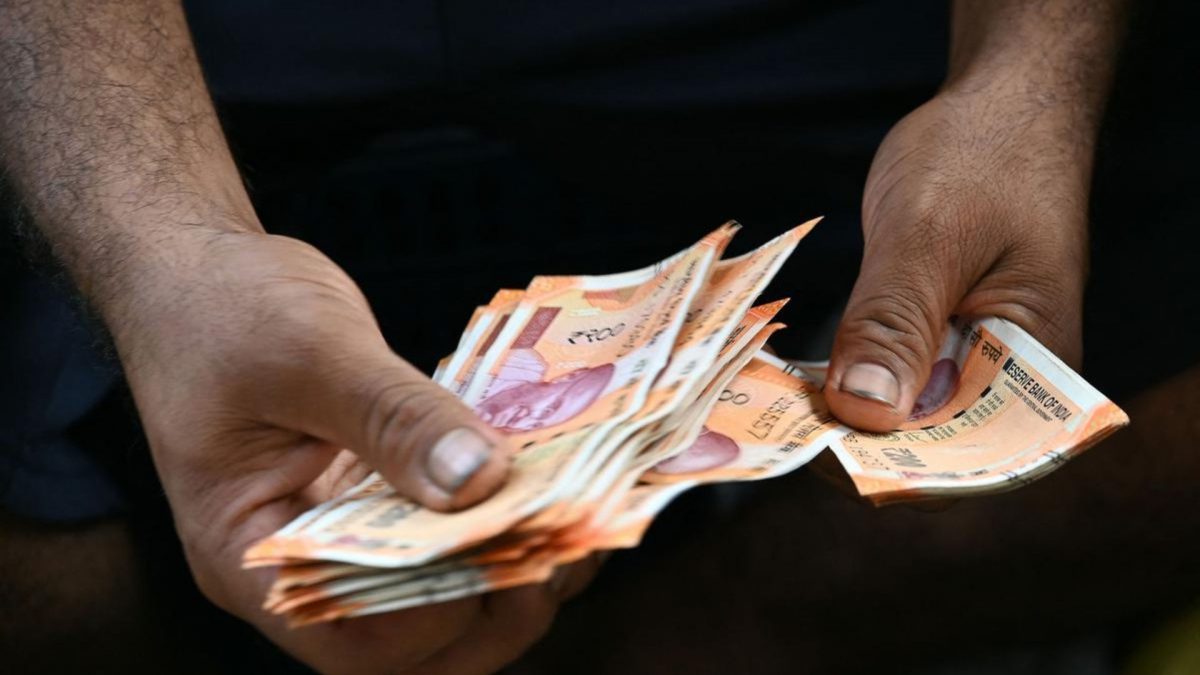
 "Why has the rupee hit a record low? What does it mean for Indians?")
The Indian rupee just keeps hitting new lows.
On Wednesday, the currency for the first time ever crossed the Rs 90-mark against the greenback. This comes after the currency, which touched 90.13, closed at 89.95 on Tuesday and 89.53 on Monday.
The development comes as little surprise given that the rupee has been one of Asia’s worst-performing currencies against the dollar this year. The fall of this psychologically important barrier left many concerned about what happens next.
But why has the rupee hit a record low? What does this mean for Indians?
Let’s take a closer look.
Why the rupee is at a record low
The rupee has fallen nearly five per cent against the dollar from the beginning of the year. Of that, 0.8 per cent was in November alone.
This comes as banks continue to purchase the US dollar at higher levels and foreign institutional investors (FIIs) continue to exit the Indian markets. Data show foreign investors have pulled out as much as $17 billion (Rs 1.532 lakh crore) from Indian markets in 2025.
India is also under pressure over the steep tariffs imposed by the Trump administration, which came in the backdrop of the two countries trying to negotiate a trade deal – which has reportedly left many top officials in the US frustrated.
Sat Duhra, portfolio manager at Singapore-based Janus Henderson Investors, has said the recent tariff dispute with the US has exacerbated matters. “Until this issue is resolved, with India now paying the highest US tariffs globally, the pressure remains.”
Things could be worse. It is likely that a weaker dollar index – which measures the value of the US dollar against a basket of six major global currencies – and a fall in the price of crude oil have actually somewhat kept the decline in check.
Some see the government and the central bank playing a slightly measured policy game when it comes to guarding against the fall.
The International Monetary Fund has described India’s rupee as “crawl-like” rather than “stabilised” earlier.
Anil Kumar Bhansali, head of treasury and executive director at Finrex Treasury Advisors LLP, said, “The rupee has been weakening with the Government of India and the Reserve Bank of India (RBI) wanting to help exporters and may have kept the dollar well bid in the past few days.”
“Nationalised banks were buying dollars at higher levels consistently yesterday (Tuesday)… There was a deal at 90.0050 after the close of market hours on the trading platform,” he added.
“For now, the central bank may be letting the rupee weaken a little more to make exports more competitive in light of US tariffs,” David Forrester of Crédit Agricole was quoted as saying by The Times of India.
What this means
A falling rupee means different things for different people. For the average person, a falling rupee raises the cost of living. This is because India imports much of its fuel, cooking oil, electronics, medicines and machinery from abroad – goods which are priced in dollars. Which means petrol, vegetables, transport and groceries get more expensive. Travelling and going to university abroad similarly become lakhs more expensive.
As Sanjana M Kumar, a master’s student in media studies at New York University, explained to India Today. “My parents send me $1,500 a month, which covers my basics. When we planned last year, when a dollar was at around Rs 83.5, that was Rs 1,25,000. Now $1,500 costs almost Rs 10,000 more.”
Kumar said she has had to make sacrifices to her daily life.
“I have stopped going to cafes and have cut down on outings with friends because I had a dentist visit last month. Earlier, I could afford cabs once in a while (which are very expensive in New York), but now I walk a few blocks before I take a taxi. It saves me a few dollars. Luckily, my parents can afford to make me study in one of the most expensive cities in the world, but the little comforts are gone because of something I didn’t expect,” she says.
However, a falling rupee is good news for exporters. This is particularly true for companies in the fields of Information Technology, pharma, textiles, engineering and gems and jewellery, all of which earn in dollars. The falling rupee also benefits non-resident Indians who literally get more bang for their buck. India received around $137 billion (Rs 12.347 lakh crore) in remittances last year.
For the Indian government, the falling rupee is a mixed bag. On the one hand, this increases India’s import bill and its current account deficit – which is measured by the value of goods and services imported against the value of goods exported — and increases inflation. It can also result in the Reserve Bank of India having to keep its interest rates higher, and can affect growth and borrowing.
What happens next
All eyes are on the Reserve Bank of India, which is set to hold its Monetary Policy Committee meeting on Friday. Will the central bank maintain interest rates, hike them or lower them? Traders will get the answer by the end of this week.
It also remains to be seen whether the RBI will intervene in response to the falling rupee and try to prop it up or not. Radhika Rao, senior economist at DBS Bank, was quoted as saying, “The recent intervention bias suggests that the currency will be allowed to find its equilibrium, to better reflect underlying macro shifts. The need to maintain the currency at competitive levels stems from the broader focus on manufacturing, unfavourable tariff differentials at this juncture and a subdued portfolio-flows outlook.”
When it comes to the rupee falling further, some think the RBI has limited room to manoeuvre.
Bank of America analysts wrote, “The RBI’s reserves remain adequate to contain risks of a larger depreciation for now. However, continued portfolio outflows could make these operations unsustainable or a build-up of short USD positions on RBI’s forward book may skew return expectations on INR.”
Markets also want clarity on a trade deal.
India Today quoted Jateen Trivedi, VP Research Analyst for Commodity and Currency at LKP Securities, as saying, “The rupee slipped below the 90 mark for the first time, pressured by the absence of a confirmed India–US trade deal and repeated delays in timelines. Markets now want concrete numbers rather than broad assurances, leading to accelerated selling in the rupee over the past few weeks.”
The analysts said the rupee could pare back its losses in 2026.
“We believe USD weakness next year should support mild INR appreciation, and that this could pick up pace around the seasonally favourable Q1 for INR. We forecast INR to reach 86 per USD by end-2026,” it said.
With input from agencies


 "Trump’s late-night 160-post Truth Social blitz: What did he rant about?")
 "India vs South Africa LIVE Score 2nd ODI at Raipur: 100 up for India but Jansen testing Ruturaj with short balls")
 "Trade, defence deals and labour pacts… What Vladimir Putin’s India visit is all about")
 "Putin’s Delhi visit poised to propel military aviation ties to new heights")
 "Trump’s late-night 160-post Truth Social blitz: What did he rant about?")
 "India vs South Africa LIVE Score 2nd ODI at Raipur: 100 up for India but Jansen testing Ruturaj with short balls")
 "Trade, defence deals and labour pacts… What Vladimir Putin’s India visit is all about")
 "Putin’s Delhi visit poised to propel military aviation ties to new heights")



