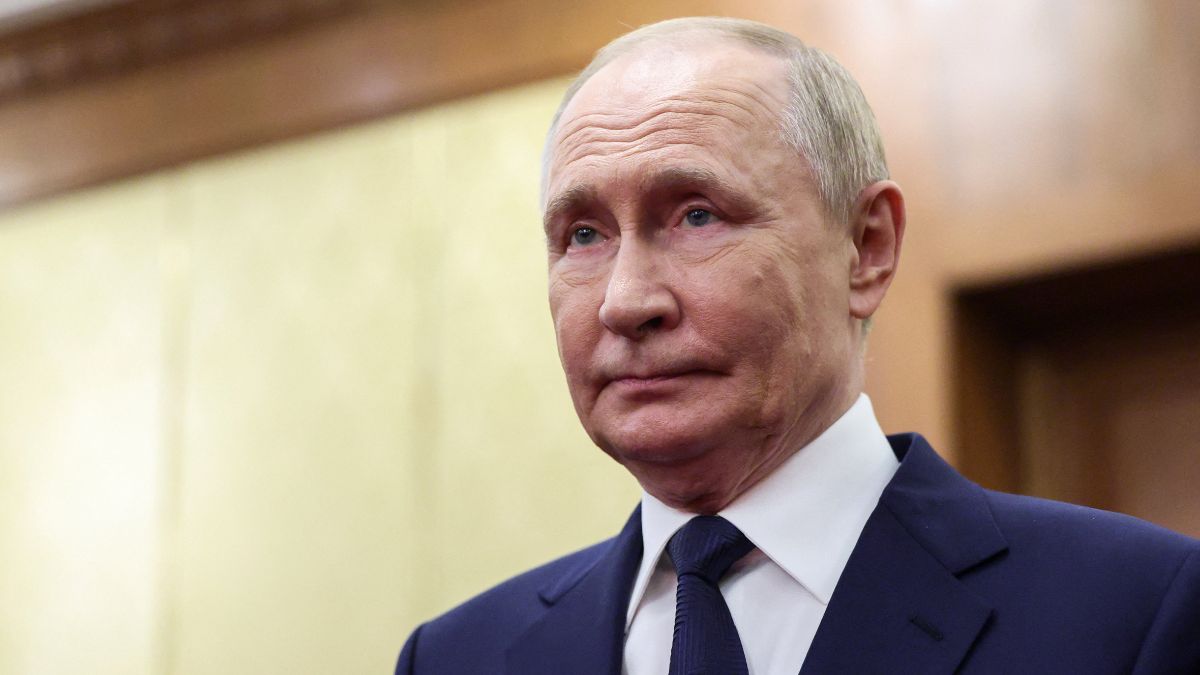
 "Russian President Vladimir Putin is slated to visit India this week. AFP")
Russian President Vladimir Putin arrives in India this week.
During his December 4–5 visit, he will meet Prime Minister Narendra Modi for the 23rd India–Russia annual summit, his first trip to India since the Ukraine war began in February 2022. Putin previously visited India in December 2021, just a few months before the outbreak of the Ukraine war.
According to the Ministry of External Affairs, the visit will allow both sides to “review progress in bilateral relations, set the vision for strengthening the Special and Privileged Strategic Partnership and exchange views on regional and global issues.”
“This visit is of great importance, providing an opportunity to comprehensively discuss the extensive agenda of Russian–Indian relations as a particularly privileged strategic partnership,” the Kremlin said in a statement.
That partnership, which began in the decades after Independence, flourished during the Cold War, survived the collapse of the Soviet Union and a turbulent 1990s, gained renewed strength in the 2000s and continues to hold in the aftermath of the Ukraine invasion.
Let’s take a closer look.
Nehru and the early years
From the earliest days of Independence, India insisted on strategic autonomy — not aligning with either Cold War camp. However, as Washington drew closer to Islamabad, the Soviet Union opened its doors to New Delhi.
Jawaharlal Nehru’s 1955 and 1961 visits to the USSR were building blocks of the relationship. The Soviets backed India’s industrialisation drive at a time when few others were willing to invest political capital in India’s development.
Steel plants, heavy machinery, technical institutions and early scientific cooperation followed. Soviet military equipment, particularly MiG aircraft, gradually became the backbone of India’s defence modernisation.
Indira and treaty that changed everything
The Indo–Soviet Treaty of Peace, Friendship and Cooperation signed by Prime Minister Indira Gandhi in 1971 brought the relationship into a new stratosphere.
As India and Pakistan clashed over East Pakistan — soon to become Bangladesh — global alignments hardened. The Nixon administration tilted sharply towards Pakistan, deploying the Seventh Fleet’s Task Force 74 to the Bay of Bengal. Britain moved the HMS Eagle into the region. India’s recognition of Bangladesh raised the stakes even further.
The Soviet Union stepped in. It deployed its own naval assets, including nuclear submarines, signalling that any intervention by outside powers would be met with consequences. And at the UN Security Council, Moscow repeatedly vetoed ceasefire resolutions pushed by the US and UK, buying India the diplomatic space it needed. Days later, Pakistani forces surrendered in Dhaka.
Indira’s multiple visits to the USSR through the 1970s and 1980s also brought the countries closer together.
From defence to culture
Regular Soviet supplies and licensed production of aircraft, tanks, submarines and artillery systems through the 1960s, 1970s and 1980s made Russia central to India’s military ecosystem. Training, maintenance and doctrine became intertwined.
Even today, it is estimated that 70 to 80 per cent of Indian hardware when it comes to arms and ammunition comes from Russia. India relies on several Russian-made weapons systems including the Su-30MKI fighters, T-90 and T-72 main battle tanks, BMP-2 infantry fighting vehicles, S-400 Triumf, INS Vikramaditya aircraft carrier and the Chakra II nuclear submarine.
In 1975, the USSR launched Aryabhata, India’s first satellite. In 1984, Rakesh Sharma flew aboard the Soyuz: a symbolic high point in space cooperation. Joint commissions, technology transfers, research exchanges and equipment support in fields ranging from metallurgy to electronics built a science-and-industry partnership that shaped Indian institutions for decades.
And there’s more. “There are other projects of defence collaboration, which necessarily have to remain outside the public domain. Simply put, no country has transferred the level of technologies to India that Russia has done,” a Russian envoy was quoted as saying a few years ago, as per ORF.
Meanwhile, student exchanges, film festivals, book translations, Doordarshan broadcasts of Soviet films and the popularity of Indian cinema across the USSR added a layer of mutual familiarity. This did not drive policy, but it softened it — making cooperation the default posture rather than an exception.
The fallow 1990s
The collapse of the Soviet Union tested the partnership. While Russia was consumed by economic crisis, India decided to open up its doors to the world via liberalisation. Russia was consumed by economic crisis; India was liberalising and diversifying its external ties. As Manmohan Singh put it in his landmark 1991 Budget speech, “No power on earth can stop an idea whose time has come.”
Looking back, many predicted the relationship wouldn’t last. However, even during this time, India continued to place defence orders with Russia, crucial for their factories. The Su-30MKI programme also began taking shape at this time.
Prime Minister PV Narasimha Rao visited Russia in 1992, Boris Yeltsin came to India the following year. Nuclear cooperation persisted at a time when Western nations remained uninterested in supporting India. The early steps towards what would eventually become the BrahMos missile project were taken in this period.
Enter, Putin Vajpayee and Modi
Vladimir Putin’s rise to power in 1999 injected new direction into the relationship. During his 2000 visit to India under the Atal Bihari Vajpayee government, the two nations signed the “Declaration on the India–Russia Strategic Partnership,” establishing annual summits and structured dialogue mechanisms.
The 2000s and 2010s saw cooperation broaden and deepen:
• BrahMos matured into a flagship co-development project.
• Sukhoi upgrades and licensed production expanded India’s aviation capabilities.
• Cryogenic engine technology transfers supported India’s space ambitions.
• Nuclear energy cooperation accelerated, with Kudankulam as the centrepiece.
• Energy ties strengthened, including India’s stake in Sakhalin-1.
In 2010, under Dmitry Medvedev and Manmohan Singh, the partnership was elevated to the “Special and Privileged Strategic Partnership.”
With Narendra Modi in office from 2014, personal chemistry between him and Putin added new momentum to the ties. Modi’s multiple visits, including to Vladivostok in 2019, opened new areas such as Russia’s Far East. Even as India expanded ties with the US, Europe and the Indo-Pacific, the Moscow channel stayed active.
Crimea and the Ukraine war
The relationship between India and Russia has survived many tests over the past decade and emerged unscathed. When Russia annexed Crimea in 2014 under then US President Barack Obama, India declined to join Western condemnations. New Delhi framed its position around its legitimate interests and emphasised the need for dialogue — consistent with its long-term practice.
India’s purchase of the S-400 air defence system triggered the possibility of US sanctions under CAATSA. However, India refused to back down to Washington. While Moscow moved closer to Beijing in the wake of Western sanctions, concern grew in Delhi about long-term strategic implications. However, ties between the two countries, based on decades of cooperation, did not break.
In the aftermath of the Ukraine war in 2022, India abstained on UN resolutions condemning Russia. Though Modi famously told Putin that “today’s era is not an era of war”, India continued to advocate for diplomacy and dialogue as the way forward, even putting itself forward as a possible mediator and a bridge to Russia. With Western sanctions imposed on Russia, India became among the largest buyers of its discounted crude. This was a sea change for New Delhi, which prior to the war bought just a fraction of its oil from Russia, preferring traditional suppliers in West Asia.
Though the West continued to pressure India to distance itself from Moscow, New Delhi refused. Russia, for its part, has continued to back India, saying that every independent nation should be free to choose its own trading partner. Indeed, Putin just last month praised India’s decision to resist the West’s entreaties not to buy Russian crude as “self-reliant and dignified”. New Delhi too has pointed to the hypocrisy of the West, particularly America, which continues to have its own dealings with Russia in the aftermath of the Ukraine war.
Whatever happens next, the eyes of the world will remain on Putin’s visit to India.
With inputs from agencies