

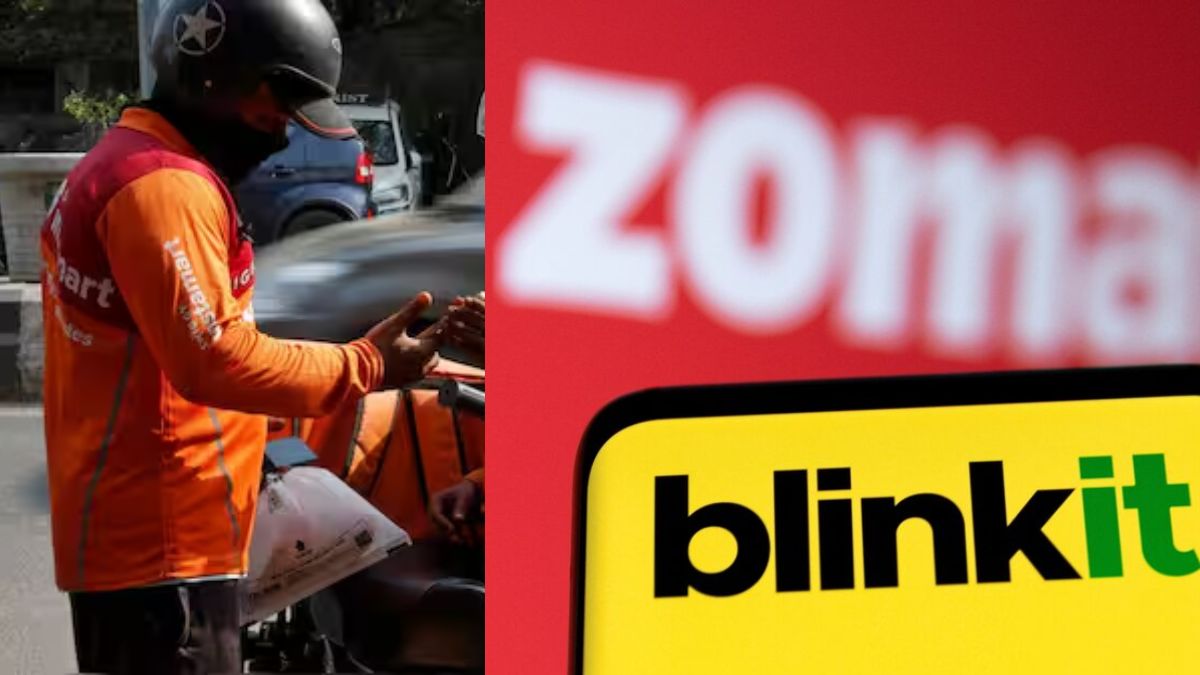
 "A New Year’s Eve dampener? Why are gig workers going on strike on December 31?")
If you are planning to order food from Swiggy or Zomato this New Year’s Eve, prepare to face delays. And it’s not just food. Other deliveries via Zepto, Blinkit, Amazon and Flipkart may also be delayed.
Why?
This is because the Indian Federation of App-Based Transport Workers and the Telangana Gig and Platform Workers Union have announced a nationwide strike on December 31, demanding better pay, improved safety and social security.
Interestingly, gig workers had even gone on a similar strike on Christmas, affecting deliveries across the country. Here’s a deep dive into what exactly is going on.
Why are gig workers going on strike on New Year’s Eve?
The year-end peak delivery period may face disruption on December 31. Gig workers from major e-commerce, food delivery, and home service platforms, including Swiggy, Zomato, Zepto, Blinkit, Amazon and Flipkart, have raised long-standing concerns over what they call “deteriorating working conditions”.
A strike is being held over low and failing wages, social security, lack of safety, dignity, and job insecurity. According to a CNBC-TV18 report, the Indian Federation of App-Based Transport Workers (IFAT) and the Telangana Gig and Platform Workers Union (TGPWU) have made the protest announcement.
Both TGPWU and IFAT, in a statement, noted that, “Despite being the backbone of last-mile delivery, especially during peak seasons and festivals, delivery workers are forced to endure long working hours, falling earnings, unsafe delivery targets, arbitrary ID blocking, lack of job security, and absence of basic welfare protections.”
Shaik Salauddin, founder president of TGPWU and co-founder and national general secretary of IFAT, asserted, “Delivery workers are being pushed to the breaking point by unsafe work models, falling incomes, and total absence of social protection.”
He added that “this strike is a collective call for justice, dignity, and accountability. The government can no longer remain a silent spectator while platform companies profit at the cost of workers’ lives”.
Quick Reads
View AllWhat are the gig workers’ key demands?
Along with fair pay structure and others, the unions are demanding the immediate withdrawal of the “10-minute delivery” models.
Here are some other demands:
- Enhance safety measures, including restrictions on late-night deliveries during winter fog, and end account blocking without due process.
- Proper work allocation without algorithmic discrimination.
- Ensure respect at work, which includes human behaviour by platforms and customers.
- Reasonable eight-hour working day, and mandatory breaks.
- Robust technical support during redressal for routing and payment failures.
- Full job and social security, including health insurance, accident coverage, and pension benefits.
How did the workers’ strike on December 25 impact deliveries?
Notably, many workers had gone on a similar strike in different parts of the country on December 25, disrupting food delivery operations. In Gurugram, food deliveries witnessed lengthy delays. A report by the Hindustan Times even noted that around 70-80 delivery partners gathered to protest at the Rodeo Drive Market Complex in Sector 47. Baani Square (Sector 50), ILD Tower near Subhash Chowk, Eros City Square (Sector 49), and HUDA Market (Sector 46) also suffered similar protests.
In fact, on December 25, gig workers’ protests across the city led to a massive disruption in food delivery operations. Cities like Gurugram experienced significant service disruptions, while Noida and Delhi were slightly impacted. After the strike was announced, in Gurugram, several sectors, including Badshahpur in Sector 66, Sohna Road, and Sectors 31, 47, and 48, witnessed lengthy delays in food deliveries, as reported by HT.
One delivery worker was even quoted by Hindustan Times as saying, “If some problem were to happen to us, what would we do? Neither does Swiggy have an ambulance, nor does it do medical checkups,” adding, “We don’t even have a bathroom. Food delivery companies pay us around Rs 5-6 for each kilometre travelled… fuel expenses take away a major chunk.”
Even in parts of Maharashtra, gig workers went on strike, affecting deliveries. According to Dr Laxman Aare, general secretary of the Gig Workers Union, an estimated 60,000 to 70,000 delivery riders from platforms such as Zomato and others refrained from work in cities including Mumbai, Pune, Chhatrapati Sambhaji Nagar, Nagpur, Kolhapur, and Navi Mumbai.
“Nearly 50 per cent of gig workers in the state heeded our call today,” Aare was quoted as telling the Indian Express. “This is a peaceful protest. We are not blocking roads or causing inconvenience to anyone. We’ve simply chosen not to turn up for work, that’s the most non-violent way to express our dissent.”
What steps has the government taken recently for delivery workers?
The strike unfolds in the backdrop of the government’s recent labour reforms, primarily aimed at recognising gig and platform workers for the first time.
According to the revised Code on Social Security, which came into effect on November 21, 2025, delivery workers and digital platforms are needed to contribute between one-two per cent of their annual turnover into a Social Security Fund, capped at five per cent of payments made to aggregators and platform workers, MoneyControl reported.
The Press Information Bureau said that this move intends to finance welfare schemes, including health cover, accident insurance and maternity benefits. It also mandates Aadhaar-linked universal account numbers for delivery workers, ensuring social security benefits.
While many platforms welcomed the move, unions said that statutory contributions are the first step, and they do not entirely address structural wage issues, safety, security and others.
With inputs from agencies

 "Zelenskyy says he will meet Trump in ‘near future’, hopes for peace breakthrough 'before New Year'")
 "What Tarique Rahman’s return to Bangladesh means for India")
 "Malaysia’s ex-PM Najib Razak convicted of abuse of power in second 1MDB trial")
 "Why Myanmar is holding elections despite being in a civil war")
 "Zelenskyy says he will meet Trump in ‘near future’, hopes for peace breakthrough 'before New Year'")
 "What Tarique Rahman’s return to Bangladesh means for India")
 "Malaysia’s ex-PM Najib Razak convicted of abuse of power in second 1MDB trial")
 "Why Myanmar is holding elections despite being in a civil war")



