

 "What Tarique Rahman’s return to Bangladesh means for India")
Tarique Rahman has returned to Bangladesh.
The 60-year-old son of former Bangladesh Prime Minister Khaleda Zia and chief of the Bangladesh National Party (BNP) has returned to his native soil after spending nearly two decades in exile.
Rahman’s return comes after the Bangladesh Election Commission announced polls will be held in February 2026. Muhammad Yunus, chief adviser of the interim government, has announced that he will step down after the polls. The two men met in London earlier this year.
Zia, Bangladesh’s first woman Prime Minister, is an arch-rival of Sheikh Hasina. The 80-year-old has been in poor health of late and was even put on ventilator support.
But how did Rahman return? What does this mean for India? Who is he?
How Rahman returned
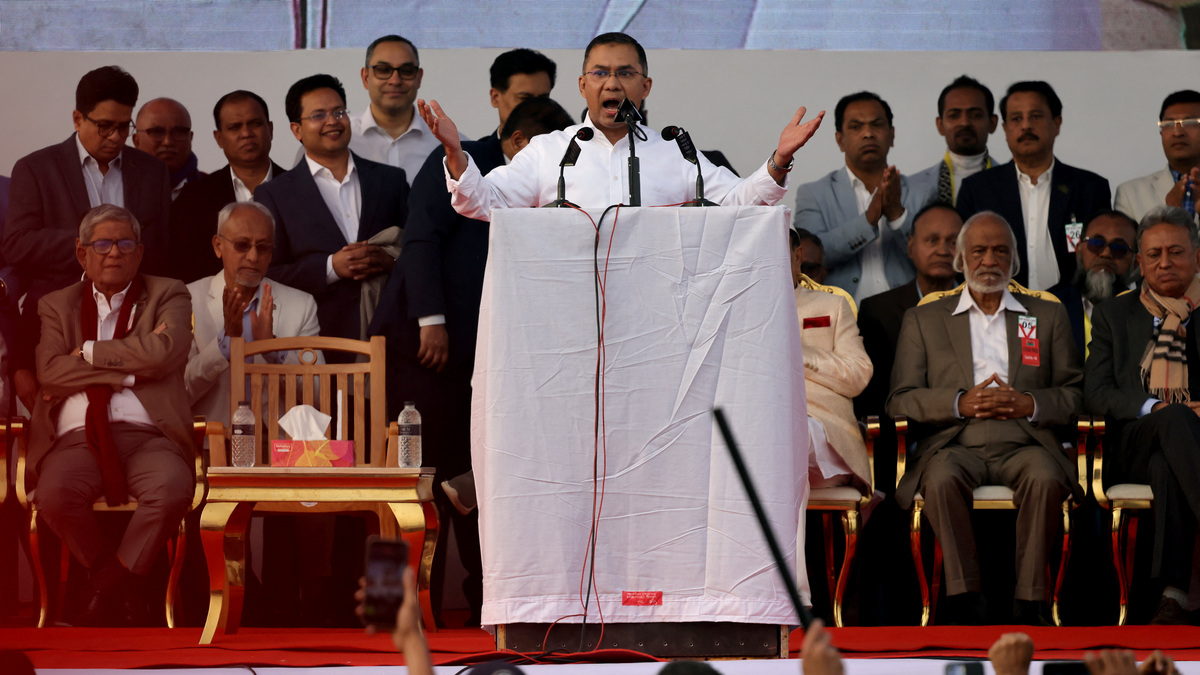
Rahman touched down on Thursday morning at Dhaka’s Hazrat Shahjalal International Airport, where he was greeted by thousands of vociferous supporters and BNP senior functionaries amid tight security. Rahman, dressed in a light grey, finely checkered blazer over a white shirt, exited the airport, removed his shoes to step barefoot onto Bangladeshi soil, and picked up a handful of earth in a symbolic gesture of homecoming.
Addressing cheering crowds at the reception centre, Rahman began his speech with the words, “Beloved Bangladesh,” pledging to unite people of all faiths and ensure their safety. “We will build a Bangladesh that a mother dreams of,” he said, urging Muslims, Hindus, Buddhists and Christians to join him in creating an inclusive nation.
Rahman, on his return, echoed civil rights icon Martin Luther King Jr’s ‘I Have a Dream’ speech. Declaring, “I have a plan — a plan for the people of my country, for my country,” Rahman stressed that with cooperation, his vision of a democratic, economically strong Bangladesh can become reality, repeating his appeal: “We want peace in the country.”
Rahman, who held a roadshow to his residence, was greeted by tens of lakhs of supporters along the route. “This is a defining political moment,” senior BNP leader Ruhul Kabir Rizvi said.
Why New Delhi is watching closely
Because Rahman is widely considered the front-runner in the race for prime minister. His calls for peace and safety for individuals of all faiths come at a time when Bangladesh is roiled by political instability and there are reports of minorities, particularly Hindus, coming under attack.
“Whether it is a child, a woman, or a man, people of all ages, classes, professions and religions must be safe,” Rahman said. He had also wished Hindus well ahead of Durga Puja.
“May all Hindus be able to celebrate the festival with enthusiasm, safety and security… Religion is for the individual, but the right to security is for everyone,” Rahman said.
His words will be of some comfort to New Delhi, which has called on Dhaka to protect minorities.
India will also have to take a closer look at its Bangladesh strategy. This is because surveys, including by the US-based International Republican Institute, show that the BNP is set to win the most seats in Bangladesh’s Parliament.
India has historically had a more contentious relationship with the BNP and closer ties with Hasina. However, Hasina’s Awami League has been dissolved by the authorities in Bangladesh and barred from next year’s election.
Rahman, for his part, has made it clear he will put Bangladesh first. “Not Dilli, not Pindi (Rawalpindi), Bangladesh before everything,” he said earlier this year. A slight warming of relations between the two countries was seen when Modi expressed concern over the health of Zia and offered “all possible support”, to which the BNP responded warmly with its “sincere gratitude”. Modi previously met Zia, then an opposition leader, when he visited Bangladesh in 2015.
India is also concerned about the rise of the Islamist Jamaat-e-Islami party, which has made a comeback under Yunus. There were reports that the Jamaat was key to Yunus getting the position of chief adviser. The Jamaat also reportedly has the backing of Pakistan’s Inter-Services Intelligence (ISI).
The Jamaat is close behind the BNP in the race for the most seats in next year’s polls. For India, the BNP is widely viewed as far more palatable than the Jamaat, whose student wing prevailed in the Dhaka University union polls.
Congress MP Shashi Tharoor drew attention to this. “It is a worrying portent of things to come… How will this play out in the February 2026 general elections? Will New Delhi be dealing with a Jamaat majority next door?” he wrote on X.
Rahman, in a move that will further hearten Delhi, has already taken aim at the Islamist party. “Those who are now asking people for support… the country has already seen them in 1971. They not only killed lakhs of people, but their collaborators also violated countless mothers and sisters. We must never forget this,” Rahman was quoted as saying. This is an interesting turn of events given that the two parties were previously allies.
Riva Ganguly Das, former Indian High Commissioner to Bangladesh, was quoted by The Economic Times as saying, “I think his return is politically very significant. He has been away for a very long time, and because Begum Zia herself was not well, he has managed the party quite well.”
“Right after the ouster of Sheikh Hasina’s government, we saw that Tarique Zia consolidated the party’s political support. And even though he was doing it online and through various new technologies, he was able to keep the party with him. So his coming back at this stage, when there is so much violence in Bangladesh and the country is literally being torn apart between various ideological views, it is expected that he will bring back some semblance of political stability and maybe he will be able to consolidate the centrist forces which are there in Bangladesh, because the main concern now is the rise of the right wing and what the right wing has been up to…”

 "Zelenskyy says he will meet Trump in ‘near future’, hopes for peace breakthrough 'before New Year'")
 "Why did Trump order strikes on Islamic State targets in Nigeria?")
 "Who was Shivank Avasthi, the Indian student shot dead near Toronto University campus?")
 "Cambodia accuses Thailand of ‘ruthless’ air strikes as border peace talks continue")
 "Zelenskyy says he will meet Trump in ‘near future’, hopes for peace breakthrough 'before New Year'")
 "Why did Trump order strikes on Islamic State targets in Nigeria?")
 "Who was Shivank Avasthi, the Indian student shot dead near Toronto University campus?")
 "Cambodia accuses Thailand of ‘ruthless’ air strikes as border peace talks continue")



