

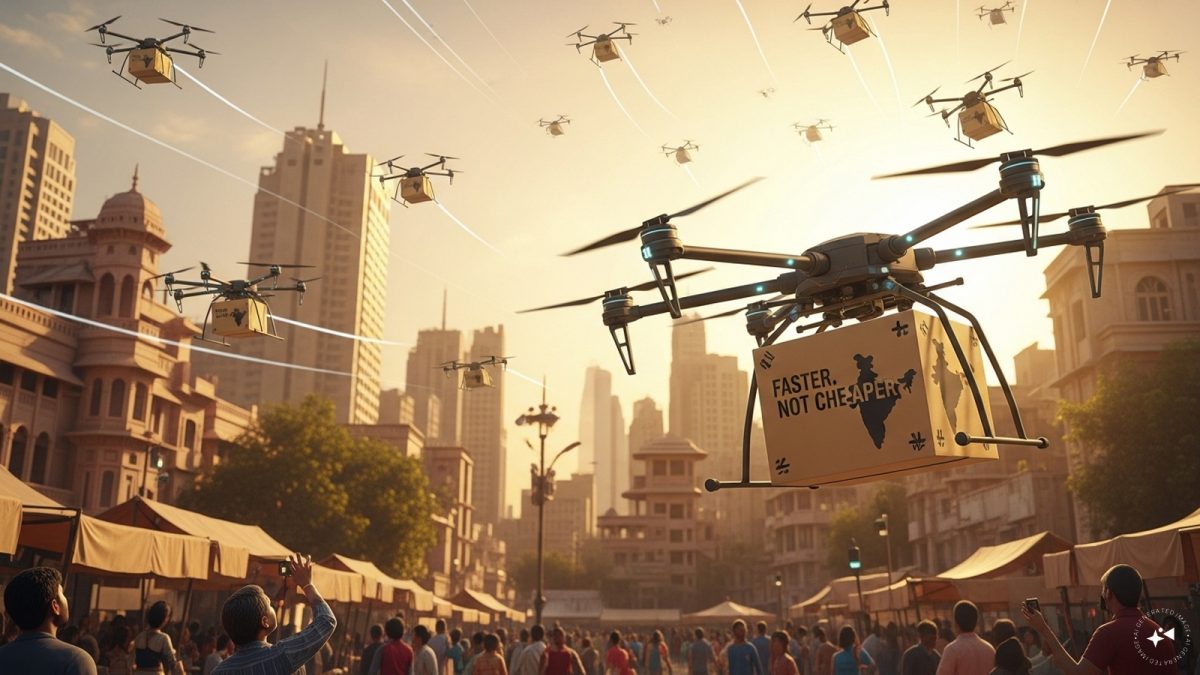
 "Faster but not cheaper: The economics of drone deliveries as India joins global race")
Across India’s crowded cities, delivery riders weave through traffic, tracked relentlessly by apps even as they keep the urban economy moving. Yet while they remain indispensable, logistics companies are already scanning the skies for their next breakthrough. As India joins the global race to launch delivery drones, one message is becoming clear: speed may soar, but costs won’t come down easily.
Logistics firms in India and overseas are testing drones as a potential alternative to traditional delivery networks. Promoted as faster and more efficient, drone deliveries are being rolled out in pilot stages across multiple markets. Yet behind the push lies a financial reality that remains difficult to ignore. For now, the economics do not favour drones, raising doubts about their ability to replace bikes and vans and fuelling unease among gig workers concerned about automation.
From remote healthcare to urban logistics
Drones have already been part of India’s delivery system, primarily in healthcare. For years, they have been used to transport blood packets, vaccines and diagnostic samples to locations that are difficult to reach by road. In these situations, drones make economic sense. Poor infrastructure, long travel distances and limited transport options often make ground delivery slow and costly, while a direct aerial route can save both time and money.
The challenge emerges when companies try to extend these operations into crowded urban areas. According to a Nikkei report, several firms are preparing to expand drone-based shipping within Indian cities, banking on the idea that automation will eventually reduce expenses and lessen reliance on large delivery workforces.
This shift is not limited to India. In the US, companies such as Walmart and Amazon are testing drone deliveries in selected locations. Similar pilot programmes are under way in Ireland and Israel. In Tel Aviv, one firm already carries out thousands of takeout deliveries each month using drones, showing that the model can function in dense city airspace.
High costs behind the promise of speed
Despite operational progress, profitability remains a major concern. Industry claims that drones will significantly reduce delivery costs have yet to be borne out. Independent estimates suggest the opposite. A McKinsey study found that delivering a single package by drone can cost as much as seven times more than delivering it by van.
Several factors drive these costs. Drones are costly to build and maintain, have limited carrying capacity and depend on advanced navigation, monitoring and safety systems. Human labour has not disappeared from the equation. Many operations still require trained personnel to oversee flights and intervene when issues arise.
Quick Reads
View AllRegulatory requirements further increase expenses. Urban drone deliveries must secure approvals from aviation authorities, meet strict safety norms and coordinate with local administrations. In Delhi, more than half of India’s National Capital Region is restricted airspace for drone deliveries. In addition, concerns around accidents, privacy and airspace congestion in busy cities slow expansion and raise costs.
These financial realities matter because drones are not competing with inefficient systems. In Indian cities, they face competition from a vast workforce of low-paid delivery riders. Often migrants or young workers with limited alternatives, these riders form one of the most flexible and affordable labour pools in the urban economy. Replacing them with technology that is still significantly more expensive offers little immediate commercial advantage.
Even so, apprehension among workers is growing. Riders say they are already dealing with tighter incentives, declining per-order payments and algorithm-driven pressure to work longer hours for less pay. The introduction of drones, even on a limited scale, adds to uncertainty about what lies ahead.
Economists argue that large-scale job losses are unlikely in the near term precisely because drones remain costly. Vans and bikes continue to be cheaper, more adaptable and capable of completing multiple deliveries in a single trip. For now, drones are expected to supplement existing systems rather than replace them, serving specific routes, urgent deliveries or challenging terrain.
However, the longer-term outlook remains uncertain. Companies investing in drone delivery are betting that costs will fall as technology improves, production expands and regulatory frameworks become clearer. Batteries are expected to become lighter, payloads heavier and automation more advanced, potentially altering the cost balance.
For consumers, cheaper deliveries remain more promise than reality. Companies testing drones are absorbing the high costs as part of research and development, rather than passing savings on to customers. At present, drones serve more as a signal of innovation than as a tool for lowering prices.
This leaves a central question hanging over the rise of drone deliveries: if the technology is faster but not cheaper, who bears the cost? For now, companies are absorbing losses in pursuit of future gains. For delivery workers watching these developments unfold, the concern is less about today’s experiments and more about long-term job security.


 "‘Bangladesh’s Yunus govt failed to control ‘mobocracy’’: BNP leader on attack on Indian mission")
 "Tarique Rahman to return to Bangladesh after 17 years: Can Khaleda Zia’s son influence February elections?")
 "US Congressmen raise alarm over anti-Hindu violence in Bangladesh")
 "‘Time to Kash out’: Why Kash Patel’s choice of new wheels has sparked a row")
 "‘Bangladesh’s Yunus govt failed to control ‘mobocracy’’: BNP leader on attack on Indian mission")
 "Tarique Rahman to return to Bangladesh after 17 years: Can Khaleda Zia’s son influence February elections?")
 "US Congressmen raise alarm over anti-Hindu violence in Bangladesh")
 "‘Time to Kash out’: Why Kash Patel’s choice of new wheels has sparked a row")



