

 "Beyond Rushdie: Nine questions from the Jaipur Literature Festival")
by Neelanjana Banerjee
Whether Salman Rushdie shows up or not, the DSC Jaipur Literature Festival remains the biggest literature festival in the Asia Pacific region. As the festival gets under way today at Diggi Palace in Jaipur, Neelanjana Banerjee has eight questions based on her experience at JLF 2011. Re_published from HTMLGiant ._
1. Do glamour and literature make good bedfellows, or should they stop hooking up?
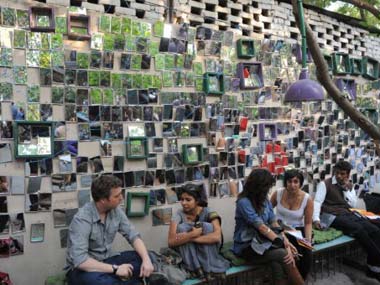
Jaipur is a city on the edge of desert. It is a few-hour or half-day drive from New Delhi (depending on who you’re asking), which is India’s publishing and intellectual capital. I’ve never been to The Hamptons, but Jaipur feels like it could be an equivalent, except the white linen and Bentleys are exchanged for multicoloured, mirror-work, ethnic wear and camel carts. It is also the bastion of very old money, meaning the town is populated with the offspring of an 11th century clan of feudal rulers known as the Rajputs, who built hundreds of opulent palaces, most of which have been turned into tourist attractions or guest houses.
Hearing writers speak under grandly decorated tents at a Rajput mansion built in the 1860s gives all of the Jaipur Literature Festival’s events (even a panel named “The Return of Philosophy”) an inherently glamorous feel. Glamour is defined as “the quality of fascinating, alluring, or attracting, especially by a combination of charm and good looks,” and it is the preposition that makes me suspicious when it comes to the literary scene. But maybe, just two months in to a year of living in India, I’m just not used to it. Because in my experience, book events in America are held in convention center rooms under florescent lights, or in the children’s section of a bookstore set with uncomfortable folding chairs, or in the usual stronghold of American literary glamour: the grimy bar.
The Indian English book market is supposedly outdoing America’s nine times over, which would seem a veritable reason for massive celebration. Maybe this is also why corporations such as infrastructure company DSC Limited bankrolls the event, along with sponsors like Merrill Lynch, Coca-Cola, Goldman Sachs and Shell , among others, but along with the fancy parties and voluptuous meals for writers — they also kept the daily events free for the masses, which included large groups of school children dressed in shabby blazers.
At a panel entitled “Migritude”, a term coined by Oakland-based poet Shailja Patel and having to do with migrants with attitude, Guyanese-born British writer and actor Pauline Melville opened by drawing the connection between forced migration and some of the more nefarious sponsors.
“This festival is for writers, people who are genuinely interested in the human condition, but behind us are the logos–staring at everybody–of the most pernicious organisations in contemporary finance,” Melville said. “Even as I speak, I’m half expecting to get a bullet in the back.”
2. Is there anything more glamorous than controversy?
In the weeks leading up to the festival, Open Magazine (kind of a cross between Newsweek and Salon.com) writer Hartosh Singh Bal penned a piece that pointed out India’s continued deference to British literary arbitrators, the foremost of whom is Jaipur Literary Festival co-director William Dalrymple – who in terms of basic attire (polo shirts, khakis and sneakers) was entirely non-glam by Indian standards for the entire festival. Dalrymple shot back an angry response calling Bal racist, which earned another knocking for throwing around the weighty word. (I had a sneaking suspicion that Open Magazine, whose banner flew outside the gates of the festival inviting their readers in, was in cahoots with Dalrymple to strum up media, but my idea was shot down by a foreign correspondent at the NY Times who obviously has no sense of the glamour of conspiracy theories.)
3**. Is glamour bad for the aspiring writer who needs to learn to fail?**
Junot Diaz, who Indians found incredibly glamorous , spoke at length about how the need for approval was the young writer’s worst enemy–a subject he has been adamant about since winning the Pulitzer.
All of us are trying to do what the Latin teaches us the root of author is, which is to augment. Author: augmentus. You’re trying to add something, no matter how slight…Artists, by their nature, we’re kinda pain-in-the-asses. If you’re an artist because you want more friends, you’re like an evil artist. For real, you’re like a bad Jedi…The good artist, of course, is not looking to make friends. In general, the good artist is going to do something that will discomfit. The very nature of the new is that you are going to make less friends than you would if you were just trying to gain approval. Because we have a society that so encourages everyone to seek approval, there isn’t much space for people to form an artistic personality because we spend our entire lives in a society that tells us: ‘Do the monkey dance, so we can clap for you.’ So many of my young artists that I work with, they are wonderfully talented, but they are so desperate for approval that they are never going to produce anything of worth that we need, not because I am the final judge, but because we know we need less applause and more conversation.
Of course, this was met with wild applause.
Watch video of what to expect at this year’s Festival
Continues on the next page
4. Who’s more glamorous: a Booker Prize winner, Nobel Laureate, a chick-lit writer, an elder statesmen, or a Bollywood lyricist?
Kiran Desai, winner of the 2006 Man Booker Prize for Inheritance of Loss, was described as a “giggle head” by the Indian newspaper, Daily News and Analysis. That might have canceled out her glam factor – in the Indian media – if she weren’t in a relationship with Turkish Nobel laureate Orhan Pamuk, who spent much of his public appearances at the festival scolding audience members for their run-on questions and panel moderators for not fully understanding the importance of writing not in English. Sometimes grumpy can equal glamorous, I guess.
Another Nobel laureate JM Coetzee refused to engage with the massive Indian crowds through conversation and instead read a 45-minute story, The Old Woman and the Cats, about a famous writer who has retired to a village in Spain whose son comes to visit from America. Over the course of the visit, the mother and son have a days-long conversation about her adoption of the feral cats in the village and why exactly she has taken in the village flasher. There was a horrifying description of the flasher’s teeth, which the son imagines the man has not brushed in years. I found Coetzee’s quiet, steady voice and blue-button down shirt completely unglamorous, in a good way.
India’s own Chick Lit ingenue Ira Trivedi , who described herself as an “author-turned-model” while marketing her best-selling 2006 novel What Would You Do to Save the World: Confessions of a Would Have Been Beauty Queen?, launched a new book about Wall Street internships and moderated a discussion with Candace Bushnell, one of the only major American women writers present. During their well-researched conversation, Trivedi asked Bushnell, 52, if she ever planned to have children. Even more glamorous than these beautiful women was the festival’s sense of literary populism.
Opening guest of honour Dr. Karan Singh , elder statesman and bibliophile, put materialism in its place by saying: “In all my life, I haven’t bought cars, I haven’t bought jewelry, but I have bought books…[if you come to my library>, you’ll find 25,000 books that I have collected over the course of my lifetime.” In a rousing speech in Hindi and then translated to English, he reminded the audience that India has creative writing in 25 different languages. The glamorous block-printed gift-bags for festival delegates had copies of his anthology A Treasury of Indian Wisdom.
But Bollywood screenwriter and lyricist Javed Akhtar won the glamour contest, because at the end of the day, it’s quite tough to compete with the biggest film industry in the world. When a tent with capacity for some 300 people was up to 600 with rumors of a stampede outside, I decided he was just too glamorous for me and escaped out a hole in the back.
5. Does a glamorous, well-endowed prize matter?
One day I was sitting in on a conversation about how authors who sell books in India make no money from the sales–the average price of a book here seems to be Rs 300 or $6, cheaper than the cheapest e-book in America. The theory was posited that the only way to really make money from selling books was to sell books in the UK or America. But how many people really make money from selling books?
Some of the glamour of the festival, especially the brand-new DSC Prize for South Asian Literature for $50,000, seemed to have been hatched to overturn that idea. Unlike the Pulitzer and the Booker, this prize doesn’t seem to have geographic specifications, only subject matter matters: “Authors could belong to this region through birth or be of any ethnicity but the writing should pertain to the South Asian region in terms of content and theme.”
Bollywood-crossover star Kabir Bedi – you may recognise him as evil Bond henchman Gobinda from Octopussy, or his various stints as a regal Arab on various American soap operas – awarded the premier prize to first-time novelist HM Naqvi for Homeboy.
Naqvi was sporting the very glamorous shaved head, unbuttoned-shirt-look of several male writers at the festival. Get a sense of his glamour in this video of him playing ping pong in boots and a wife-beater.
6. Is there anything that confirms glamour like a drunken fist fight?
During one of the festival’s nightly parties, poet, novelist and journalist CP Surendran , who looks very misanthropic in his Times of India column photo, mistakenly asked a man whose religion considers “smoking injurious to the soul” for a light – this led to some violence. My favourite report of this incident was in novelist and comic book writer Samit Basu’s twitter feed: “Top #jlf moment. Watching Tarun Tejpal and Sanjoy Roy rescuing C P Surendran from angry punchy Sikh dude.” Like any glamorous high school party when someone from the uninvited crowd starts the fight, the fight has been used to talk about what’s wrong with “those people.” Obviously, the puncher is not familiar with the chorus of Sheila E’s anthem The Glamorous Life: “Without love, it ain’t much, it ain’t much.”
Continues on the next page
7. Have discussions about displacement and diasporic writing lost their glamour?
There was a great deal of consternation about whose “Imaginary Homelands” might have actually been “Two Nation, Two Narratives”, which came from somewhere “Out of West.” (All event titles.)
The glamorously casual Pakistani novelist Kamila Shamsie pooh-poohed the question of displacement and diaspora, since even when she lived in Karachi, her writing was talked about as “showing the anxiety of displacement.”
But far more interesting to me, was that as a child I lived in Karachi my whole life, and I was obsessed with reading novels and all the novels I read were in English and none of them were set in Karachi. So that imagined world, which I spent just as much time in as the surroundings around me, was shaped by what I was reading. And my childhood novels were all set in a fantasy world, it was all time machines and dog heaven–and it took awhile to figure out what it was to write a novel in the English language about Karachi.
Actually, I thought the most fascinating moment of diasporic writing came from Malyasian-Australian rapper Omar Bin Musa, who was part of the musical line-up one evening, and not just because I had never heard an Australian rapper before. Musa, from the rural town of Queanbeyan, spit lyrics about identity and politics over decently produced beats. But it was when he performed a song that was most definitely influenced by the Pitbull Miami hip hop sound with the chorus: “Pura vida mami” that I felt like I had witnessed something especially glamorous. I’m hoping Dalrymple will invite Jay-Z to talk about Decoded next year.
8. Is it glamorous to put down American writing?
British writer Martin Amis, who is apparently moving to America , seemed especially intent in proving to Junot Diaz, Richard Ford and Jay McInerney that “The Crisis in American Fiction” was basically that “the senior generation of writers” have all died recently– meaning John Updike, Saul Bellow and Norman Mailer. The complete lack of women writers in the discussion and any mention of women writers (until Richard Ford quoted Eudora Welty sometime around minute 20) gave the conversation a feeling like it was at some writer fraternity where American writers have to be hazed by the grumpy Amis in order to later drink jungle juice out of a garbage can.
But Ford and McInerney did their best to defend the diversity of American fiction, while Diaz spoke about how maybe the issue wasn’t the novel’s fault but “the structural shifts in the society that have made contemplative life and the ability for you to sit and read a novel for two or three hours everyday threatened and almost impossible.”
Amis parried with the idea that it would be impossible for a novel like Saul Bellow’s contemplative tome Humboldt’s Gift to spend eight months on the American best seller list like it did in it’s day. McInerney brought up Franzen’s Freedom and its success, then Amis replied with: “Not a comparable novel…There is a lot going on in that Franzen novel, in Humboldt’s Gift, nothing happens at all.”
Ford, who I found most glamorous with his elegant Mississippi accent and white hair, may have put it best when he said: “When I break the threshold of inanition to perform something on the page, that’s where the crisis actually exists, not somewhere up above my head.”
9. Are there things to learn when not being glamorous?
You know what’s not glamorous at all? Getting food poisoning on the last day of the book festival, and having to skip hearing Vikram Seth and Irvine Welsh and even the uber-glam party held at the Amber Fort replete with camels and dancing and drunk author antics. Instead, I spent the day in the bed of my well-appointed artist residency-esque inn on the outskirts of Jaipur, listening to doves and watching the paper kites sway where they have been captured by the trees. But there is a certain glamour in the way the cook and her daughter retreat to the balcony outside your room at noon to oil each other’s hair.
Perhaps it is an un-glamorous space like this that one needs to analyse the literati– the bird’s eye view as it were. I mean, the danger of the glamour is that it overshadows the very unglamorous space of the writer’s desk, or it masquerades as a consolation for the quiet time one must put in. I don’t write for the smart people with moneyed connections who put glamorous parties together, but for a reader somewhere who will connect with my work, right? As an aspiring writer myself, does a decadent party like Jaipur inspire me or spin my head in the wrong direction? Or maybe I’m wrong, maybe the hundreds of school children who hob-knobbed with the world’s literary stars came away wanting to be a writer, and maybe more importantly, wanting to be readers in a country where that is exciting, alluring and attractive.
One of my final views from the car on the way to the airport were polo players on the Jaipur Polo Fields and the sun setting on the Amber Fort in the distance. It was one of the most glamorous sights I’ve seen in my life.
Neelanjana Banerjee is the co-editor of Indivisible: An Anthology of South Asian American Poetry (University of Arkansas Press, 2010).





 "Time to shed White Mughal mentality: Why Dalrymple must stop running with Indian hare while hunting with British hounds")
 "Yoga guru Ira Trivedi: Yoga should become an essential part of people's lives, especially in this post-pandemic world")
 "Nobel Laureate Orhan Pamuk probed for 'insulting' Turkey's founder in latest novel")
 "Secret British-era tunnel connecting Delhi Legislative Assembly to Red Fort found; check details here")
 "Time to shed White Mughal mentality: Why Dalrymple must stop running with Indian hare while hunting with British hounds")
 "Yoga guru Ira Trivedi: Yoga should become an essential part of people's lives, especially in this post-pandemic world")
 "Nobel Laureate Orhan Pamuk probed for 'insulting' Turkey's founder in latest novel")
 "Secret British-era tunnel connecting Delhi Legislative Assembly to Red Fort found; check details here")