

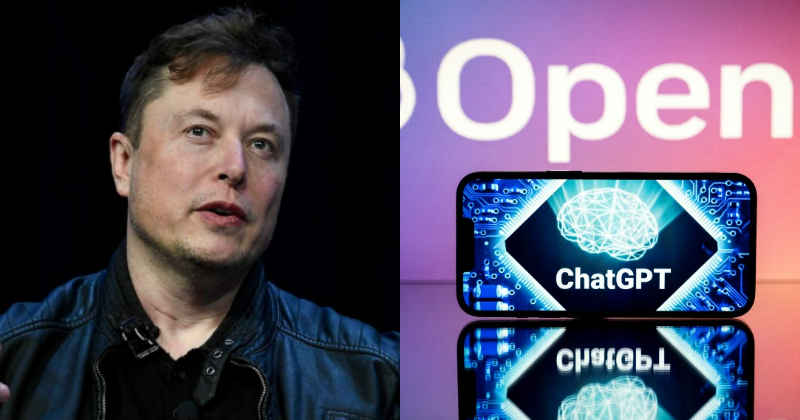
 "Halting AI: Musk and China share an ulterior motive in calling for pause on development of ChatGPT")
A few days ago, thousands of tech moguls and tech experts, including Elon Musk called for halting the rapid development of AI models like GPT-4 and all other AI models that outperform GPT-4. Musk, now has found a group of rather unusual supporters - scientists and AI experts based in China and Hong Kong.
A group of artificial intelligence (AI) specialists from mainland China and Hong Kong have joined demands from some global tech veterans to halt development of AI technologies more advanced than GPT-4, warning that the current rate of progress is “too fast."
Chinese scientists and AI experts support Musk’s call to halt development
The Future of Life Institute (FLI), a study centre that studies technological risks to human civilization, wrote an open statement last month that has thousands of signatories, including Tesla CEO Elon Musk, Apple co-founder Steve Wozniak, and published historian Yuval Harari. It claims that the present AI race is risky and asks for the establishment of autonomous regulators to ensure that future systems are safe to implement.
Although some practitioners have criticised the letter for instilling fear about the future of AI, several experts in mainland China and Hong Kong have expressed support, stating that it is critical to address concerns about ChatGPT, the AI-powered chatbot developed by Microsoft-backed OpenAI that employs the GPT-4 large language model (LLM).
Impact Shorts
More ShortsThere has been open discussion about whether AI will one day outsmart humans since long before the November debut of ChatGPT.
Several Chinese tech experts share Musk’s fears
Cai Hengjin, a researcher at Wuhan University’s Artificial Intelligence Research Institute, says the introduction of ChatGPT has demolished the arguments of those who believed it couldn’t happen.
“One metric is how quickly and powerful AI would grow to levels beyond our imagination.” “Some people thought it would grow slowly, and we still have decades, if not hundreds of years left” Cai said. “But that’s not the case… we only have a few years because our AI advancement is simply too rapid."
Many other Chinese signatories to the FLI’s open statement share Cai’s worries.
The recent tendency of having ChatGPT assess research papers on AI chatbot technologies, according to Zhao of Tricorder, is a risky indication, indicating that we have already started the process of enabling AI to rate human work.
Alfonso Ngan, associate dean of engineering (research) at the University of Hong Kong, who also signed the letter, stated that the institution will ask students not to use the technology for one semester in order to develop an agreed position on how it can be appropriately applied within an academic environment.
“We’re not going to ban this forever,” Ngan said, adding that powerful AIs like ChatGPT pose a problem for the education sector.
“On the one hand, we want our students to be exposed [to AI technology] in order to learn, and we even need to teach such technologies,” Ngan explained. “However, the education sector requires time to adjust operations, particularly in relation to assessment, homework, and assignments."
**Also read: Belgian man dies by suicide following long chats about climate change with AI bot**Ngan and other signatories, including Tricorder’s Zhao and Chen Yongli, creator of Internet of Things start-up Edgenesis, said ChatGPT’s strength should not be underestimated.
“You can’t simply hope that as AI grows smarter and stronger, it will still have compassion for us humans, that it will still be rational, and that it will only inherit good and not humanity’s bad nature,” Cai said, adding that ChatGPT was taught entirely with human language materials.
“We could use the time we still have to evolve alongside it in the metaverse and coach it to be good,” Cai suggested.
China may share Elon Musk’s ulterior motives
Although Musk has warned the general public of the dangers of AI, one cannot help but notice that he is deeply invested in AI for his businesses. One of the biggest reasons why he left OpenAI, the startup behind the GPT model and ChatGPT, is because of a conflict of interest that developed when Tesla started working on AI.
Furthermore, there have been several reports that indicate that Musk was furious when OpenAI launched their ChatGPT to the public and the popularity it gained from the public. Shortly thereafter, he started hiring a team that would make an alternative to ChatGPT that would take it down.
OpenAI’s GPT model, as limited as it may be, is one of the most advanced AI models that is available to the public right now. GPT-4 in particular, with the APIs and plug-ins it supports, is at a different level altogether.
In such a scenario anything reason that Musk gives about halting the development of GPT-4, should be taken with a pinch of salt.
China finds itself in a similar position to Musk. Because they don’t have access to the latest processors and silicon manufacturing processes because of the US-China war, it is extremely difficult for them to develop any AI model that would outperform GPT-4.
Several Chinese tech firms are working on AI models of their own. Baidu, the biggest tech firm in China was supposed to showcase its Ernie bot to the general public. However, it had to back out at the last moment.
Speculations suggest that they had to back out of the public showcase because the AI bot wasn’t ready for a public demo, and could only be showcased to businesses for its potential commercial applications. Needless to say, China’s AI industry is also suffering majorly.
Read all the Latest News, Trending News, Cricket News, Bollywood News,
India News and Entertainment News here. Follow us on Facebook, Twitter and Instagram.


 "Zelenskyy warns world of ‘most destructive arms race in history,’ says weapons will decide who survives")
 "US opposes Russia’s bid for UN aviation seat, says Moscow makes airspace ‘more dangerous’")
 "'It seems like even a combined team from Asia can't beat India': Men in Blue storm into Asia Cup 2025 final")
 "Israel’s Netanyahu vows combined military-diplomatic push to free Gaza hostages")
 "Zelenskyy warns world of ‘most destructive arms race in history,’ says weapons will decide who survives")
 "US opposes Russia’s bid for UN aviation seat, says Moscow makes airspace ‘more dangerous’")
 "'It seems like even a combined team from Asia can't beat India': Men in Blue storm into Asia Cup 2025 final")
 "Israel’s Netanyahu vows combined military-diplomatic push to free Gaza hostages")



