

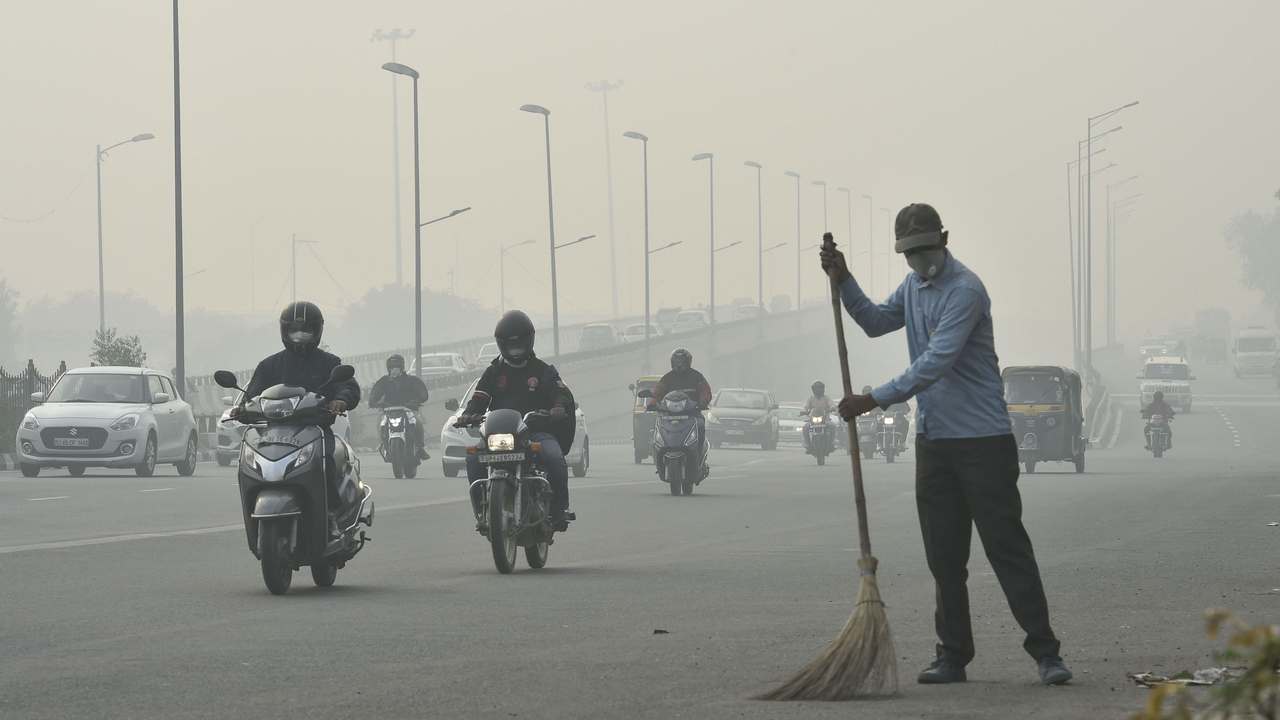
 "Air pollution: Long way to go before there are conclusive results pertaining to 'anti-smog towers' to fight air pollution")
An air-purifying tower the size of a small skyscraper has been built in the city of Xi’an, China. Reports from the scientists behind the project seem at first glance to be
rather positive, offering a technological route to clean pollutants out of the air at the sort of scale that could help an entire city. But as there isn’t any hard data publicly available to support the claim, for now, a dose of scepticism is likely in order. This isn’t the first project to use a technological or natural intervention to try and clean up pollution from ambient air. In India,
water cannons have been used recently in an attempt to wash out particles, while in London,
NOx-eating paint has been promoted as a solution to harmful nitrogen oxides. And many cities have mooted the planting of more trees and shrubs as a route to cleaning up the air. (In India, the Supreme Court has
**also asked the Delhi government and Centre** to keep their differences aside and sit together to finalise a plan, within 10 days, for setting up air-purifying towers in different parts of city.) [caption id=“attachment_7599641” align=“alignnone” width=“1024”] Gurugram’s air quality was 17 times poorer than the prescribed safe limit by the World Health Organisation (WHO). Image: Vinay Gupta[/caption] All of these, and indeed the purifying tower, are underpinned by at least some plausible science. A tower that filters the air no doubt will take tiny harmful particles out of the air, titanium oxide paints do react with NOx, and trees do act as sinks for air pollution. However, the more important but often neglected question is whether the effects really make a useful difference.
Pollution spreads far and wide
The biggest challenge in trying to take pollution out of the air (rather than exhaust pipes) is that it is very diluted. Although humans live predominantly in the bottom couple of metres of the atmosphere, what we breathe is heavily influenced by a much deeper layer of air that runs from the surface up to around 1 km in height, referred to in meteorological terms as the planetary boundary layer. Pollution is rapidly mixed in the boundary layer due to turbulence and thermals, and it is this much bigger volume of air that needs scrubbing and cleaning if pollution is really to be reduced on large scales.
An "anti-smog gun" sprays atomised water into the air to reduce pollution, during its trial run in New Delhi, December 20. Photo by @saumyaphotos #pollution pic.twitter.com/DXJTpY7c5n
— Reuters India Photos (@IndiaPhotos) December 20, 2017
Anti-smog paint is a good illustration of this. In 2016, the British government reported on the possible effectiveness of using paints as a sink for NOx in London. The conclusion was that the basic chemistry was reasonable, in so much as some helpful reactions did occur, but the fundamental aerodynamics of moving pollution through the boundary layer and onto the painted surface was a critical limiting step. Only a tiny fraction of the city’s atmosphere would be in contact with the paint at any one time. Therefore, the report said, hardly any beneficial effect would be seen, even if totally implausible amounts of London were covered in white paint. The analysis boiled this down to the truism, beloved of Star Trek, that you cannot break the laws of physics. Similar issues arise with getting pollutants onto the surfaces of trees and shrubs; vegetation is broadly beneficial (and has many other excellent qualities), but in reality, it can only make a very small impact on overall air quality.
Cities aren’t sealed boxes
China’s air filtration project takes a slightly different approach. Rather than being passive, it actively moves air through a cleaning system, using greenhouses to generate currents of warm air that rise through its filters. On the face of it, the numbers claimed look large – 10 mn cubic metres of air cleaned per day. But in the context of a modest Chinese city that is say 10 km x 10 km in size, and with a boundary layer 1 km deep, the purifier is only releasing perhaps 0.01 percent of the air in the “atmospheric box” sat over the city. It may turn out that the benefits at the surface might be somewhat greater, and more so when the boundary layer is particularly shallow. But counted against this is the reality that cities aren’t sealed boxes, and they have a constant inflow of pollution that needs removing. More straightforwardly, for any system that is releasing clean air from a chimney, it is only those areas directly downwind that will see any benefits.
A smog-filtering tower developed by Chinese scientists has been built in Xi’an, NW China’s Shaanxi, and is in the trial phase. The tower is coated in glass and has a heat collector and a draught fan, which is all designed to help filter air and improve the purification efficiency pic.twitter.com/QKRil1rsRn
— People's Daily, China (@PDChina) January 19, 2018
It’s hard to tell what actually works
The scientists on this project will have quite a bit of work to do, to prove conclusively that their intervention really has made a change that can be detected over and above the natural variability in the atmosphere. Detecting the benefits of air pollution policy typically needs measurements before, during and after, and the change must be of sufficient size that it stands out against other factors. An individual local intervention may only have a very small effect that will be superimposed on widely varying pollution conditions controlled in large part by natural variability in the weather. Treat with particular caution any study that claims a brief local intervention that led to attributable reductions in pollution. There is often a strong social and political desire to “see an effect”, but the reality can be disappointing and evidence often inconclusive. Expect to read much contradictory reporting in the coming months and years on the effectiveness, or otherwise, of Clean Air Zones in the UK. If one draws only one conclusion from this, and previous attempts at removing pollution from the air, it is that it is far, far easier to come up with technologies and schemes that stop harmful emissions at source, rather than to try to capture the resulting pollution once it’s free and in the air. Alastair Lewis is a Professor of Atmospheric Chemistry at the National Centre for Atmospheric Science, University of York This article is republished from The Conversation under a Creative Commons license. Read the original article.

 "Israel targets top Hamas leaders in Doha; Qatar, Iran condemn strike as violation of sovereignty")
 "Nepal: Oli to continue until new PM is sworn in, nation on edge as all branches of govt torched")
 "Who is CP Radhakrishnan, India's next vice-president?")
 "Israel informed US ahead of strikes on Hamas leaders in Doha, says White House")
 "Israel targets top Hamas leaders in Doha; Qatar, Iran condemn strike as violation of sovereignty")
 "Nepal: Oli to continue until new PM is sworn in, nation on edge as all branches of govt torched")
 "Who is CP Radhakrishnan, India's next vice-president?")
 "Israel informed US ahead of strikes on Hamas leaders in Doha, says White House")



