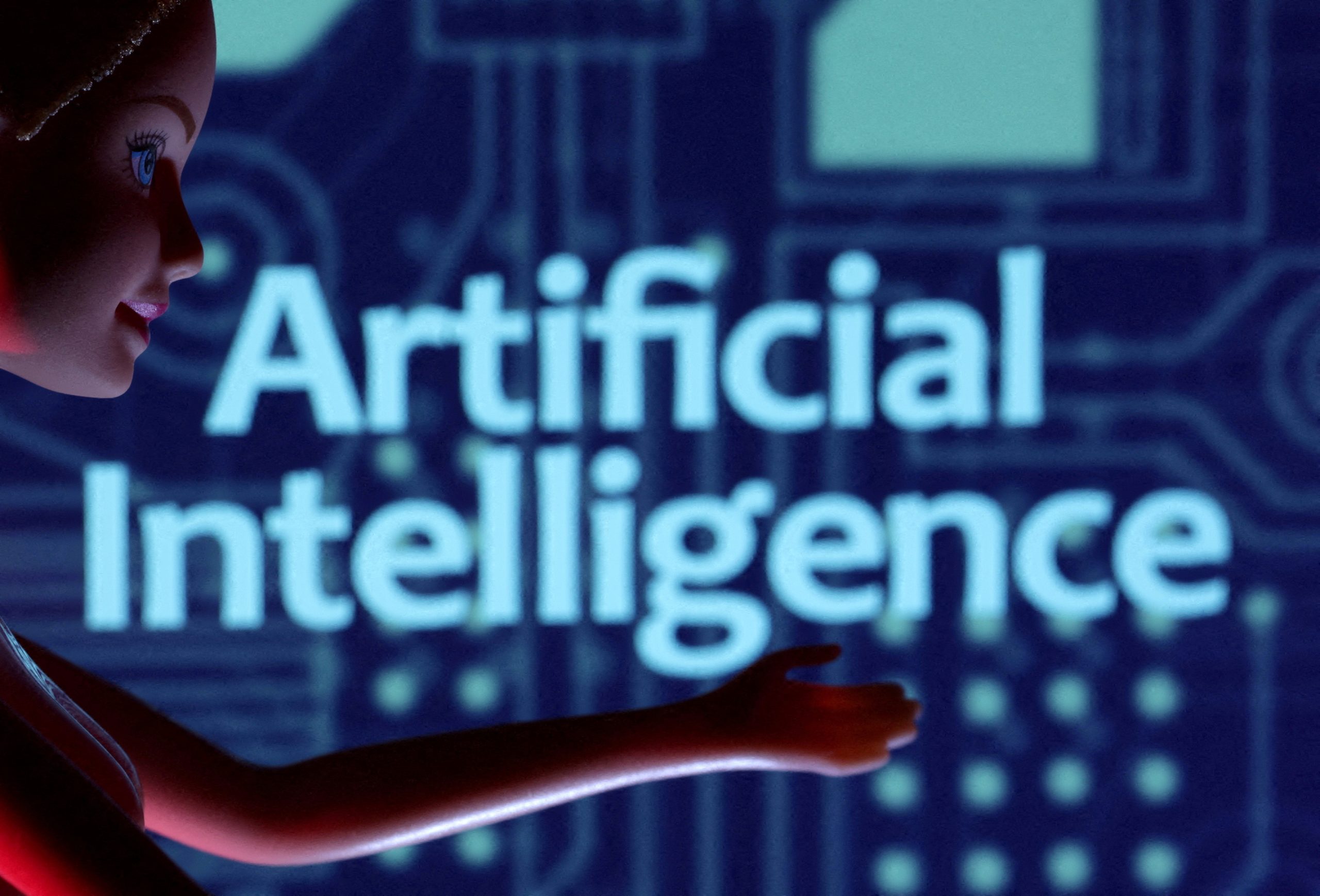
 "FILE PHOTO: Illustration shows Artificial Intelligence words")
The expressions like compassion, emotional bonding, heartfelt connection and mutual reciprocity will soon become passé. At the same time, artificial intelligence intimacy is the latest lexicon in the dictionary of media and communication. The Cambridge Dictionary has crowned the term ‘parasocial’ as the word of the year, indicating the rising popularity of AI companions.
Last month, a bride married an AI-groom that was developed on ChatGPT during a real and virtual reality wedding in Japan. AI is making life partners obsolete. Besides, Japanese human bride Kano posed in a lovemaking position beside her AI husband. Back in India, a 12-year-old girl in Hyderabad gained a strong emotional attachment to ChatGPT, referring to it as her Chinna and caring for it as a friend.
You love it or loathe it but you cannot ignore it. It has created a new contour in the realm of digital humanism. When there are an emotional boundary and mutual respect for emotional boundaries, human relations flourish. In the case of AI companions, none exist. The economics of loneliness is the larger talking point of mediated emotional communication.
The English sociologist Anthony Giddens has rightly enunciated that intimacy is becoming more reflexive, commodified, communication-based and influenced by the larger social and economic systems, so digital intimacy seems a logical extension of the current changes in love and relationships. Artificial intimacy is also becoming a new dimension of the creative economy, which is an emotional design, narrative craft, personalisation and a participatory culture. AI companions are no longer just technology but are turning into a billion-dollar business driven by emotional weakness. More so, this gives it a sociological and economic touch.
Intimacy has been hatched obstinately human along the long route of human civilisation. But over the past ten years, the matter is much deeper. Technology, which was initially a cold machine of logic, is gradually entering our emotional life. It listens. It remembers. It comforts.
Quick Reads
View AllSomething casual that started off as scrolling, streaming or chatting has gone a notch higher—far more intricate. Artificial intimacy, AI companion apps or relational AI overlap with digital humanism in multiple aspects. In fact, artificial intimacy and AI companions are components of digital humanism, as they are positioned on the interface between technology and human principles. Both of them inhabit and disrupt the ideals that digital humanism tries to enforce.
Chatbots are friends, virtual love interests; AI friends can comfort loneliness, and robots are more aware of our most insecure needs than others who are physically present. What started as a digital niche concern has become a worldwide trend that is redefining relationships, ethics and even the composition of emotional life.
And even India, which is commonly believed to be a traditional society, is slowly turning into one of the most active adopters of digital emotional companionship. Simultaneously, AI is not human, but it is created by humans, who may find that humanising it will allow them to avoid responsibility.
In the United States, where Replika AI can provide companionship; in China, where Xiaobing can be counted on to listen and understand; and in India, where Niki.ai-driven relationship experiments can be relied upon not to judge, misunderstand or leave—millions of people are now looking to find a system that will listen, understand and not abandon them. These AIs promise a revolution or a relationship without the disorders of human flaws.
This transformation did not occur in a vacuum but due to some factors that contributed to it. Loneliness is turning into an international scourge. AI is slowly becoming conversational, emotionally receptive and hyper-personalised. The digital native generation is making screen-start relationships and screen-based relationships a normal practice. Negotiation exists in human relationships. AI relationships provide a protective getting-out-of-hiding place, nurture without care, affection without commitment. When mentioning a few, we mean that as we train them, they are, quite literally, learning how to love us—though we do not know whether we humans are doing a good enough job of it.
With the boundaries separating reality and virtual constantly becoming blurred, the question is—are we prepared to defend people against being transformed into computer-generated daydreams to be consumed by the multitude? India is at a peculiar crossroads. We are a young country, technologically forward-thinking, emotionally vocal, and connected to family structures. AI intimacy interferes with all levels of this equation. China has already put a ban on emotional AI for minors. Europe is debating it.
Intimacy will never change into something fake; it will be a blend of both—the most effective aspects of technology and the eternal demand of the human heart. And one thing is sure in that future: the meaning of love will be up to us, and machines can learn to take care of us.
(Chakraborty is an Associate Professor in TAPMI, Bengaluru, MAHE. Biswal is an Associate Professor, Department of Journalism and Mass Communication, Rama Devi Women’s University, Bhubaneswar. Views expressed in the above piece are personal and solely those of the authors. They do not necessarily reflect Firstpost’s views.)