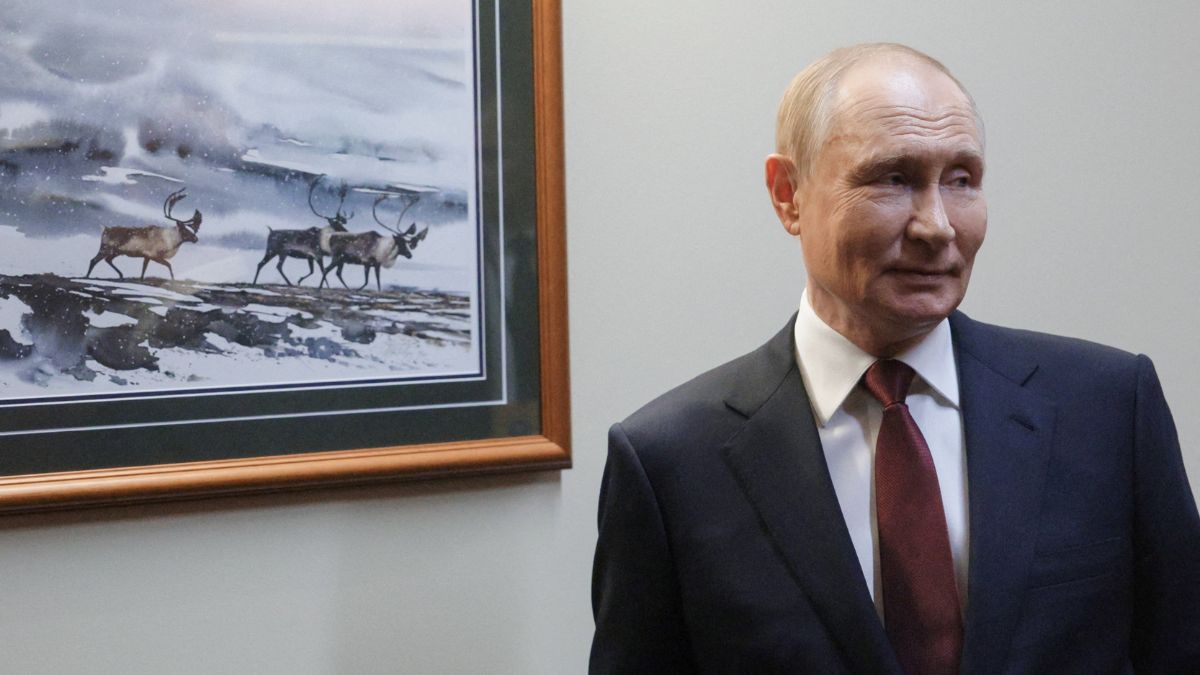
 "Russian President Vladimir Putin is expected to be in New Delhi on December 4-5 for a two-day official visit to attend the annual India-Russia Summit.. File Image/Sputnik via Reuters")
India and Russia’s multi-dimensional partnership and 78 years of establishment of diplomatic relations, 1947-2025, have served as a historic benchmark and sustained partnership in the promotion of global peace and security. Both the countries, as strategic and specially privileged partners, have reaffirmed their commitment to cooperate bilaterally and also at various international forums.
The bilateral relationship is geared towards the establishment of a stable and predictable multipolar and just world order based on sovereign equality of all states, peaceful coexistence, respect for territorial integrity and non-interference in their internal affairs, and a win-win proposition on major issues of mutual interest.
Robust Economic Partnership
India and Russia have developed vibrant bilateral trade and economic relations by promoting investments, expanding trade, and working to remove barriers and tariffs. During their bilateral meeting in Moscow on July 9-10, 2024, as well as at the Kazan meeting on October 22, 2024, and on the sidelines of the Tianjin SCO meeting on September 1, 2025, Prime Minister Narendra Modi and President Vladimir Putin agreed to accord high priority to mutually beneficial commercial engagement between the private sectors of both countries. President Putin is expected to be in New Delhi on December 4-5 for a two-day official visit to attend the annual India-Russia Summit.
To promote smoother and greater movement of businessmen, the two countries set a target of $30 billion in bilateral trade by the end of 2025 and a target of $100 billion in bilateral trade by 2030. This syncs well with India’s ambitious goal of achieving $5 trillion by early 2026. Currently, India has overtaken Japan to become the 4th largest economy, with its Gross Domestic Product (GDP) crossing $4 trillion. If the current rate of growth is sustained, India by 2028 is likely to surpass Germany and become the 3rd largest economy globally.
Major items of export from India include pharmaceuticals, tea, coffee and tobacco, nuclear reactors and boilers, machinery and mechanical appliances, organic chemicals, and electrical machinery and equipment. Major items of import from Russia include pearls, precious and semi-precious stones and metals, nuclear power equipment, electrical machinery and equipment, mineral oil and products, iron and steel, optical, precision and surgical equipment, inland waterways, civilian aircraft production, railways, and the IT sector (robotics and big data).
Quick Reads
View AllDefence Collaboration
In the realm of defence cooperation, India and Russia share a longstanding and wide-ranging partnership. The Indian-Russian Inter-Governmental Commission on Military-Technical Cooperation plays a leading role in this collaboration. Joint exercises, such as Indra, involving ground forces in Russia, with more planned, further strengthen this cooperation.
Ongoing initiatives include the collaborative design, development, and production of high-technology military equipment; the establishment of a Joint Venture for Ka-226T helicopter production; the BrahMos Missile System’s successful deployment during Operation Sindoor; four Admiral Grigorovich-class guided missile stealth frigates; joint development of the Fifth Generation Fighter Aircraft; and the licensed production in India of SU-30 aircraft and T-90 tanks.
The dedication of the Russian-built aircraft carrier INS Vikramaditya off the coast of Goa is another example of strengthened cooperation in India’s naval arena.
Cultural Dimension and Role of Diaspora
Showcasing India’s soft power capability as a major source of attraction, the Indian diasporic community in Russia, which is estimated at about 30,000 , including presence in its major cities such as Moscow, St Petersburg, Ekaterinburg, Sochi, Kazan, etc, has been extremely proactive in its engagement with the Russian public and its government for enhancing the relationship with India and the country’s soft power and thus taking it to a higher benchmark.
About 500 Indian businessmen reside in Russia, out of which around 200 reside and work in Moscow itself. An estimated 300 registered Indian companies operate in Russia. There are approximately 5,000 Indian students, with most of them pursuing medical studies, enrolled in institutions spread throughout Russia. Indian Council for Cultural Relations (ICCR) India Chairs have been instituted in various Russian universities to promote and encourage contemporary Indian studies.
Hindustani Samaj is the oldest Indian organisation in Russia, functioning since 1957, with activities being organised all year long. Other Indian organisations in Moscow include the Indian Business Alliance, the All Moscow Malayalee Association (Amma), the Indian-Russian Friendship Society (Disha), Amrit India Cultural Center of Tarusa City, and the Ramakrishna Society Vedanta Centre that showcase Indian culture in various forms to the Russian public on a regular basis.
The Way Forward
While India and Russia are committed to enhancing the framework of the strategic and privileged partnership and accelerating existing cooperation, in keeping with the realist theory in international relations emphasising core national interests in various avenues of strategic partnership, Prime Minister Modi’s fervent call to pursue dialogue and diplomacy and make a plea for ending bloodshed and human suffering by describing the Ukraine crisis as ‘this is not an era of war’ demonstrates India’s pursuance and commitment to peace and stability in the turbulent region.
Irrespective of geopolitical imperatives, it is very likely that India-Russia relations will weather these onerous challenges and will endure towards a more durable world order in which both countries will find areas of commonalities to work on and take the proactive momentum forward. Future bilateral meetings between India and Russia and between Prime Minister Modi and President Putin are likely to take the 78-year-old relationship between the two countries to greater heights by emphasising areas of convergence and engagement.
As power dynamics at the global level undergo profound change, and there is global tumult and flux at multiple levels, India and Russia are likely to forge a consequential and sustainable partnership for navigating strategically amidst fast-evolving geopolitics around the globe.
(Mohammed Badrul Alam is Director of Research; Professor and Head, Department of Political Science, Retd; Faculty of Social Sciences, Jamia Millia Islamia University, New Delhi. Views expressed in the above piece are personal and solely those of the author. They do not necessarily reflect Firstpost’s views.)