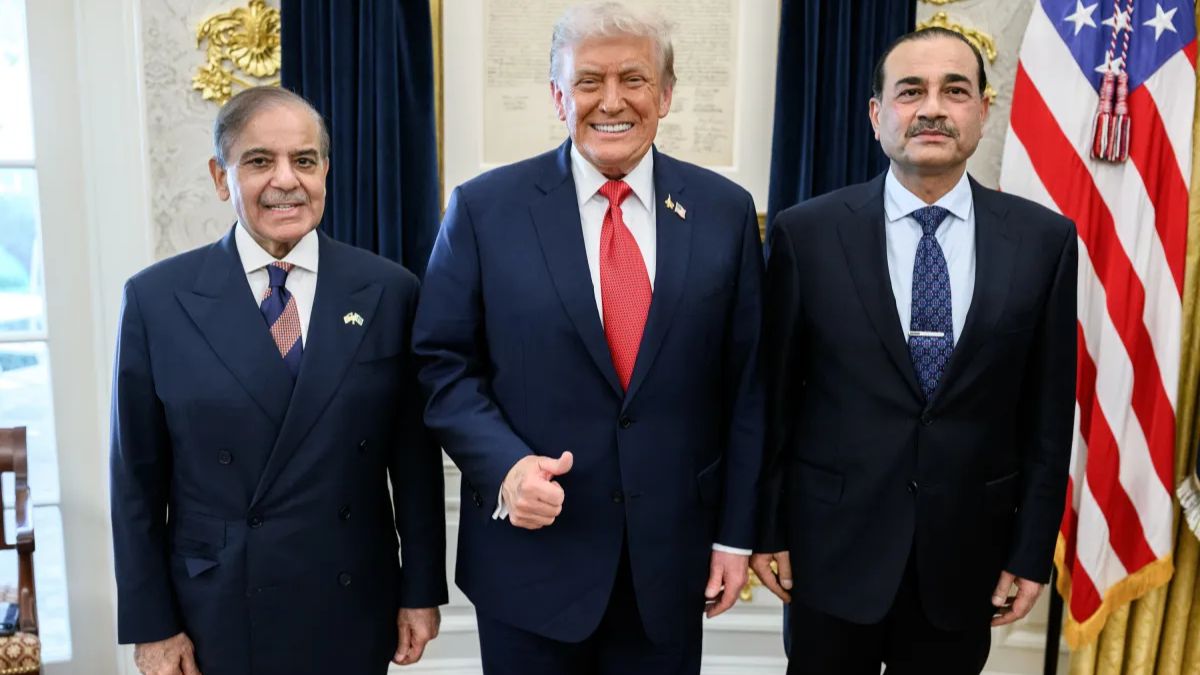
 "US President Donald Trump meets Pakistan's Prime Minister Shehbaz Sharif and Army chief Field Marshal Asim Munir on September 25, 2025, at White House. (Photo: White House)")
On November 26, a shocking incident occurred just blocks away from the White House, as two members of the National Guard were shot by a man, who turned out later to be Afghan. One of them is dead, and the other is fighting for his life. President Donald Trump predictably used the tragedy to hit out at his predecessor Joe Biden and Biden-era policies that allowed Afghans in, and announced a review of all ‘aliens’ in the country and the ending of all immigration from Afghanistan, which he termed a ‘hellhole’.
Rather conveniently, Trump also announced another 500 troops to guard the national capital, further cementing a policy that has drawn ire across the country. All in all, a typical Trumpian reaction. But the mystery of the Washington shooting lies elsewhere.
Sordid Background
First, the attacker himself is now known to be Rahmanullah Lakanwala, who had come into the country under a policy that sought to shield those who had cooperated with US forces from Taliban revenge. More than 190,000 Afghans have been resettled in the United States, most under Special Immigrant Visas, due to the extreme risks they took in helping its forces. Lakanwala was in a different category. He joined the Central Intelligence Agency (CIA) around 2011 and would have been extensively vetted before that, which makes the attack even more surprising.
An astonishing and thorough report on the unit documented widespread cruelty and indifference in raids on Afghan villages that were based on faulty intelligence and where Afghan and Special Operations soldiers accompanied by CIA officials barged into houses in ‘dead of night’ raids. The whole thing was classified, so it was not codenamed ‘Zero Units’ for nothing. Accountability was predictably zero as well. More importantly, it alienated the Afghans from the US more than any other aspect of operations.
Pakistan’s Self-Serving Intel Role
The critical point here is that during that period, much of the ‘intelligence’ came from Pakistan in trade-offs and also involved the US targeting top leaders of the Tehreek-e-Taliban Pakistan (TTP) in a bid to gain Rawalpindi’s critical support. That relationship ended, for all intents and purposes, when US troops pulled out on a hurried timetable that was of Trump’s making.
One of the most poignant images of that period is that of Afghans clinging to departing US aircraft in a desperate bid to leave the country. Few acts defined the utter failure of US strategy in handing over the state to the Taliban, with the equally famous image of the then Director General ISI Lt Gen Faiz Hameed celebrating Pakistan’s win over a ‘cup of tea’ at the Serena hotel. Pakistan apparently triumphed, but since then matters have cartwheeled to an unimaginable extent.
Quick Reads
View AllPakistan is Taking a Beating
A day before the attack in the US, Pakistan’s Inter-Services Public Relations (ISPR) Director General Lt Gen Ahmed Sharif Chaudhry, in a briefing to the media, yet again warned that the Afghan Taliban regime has become a threat not only to Pakistan but to the entire region and the world, a complaint that Islamabad has been making ever since the TTP restarted its ferocious attacks against Pakistan. That the Pakistanis are equally supporting a faction of the Islamic State-Khorasan in the area of Nangarhar and beyond is also equally well known among the intelligence agencies of all countries.
Pakistan launched its first air strikes on Afghanistan in mid-2024, and they have escalated since October 2025, with Kabul included in targeted operations. Since then, according to the Pakistani military, it has carried out 67,023 intelligence-based operations (IBOs) nationwide—including 12,857 in Khyber-Pakhtunkhwa and 53,309 in Balochistan—even as Afghanistan retaliated by striking numerous Pakistan army posts, even as the TTP struck repeatedly.
A reputed Pakistani think tank put violence as the worst ever in a decade, with 2025 being the worst year, as of October. With an entire quarter still remaining, data indicates 2414 fatalities recorded compared to the entire tally of 2024 (2546). There is no sign at all that this trend is going to reverse.
Meanwhile, Pakistan’s Foreign Minister has declared that at least 4000 military personnel have died since 2021—a conservative estimate since the prevailing violence involves the killing of at least 30 security personnel every month—and also that 20,000 have been injured since then. Considering that border clashes have spanned the entire length of the border, from Baramcha in the south—where the Islamic State shelters inside Pakistan—to Chitral in the north, there is no question but that the border is entirely on fire.
Taliban Digging Heels
Meanwhile, all statements by Afghanistan’s leadership indicate that they are on the war path. Recently, the Taliban Commerce Minister had declared their intention of stopping all trade through Pakistan’s Karachi and into Pakistan itself, shifting instead to Chabahar. Afghan border forces have officially declared that the Durand Line is a ‘fictitious’ one, while Mullah Beradar issued a strong warning to Pakistan, calling upon Islamabad “not to disrespect our airspace and land, and not to target innocent women, children, and Afghans contrary to all principles”.
The closing of the border by Pakistan has boomeranged badly on Pakistan, as produce lies unsold, and Pakistani businessmen, particularly in the tribal areas, have been appealing to leaders like Maulana Fazlur Rehman to get the border reopened for trade. That, in turn, has led to a political outcry in Khyber Pakhtunkhwa, with the new Chief Minister Suhail Afridi railing against the Pakistan army and getting beaten severely by security forces as a result. This is a powder keg of unimaginable proportions, and Rawalpindi knows it.
As the foreign minister alleged that a heavy ‘clean up’ operation of terrorist hideouts in Afghanistan was stopped due to the intervention of Qatar, it seems Pakistan is running out of options. Despite the bravado among officials, there is strong awareness that a full-on attack on Afghanistan could be suicidal. Islamabad’s only recourse is to ‘outsource’ the operation to an external power. While it is now repeatedly asking for external mediation from Saudi Arabia or Qatar, the reality, however, is this.
For years now, Rawalpindi has been using every trick in the book to lure the US back into Afghanistan, thereby giving itself—yet again—not just a large role in that unfortunate country, but also the funds that it desperately needs. The ‘War on Terror’ brought in billions in unaccountable funds—most of it to Corps Commanders—for years, and the stoppage of those funds has been severely felt.
Meanwhile, the near-daily attacks have severely depleted Pakistan’s security forces in strength and morale and caused what it most dreads—the complete alienation of the tribal areas. To stop this cycle of events, it needs a heavy hand with powerful leverage. The US fits the bill. The terror attack against US servicemen may be just that, the prod that gets a reluctant Trump to at least up the ante, even if only from Pakistani soil. It’s a long haul.
(The writer is Director [Research and Analysis] at the Centre for Land Warfare Studies. Views expressed in the above piece are personal and solely those of the author. They do not necessarily reflect Firstpost’s views.)