

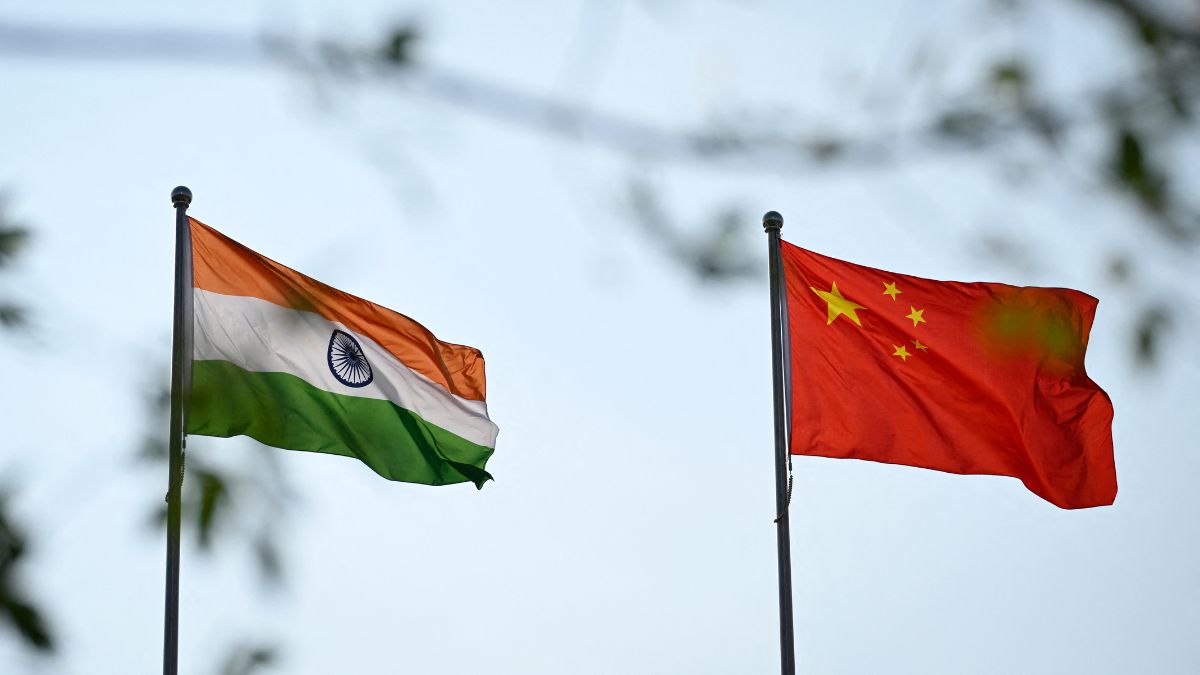
 "75 years on: Why India’s hasty recognition of Red China remains a strategic folly")
Seven and a half decades ago, an event largely forgotten today took place; it would become a turning point in the history of the Asian nations. It not only changed the fate of a small (not by size) nation, Tibet, but also triggered ripples (not to say a tsunami) which still endure along the entire northern border of India, wiping out its serenity.
India decided in a hurry to recognise Red China without obtaining any guarantees for its own security.
It began on New Year’s Eve; on December 31, 1949, the Government of India pushed through the recognition of the new regime in Beijing.
Patel’s Position
But let us first go back to 1949.
Nehru was not overly worried about the situation developing in China. On September 10, in a letter to John Matthai, his Finance Minister, he wrote: “Recent developments in China and Tibet indicate that Chinese Communists are likely to invade Tibet sometime or other. This will not be very soon. But it may well take place within a year. The government structure of Tibet is feeble. A Lama hierarchy controls the whole country, the majority of whose population is very poor. Any effective attempt by the Chinese Communists can hardly be resisted, more especially as the greater part of the population is likely to remain passive and some may even help the Communists. On the other side at Sinkiang [Xinjiang today], Soviet influence is already strong. The result of all this is that we may have the Chinese or Tibetan Communists right up on our Assam, Bhutan and Sikkim border. That fact by itself does not frighten me.”
In October, soon after Mao Zedong had declared from the rostrum of Tiananmen Square that ‘China has risen’, the Indian Prime Minister decided to go ahead with the recognition of the Communist regime; Sardar Vallabhbhai Patel, India’s Deputy Prime Minister, could not understand the hurry.
Quick Reads
View AllOn December 6, 1949, he wrote to Nehru: “It seems your intention is to recognise China soon after the UN session ends, even if it means that others are not ready by then or prepared to do so. My own feeling is that we do not stand to gain anything by giving a lead.”
Nehru immediately replied, “Our advisors [read VK Krishna Menon and KM Panikkar] are of the opinion that it would be definitely harmful to recognise… after the Commonwealth have done so. It would mean that we have no policy of our own, but follow the dictates of other countries.” Nehru ultimately won the battle.
On December 31, 1949, India was the first nation, with Burma, to recognise the Communist regime. This recognition without any counter-benefits still has serious consequences today.
China Gets Ready to Invade Tibet
A first warning was heard on January 1, 1950, a day after the recognition of Mao’s regime; in the broadcast, the New China News Agency proclaimed, “The tasks for the People’s Liberation Army (PLA) for 1950 are to liberate Taiwan, Hainan and Tibet… Tibet is an integral part of China. Tibet has fallen under the influence of the imperialists.”
Who were the ‘imperialists’? The broadcast probably meant the few Indian traders and diplomats posted in Tibet.
During the following months China would repeatedly assert that Tibet was part of China’s territory.
The Soviets Join In
On January 2, 1950, from Moscow, Mao gave Deng Xiaoping the green light to attack Tibet; the responsibility for all the preparations was left to Deng, then Political Commissar of the Second Field Army in Chengdu (Sichuan).
On January 10, 1950, Mao sent another telegram “ordering that the preparation of the liberation should be accelerated and agreeing with Deng Xiaoping’s proposal that the liberation of Tibet should be started simultaneously from all directions — from Sichuan in the east, from Yunnan in the south, from Qinghai in the north and from Xinjiang in the west”.
It would take eight months for the 18th Corps of the Second Field Army to be ready to march through Kham province and defeat the ill-equipped, poorly motivated Tibetan army.
On January 22, an interesting conversation took place in Moscow between Mao Zedong and Joseph Stalin. Mao Zedong: “Let me thank you Comrade Stalin, for the help. …Commander of the PLA’s Second Field Army, Liu Bocheng’s troops, is currently preparing for an attack on Tibet.”
Joseph Stalin replied, “It’s good that you are preparing the attack. The Tibetans need to be subdued.”
During the first months of 1950, the only unknown factor for the Chinese was the degree of resistance by the Tibetans: would the Second Army of ‘one-eyed’ Liu Bosheng march triumphantly into Tibet as the liberators, or would Tibet have to be liberated by force?
By the end of 1949, the Red Army knew that the real test would be the ‘occupation’ of Kham.
This was what was at stake in the negotiations between the Chinese Ambassador and Shakabpa, the Tibetan representative in Delhi.
Had the negotiations succeeded, the PLA would have entered Tibet ‘invited’, with China only occupying its own territory.
We should not forget that Mao’s favourite ‘teacher’ was Sun Tzu, who said, “To fight and conquer in all your battles is not supreme excellence; supreme excellence consists in breaking the enemy’s resistance without fighting.”
The Preparations to Occupy Tibet
In early August 1950, Marshal Liu Bocheng had announced: “[The] People’s Liberation Army will soon march towards Tibet with object of driving out the British and American aggressive forces so as to make Tibetans return to the Great Family of the People’s Republic of China. As soon as the Liberation Army enters into Tibet, they will carry out the Programme of National Regional Autonomy, religious freedom …The military and political systems prevailing in Tibet now will remain as they are and will NOT be changed; various ranks of officials and men will work as usual.” The plans were clear.
India Remains Unaware
After meeting Zhou Enlai on August 26, Panikkar, the Indian Ambassador in Beijing, wrote that “he expressed the hope [to Zhou] that they [the Chinese] would follow a policy of peace in regard to Tibet”. Zhou Enlai replied that “the liberation of Tibet was ‘a sacred duty’”.
For months, KM Panikkar, the Indian Ambassador in China, regularly put the blame on the Tibetans for refusing to ‘negotiate’ with China.
For Mao, however, it was clearly a two-phase strategy: first a military takeover of the Chamdo area and then a ‘peaceful liberation’ after the Tibetans had been militarily defeated and forced to sign an agreement with the ‘Central Government’, ie, the Communist regime in Beijing.
Already on August 23, the Chairman had cabled the CPC Southwest and Northwest Bureaus: “If our army can capture Chamdo in October, this will urge the Tibetan delegation to come to Beijing for negotiation for peaceful settlement.”
On October 7, 1950, the Chinese crossed the Yangtze River and invaded Chamdo, the capital of Kham province in Eastern Tibet.
Panikkar Justifies Himself
In the meantime, in a communication to the Chinese government in August, Panikkar changed the status of Tibet from China’s ‘suzerainty’ to ‘sovereignty’, an entirely different significance.
More than a month after the Chinese had entered Chamdo, the issue of suzerainty vs sovereignty was still bothering Delhi, but Panikkar was ready to justify his position …for the sake of world peace.
In a top-secret cable to the Prime Minister, the Indian ambassador admitted, “The Peking [Beijing] Government has proceeded on the assumption that since their sovereignty was recognised, India, while pressing for a peaceful settlement, could NOT legitimately object to military action if Tibetan Delegation did NOT arrive in reasonable time.”
Panikkar was not ready to withdraw the term ‘sovereignty’; he told Nehru, “Our present explanation that use of word sovereignty was by oversight would naturally appear thin to them.”
It is difficult to believe that China invaded Tibet on an ‘oversight’ of Panikkar, but it was the justification that Mao gave for the ‘liberation’.
Thus, the prophecy of the 13th Dalai Lama, a great visionary, became reality. Having seen the real face of the Communists, in 1932, in his last Testament, he had warned his people: “Precautions should be taken at a time when the forces of degeneration are most prevalent and when Communism is on the spread. Remember the fate that befell the Mongolian nation when Communists overran the country and where the Head Lama’s reincarnation was forbidden, where property was totally confiscated and where monasteries and religion were completely wiped out. These things have happened, are happening and will happen in the land of harmonious blend of Religion and Politics.”
Nobody had listened then!
Seventy-five years later, one can ask, what did India gain in acting so hastily? It has certainly lost a friendly neighbour who shared Bharat’s deeper values.
(The writer is Distinguished Fellow, Centre of Excellence for Himalayan Studies, Shiv Nadar Institution of Eminence (Delhi). Views expressed in the above piece are personal and solely those of the writer. They do not necessarily reflect Firstpost’s views.)

 "Zelenskyy to meet Trump in US on Sunday: Is an end to Russia-Ukraine war close?")
 "Why Pakistan’s mass exodus of skilled professionals puts Asim Munir’s ‘brain gain’ claim under scrutiny")
 "Thailand, Cambodia agree to an 'immediate ceasefire', halting fierce border clashes")
 "Bangladesh: BNP's Tarique Rahman pays tribute at Hadi’s grave amid tight security")
 "Zelenskyy to meet Trump in US on Sunday: Is an end to Russia-Ukraine war close?")
 "Why Pakistan’s mass exodus of skilled professionals puts Asim Munir’s ‘brain gain’ claim under scrutiny")
 "Thailand, Cambodia agree to an 'immediate ceasefire', halting fierce border clashes")
 "Bangladesh: BNP's Tarique Rahman pays tribute at Hadi’s grave amid tight security")



