

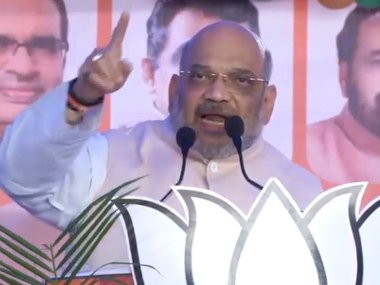
 "Unpacking Amit Shah's Hindi Divas comment: 'Himperialism' is characteristic of BJP's empire-building ambitions")
Joining the Dots is a weekly column by author and journalist Samrat in which he connects events to ideas, often through analysis, but occasionally through satire
***
Amit Shah’s statement on Hindi being the one necessary language for India has kicked off quite the political storm . Shah, in the course of a speech on the occasion of “Hindi Divas”, said : “Diversity of languages and dialects is strength of our nation. But there is need for our nation to have one language, so that foreign languages don’t find a place. This is why our freedom fighters envisioned Hindi as Raj Bhasha”.
If “diversity of languages and dialects is strength of our nation”, then why is Shah advocating the weakening of this strength?
The answer is in the next sentence: Shah wants “foreign languages” to not find a place in India. It is odd that Indian languages apart from Hindi should be chosen for sacrifice in this battle against “foreign languages”, but in any case, which “foreign languages”, in the plural, is he referring to? Bangla, Punjabi, Tamil and Nepali are spoken in other countries, but cannot be called foreign. The foreign language in question is obviously English, which unknown to Shah has unfortunately already found a place even in the remotest corners of India. In fact, it is now the link language for the whole world. So, for example, millions of Chinese now learn English, because they want to communicate with the rest of the world. So do a lot of Japanese, Koreans, Indonesians, Thais, Germans, Swedes and others. In India, a lot of people from states such as Gujarat — which send vast numbers of emigrants to the West — are especially keen learners of English. [caption id=“attachment_7346371” align=“alignnone” width=“825”]
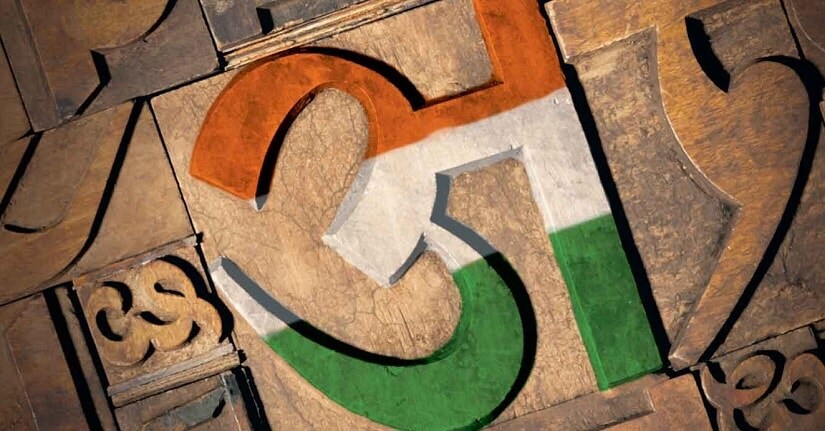 The assertion that our freedom fighters envisioned Hindi as the Raj Bhasha or official language is a vast generalisation. File Photo[/caption] Shah’s assertion that our freedom fighters envisioned Hindi as the Raj Bhasha or official language is also a vast generalisation. For instance, one of the rare Indian freedom fighters who literally fought for freedom, Subhas Chandra Bose, had favoured the usage of Hindustani, meaning a mix of Hindi and Urdu, in the Roman script. This avoided the clash between Hindi and Urdu, and helped him to lead a force, the Indian National Army, that had Hindu, Muslim and Sikh soldiers from across what are now India, Pakistan and Bangladesh. His polar opposite in many ways, Mohandas Gandhi, who was initially a votary of Hindi, also gradually came around to supporting Hindustani. Also Read:
_Hindi 'imposition' debate: Schools can play key role in promoting integration through 3-language formula_ The freedom fighter who championed the idea of “Hindi Hindu Hindustan” is the original hero of the BJP and its affiliates. His name is VD Savarkar. Like hundreds of other freedom fighters (whose names no one today remembers), he was incarcerated in the Cellular Jail in the Andamans. Unlike them, he authored a series of mercy petitions
pledging his loyalty to the British crown. The tales of his heroic exploits began circulating after his release from prison with the publication of a book called Life of Barrister Savarkar written in a foreign language, English, by someone under the pseudonym of Chitragupta, which happens to be the name of the assistant of Yamraj, the god of death. This Chitragupta was eventually revealed by the book’s publisher to be none other than Savarkar himself. The idea of religious nationalism, championed by Hindu nationalists such as the atheist Savarkar on the one hand and the irreligious, unorthodox Muslim MA Jinnah on the other, eventually broke up the British Indian Empire into three pieces, and Yamraj had a busy time as a million or so people died as a direct result. Those three pieces, India, Pakistan and Bangladesh, have still not really found peace with themselves or with one another. The relationship between India and Pakistan is outright hostile. The one between Bangladesh and the other two is complicated. Internally, Bangladesh has the best chance of becoming the kind of unitary, majoritarian nation-state that the Hindutva brigade, whose ideas of the world are about a century out of date, consider the acme of modern nation-building. Pakistan, although much smaller than India, is still too big and diverse. The Sindhis, Baloch, Pashtuns and others resent Punjabi over-lordship. Urdu is the national language there but the native speakers of the language are the minority Mohajirs, whose status in that country is still not much better than that of refugees. Pakistan therefore suffers from tensions over identity despite being more than 95 percent Muslim. Also read:
Hindi 'imposition' debate — Schools can play key role in promoting integration through 3-language formula In India, Hindi is not the national language, although some among those who want India to become a Hindu mirror image of Pakistan — a country with one religion and one national language — would like to make it so. This is based on ideas of ethnic nationalism and majoritarianism. However, it is a curious variety of both, and this may have something to do with the map of undivided India that they worship. The expansive maps of Bharat, similar to the one used to depict the extent of Hindi on Hindi Divas recently, include India, Pakistan and Bangladesh. This is an area where Abraham Grierson’s Linguistic Survey of India published in 1928 had listed 179 languages and 544 dialects, although the survey was incomplete as it did not cover most of South India. Why would this vast and diverse area including South and Northeast India be shown as the territory in which Hindi was spoken?

 "Israel targets top Hamas leaders in Doha; Qatar, Iran condemn strike as violation of sovereignty")
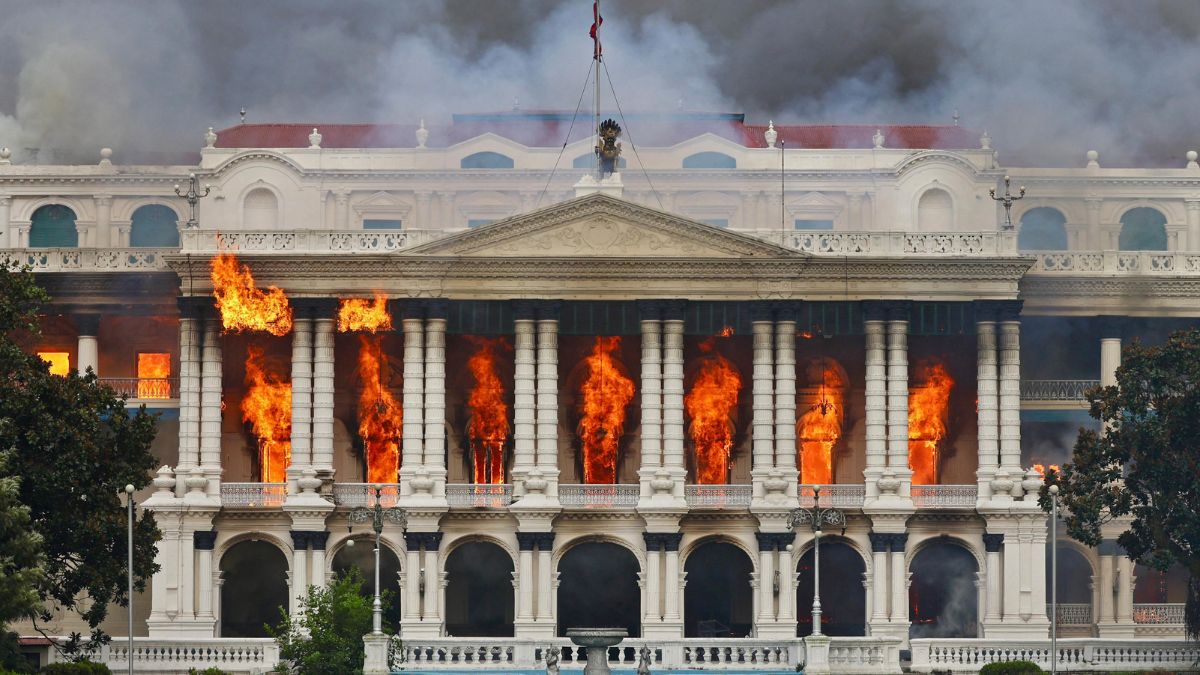 "Nepal: Oli to continue until new PM is sworn in, nation on edge as all branches of govt torched")
 "Who is CP Radhakrishnan, India's next vice-president?")
 "Israel informed US ahead of strikes on Hamas leaders in Doha, says White House")
 "Israel targets top Hamas leaders in Doha; Qatar, Iran condemn strike as violation of sovereignty")
 "Nepal: Oli to continue until new PM is sworn in, nation on edge as all branches of govt torched")
 "Who is CP Radhakrishnan, India's next vice-president?")
 "Israel informed US ahead of strikes on Hamas leaders in Doha, says White House")



](https://images.firstpost.com/wp-content/uploads/2019/09/hindi-new-min.jpg)