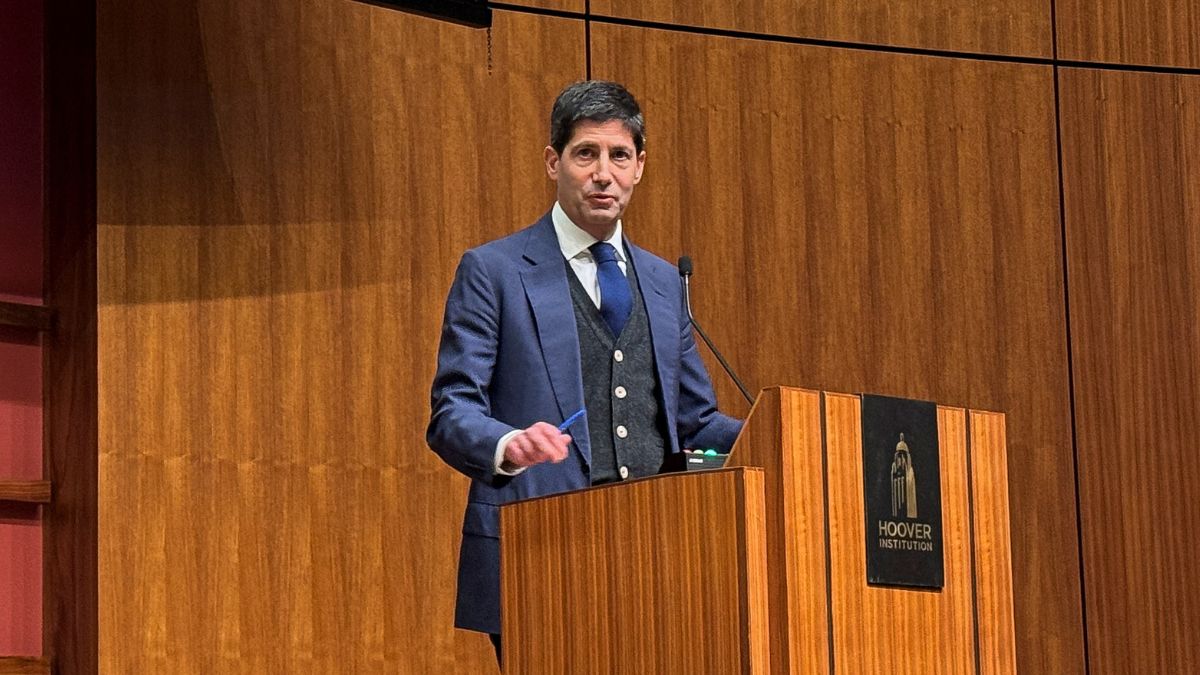
 "Who is Kevin Warsh, Donald Trump's likely pick for Fed chief?")
US President Donald Trump is expected to announce his nominee for the next chair of the Federal Reserve on Friday morning, bringing to a close a prolonged and politically charged selection process.
The decision will determine who leads American monetary policy at a time when interest rates, inflation control, and institutional independence are under intense scrutiny.
Trump confirmed the timing of the announcement late Thursday night as he entered a screening of a documentary on US First Lady Melania Trump.
Speaking briefly to reporters, he said, “I’ll be announcing the Fed chair tomorrow morning.”
He added that the individual would be “somebody that is very respected, somebody that’s known to everybody in the financial world,” describing the choice as one he hoped would be “a very good” one.
The US president declined to reveal the name, but recent reports have fuelled expectations that former Federal Reserve governor Kevin Warsh has emerged as the leading contender.
How Trump’s decision was shaped by months of conflict with the Fed
Trump’s announcement comes after nearly a year of open confrontation with current Fed Chair Jerome Powell, whose term ends in May.
Throughout this period, the president has repeatedly criticised Powell for resisting deeper and faster interest rate cuts, arguing that looser monetary policy is essential to accelerate economic growth.
Powell, by contrast, has taken a cautious approach to rate reductions, particularly in the context of elevated inflation pressures following Trump’s tariffs. The policy divergence has evolved into a broader clash over the Federal Reserve’s role, independence, and accountability.
The dispute escalated further when Trump began attacking Powell over the cost of renovations at the Federal Reserve’s headquarters in Washington. That criticism culminated earlier this month in subpoenas being issued by the Justice Department to the central bank.
In response, Powell took the unusual step of issuing a recorded public statement defending the institution’s decision-making process.
“The threat of criminal charges is a consequence of the Federal Reserve setting interest rates based on our best assessment of what will serve the public, rather than following the preferences of the president,” Powell said.
Trump, meanwhile, has continued to signal that his preferred Fed chair would pursue aggressive rate cuts that directly influence borrowing costs, money supply, inflation trends, and labour market stability.
How a new Fed chair does not mean the end of Powell
While Powell’s tenure as chair is nearing its end, his role within the Federal Reserve does not automatically conclude in May. His term as a member of the Board of Governors runs through 2028, giving him the option to remain in place even after stepping down as chair.
If Powell chooses to stay, it could complicate Trump’s ability to rapidly reshape the central bank’s leadership.
Of the seven current governors, three were appointed by former president Joe Biden, who also renominated Powell to a second term as chair. That composition limits how quickly Trump could secure a majority aligned with his policy preferences.
Powell’s continued presence could also introduce procedural hurdles.
Should Trump wish to install a new governor alongside appointing a new chair, he would need either to elevate an existing board member or replace Stephen Miran, who is currently on leave from his role as chair of the White House Council of Economic Advisers while filling a Fed governor term that technically expires on Saturday.
Replacing Miran would open a pathway for a new appointment.
At a recent press conference, Powell declined to say whether he would remain on the board but offered pointed advice to his successor on maintaining institutional credibility.
“Don’t get pulled into elected politics — don’t do it,” Powell said. He also emphasised that the Federal Reserve’s democratic accountability runs through Congress, adding that engagement with lawmakers is not optional but “an affirmative regular obligation.”
How Kevin Warsh emerged as the frontrunner
Multiple reports have pointed to Warsh as the most likely nominee. Bloomberg reported that preparations were underway at the White House for Trump to name Warsh as the next Federal Reserve chair, while pointing out that no decision is final until the president formally announces it.
Reuters separately reported that Warsh visited the White House on Thursday and met with Trump. Sources familiar with the discussion said the president was impressed, though no official confirmation was issued.
Individuals briefed on the meeting reiterated that Trump’s final decision could not be assumed until it was publicly disclosed.
When asked previously about Warsh as a potential candidate, Trump offered a brief endorsement, saying, “He’s very highly thought of.”
What we know about Warsh’s background and career
Kevin Maxwell Warsh was born on April 13, 1970, and built his career across finance, government, and academia. He served as a member of the Federal Reserve’s Board of Governors from 2006 to 2011, after being appointed by then-US president George W Bush.
During his tenure, Warsh played a key role during the 2008 global financial crisis. He served as the Fed’s primary liaison to major financial institutions and was deeply involved in crisis-management efforts that shaped the trajectory of the US economic recovery.
He also represented the Federal Reserve at meetings of the Group of Twenty (G20) and acted as a central point of contact between the US central bank and both emerging and advanced economies across Asia.
Before joining the Fed, Warsh worked at Morgan Stanley as a vice president and executive director in the firm’s mergers and acquisitions division.
He later served in the Bush administration as Special Assistant to the President for Economic Policy and as Executive Secretary of the White House National Economic Council.
In the years since leaving the Fed, Warsh has remained active in economic policy discussions. He currently serves as the Shepard Family Distinguished Visiting Fellow in Economics at Stanford University’s Hoover Institution and lectures at Stanford’s Graduate School of Business.
He is also a member of the Group of Thirty, serves on the Panel of Economic Advisers to the Congressional Budget Office, and has advised both private and public sector organisations. He was previously a member of the steering committee of the Bilderberg Group.
Warsh has frequently been mentioned as a candidate for senior economic roles, including US Treasury secretary. In June 2025, he was reported as a leading contender, alongside Scott Bessent, to succeed Powell as Fed chair.
What Warsh thinks of the Fed
In recent years, Warsh has become one of the Federal Reserve’s most prominent internal critics. He has argued that the central bank has strayed from its core mission and has called for what he has described as “regime change” in how it operates.
His criticisms have focused on several areas, including the Fed’s heavy reliance on economic data, the expansion of its balance sheet, and its handling of inflation.
While Warsh was regarded as relatively hawkish during his time as a Fed governor — favouring tighter policy and vigilance against price pressures — he is now widely viewed as supportive of lower interest rates in the near term.
Trump has reinforced that perception. Speaking to the Wall Street Journal in December, the US president said, “He thinks you have to lower interest rates. And so does everybody else that I’ve talked to.”
Warsh has argued that reducing the Fed’s balance sheet could help bring down short-term interest rates, a position that has drawn debate among economists who question whether that approach would deliver the intended effect.
What Warsh thinks about inflation, spending
Warsh has been outspoken about what he sees as the underlying causes of recent inflation.
In a 2022 Wall Street Journal op-ed, he wrote that rising prices stemmed from “a government that spent too much and a central bank that printed too much,” a framing that contrasts with the view of many mainstream economists, who have emphasised pandemic-era supply disruptions and demand shocks.
That critique has resonated strongly with fiscal conservatives and aligns with Trump’s broader messaging on government spending.
In a March 2025 interview with Fox Business, Warsh addressed the impact of Trump’s trade tariffs and broader economic conditions, stating, “The president inherited a fiscal and economic and regulatory mess, and it’s going to take a little digging out to be on a stronger platform for growth.”
On inflation policy, he was even more direct. “Inflation is a choice, and the Fed has made a lot of bad choices over these last several years,” Warsh said.
He went on to argue that executive action was necessary, adding, “The president has to take matters into his own hands and try to kill inflation by reducing government spending.”
Despite his alignment with Trump on rate cuts, Warsh has also warned against political interference in monetary policy. He has argued that the Federal Reserve must demonstrate independence not merely rhetorically but through its actions.
Referencing minutes from past Fed meetings, Warsh has criticised the consideration of political developments — including Trump’s own policies — in inflation forecasting.
What we know of any other contenders in the running
Although Warsh has emerged as the focal point, three other candidates remain under consideration.
Christopher Waller, a current Fed governor, was nominated to the board by Trump in 2020. He recently met with the president for an interview, a development that boosted his standing in prediction markets.
Waller has argued that there is scope for further interest rate reductions, positioning him as an internal candidate with policy continuity.
Rick Rieder, a senior managing director at BlackRock and the firm’s chief investment officer for global fixed income, represents the Wall Street wing of the shortlist. Rieder oversees more than $2.4 trillion in assets and has extensive experience in global debt markets.
His career includes time at Lehman Brothers and the founding of a hedge fund before joining BlackRock, giving him a market-focused perspective on Federal Reserve policy.
Kevin Hassett, a long-time conservative economist and Trump loyalist, was widely viewed as the initial frontrunner. He served as chair of the White House Council of Economic Advisers during Trump’s first term and currently leads the National Economic Council.
Hassett has been a consistent defender of Trump’s economic agenda, frequently dismissing data that suggested economic softening and echoing claims of bias at the Bureau of Labor Statistics.
However, Hassett’s prospects have dimmed in recent weeks. Trump publicly told him during a televised appearance that he was such an effective spokesperson that “I actually want to keep you where you are.”
That shift has coincided with growing attention on Warsh, particularly after Trump hinted that his choice was someone “that could have been there a few years ago,” a remark widely interpreted as referencing Warsh’s role as a finalist in the 2017 Fed chair selection process that ultimately resulted in Powell’s appointment.
Once Trump announces his nominee, the choice will move to the US Senate for confirmation.
The next Fed chair will inherit a central bank facing internal disagreements over rate policy, sustained political pressure from the White House, and broader questions about credibility and independence.
With inputs from agencies

 "‘We want a state, not war’: Palestinian FM says India can be a 'mediator' | Firstpost Exclusive")
 "What are Iran’s options if Donald Trump attacks?")
 "'We will do whatever is expected from us': Hegseth warns of possible military action in Iran")
 "What is the Alberta Prosperity Project, separatist group in Canada that met Trump officials?")
 "‘We want a state, not war’: Palestinian FM says India can be a 'mediator' | Firstpost Exclusive")
 "What are Iran’s options if Donald Trump attacks?")
 "'We will do whatever is expected from us': Hegseth warns of possible military action in Iran")
 "What is the Alberta Prosperity Project, separatist group in Canada that met Trump officials?")