 "US Sutra | America is at war with itself: Minnesota is just the tip of the iceberg")
Is the United States at the brink of a civil war? The plain answer is no. But it is a country and society that is so deeply divided that it is at war with itself. And Minnesota is just the tip of the iceberg.
The shooting of Alex Pretti on January 24 in the ongoing Minnesota siege has once again foregrounded the deep divisions in the American state and society. Pretti, a US citizen not an illegal immigrant, was seen in several video clips waving a phone when federal agents apprehended him. The official account is that he was carrying a licensed semi-automatic on his person and was shot when he pointed the weapon at an ICE agent.
Let us understand that the notion of a nation “at war with itself” does not imply widespread armed conflict between states or armies, as in the US Civil War, 1861-1865. The Civil War resulted in battle casualties as high as 750,000, more than the combined total of Americans who died fighting in World War I and World War II.
Today, we are nowhere close to such an armed and internecine conflict between two factions or sections of the US. But never in my living memory has American society been more internally divided and distraught. What we are witnessing is a profound internal rupture, political, cultural, ideological, and institutional. Competing visions of what it means to be American and what kind of nation the United States are clashing with increasing intensity, often spilling into violence, legal battles, and mutual delegitimisation.
These dangerous signs and symptoms are there for all to see. Partisan polarisation has reached historic highs. The US came out of a 43-day government shutdown in November 2025, the longest ever in US history. It is now staring at the possibility of another one. It would seem that Democrats and Republicans, instead of rivalling and competing with one another in a working relationship within the broader two-party democratic system have started viewing each other not merely as opponents but as existential threats.
Quick Reads
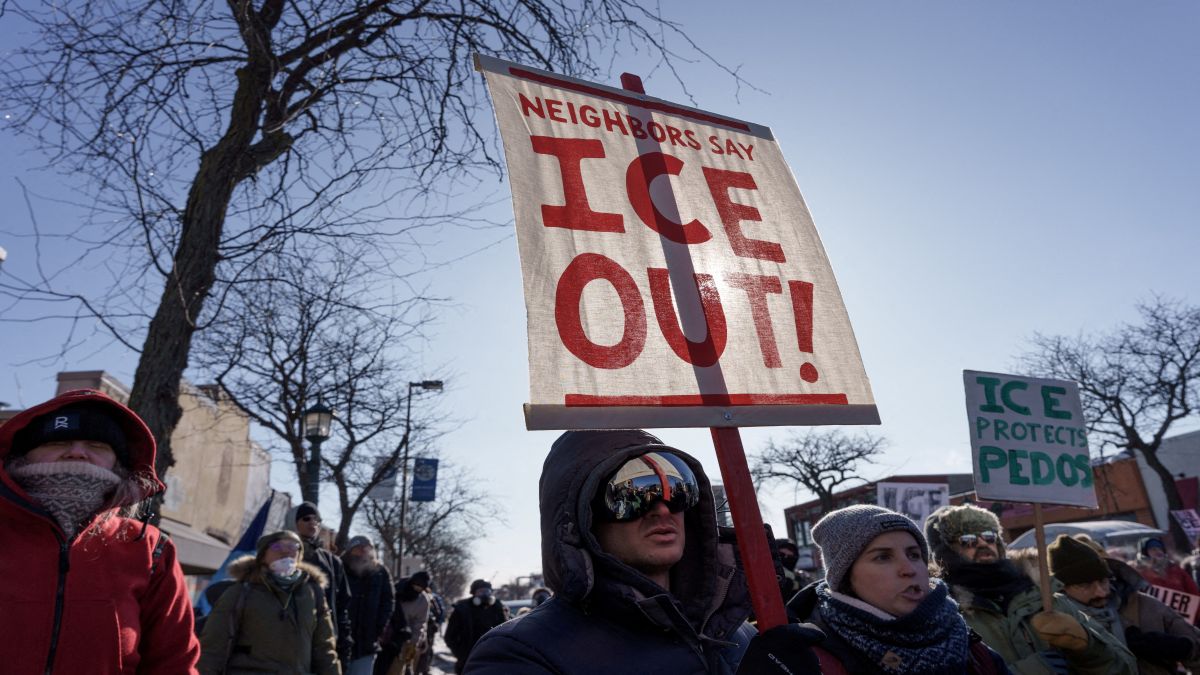
View AllThe Minnesota flashpoint starkly illustrates this internal war. In January 2026, the Trump administration intensified its immigration enforcement through Operation Metro Surge. Thousands of ICE agents come to Minneapolis, a sanctuary city and home the nation’s largest Somali community in the US, made up of both legal and illegal immigrants. Accused of large-scale fraud and misappropriation of funds, this group has come under increasing scrutiny, even hatred, in large sections of US society.
Many American Minnesotans have rallied around the Somalis, pushing back, even defying the ICE agents who descended on their state. States within the US have a great deal of autonomy. Usually, they resent Federal interference in local matters. The confrontation came to a head on January 7, 2026. ICE agent Jonathan Ross fatally shot Renée Nicole Macklin Good. This unfortunate incident triggered a nation-wide reaction against the use of excessive force by ICE agents. Good, a 37-year-old US citizen, mother of three, poet, was shot when she tried to block the Federal agents with her SUV.
The bigger problem is that trust in institutions has also been eroded in this “uncivil” war. Elections, courts, media, law enforcement have been overrun by America’s internal conflict. In US society at large, families even, the divisions are stark. The media itself, supposedly the fourth pillar of democracy, has become one massive echo chamber. With a few exceptions, it has become an amplified chorus of daily criticism of the president Trump and his unpredictable policies and even more volatile daily statements.
Growing economic inequality, racial tensions, immigration debates, and cultural disputes over identity, gender, and history fuel this fracture. Events like the January 6, 2021, Capitol riot and the 2020 George Floyd protests revealed how quickly disagreements can turn confrontational. Luckily, confined as they have been mostly to local outrage or outage, they are yet to turn into nationwide insurgencies.
But such incidents have triggered widespread outrage, accusations of racial profiling, and claims of federal overreach, culminating in the January 23 “Day of Truth & Freedom” general strike. This was a rare occurrence in the US, after 80 years. Major unions, faith leaders, students, and tens of thousands of participants participated, demanding the suspension of the anti-immigration campaign and prosecution of the officer involved.
Back to the present, Minnesota Governor Tim Waltz, who was under fire for alleged corruption, got an unintentional reprieve. Now he could attack President Trump for the latter’s invasion of Minnesota. Jacob Fry, the Democratic mayor of Minneapolis, expectedly chimed in, condemning the ICE operations. The state and city have launched lawsuits alleging constitutional violations. Federal responses included DoJ subpoenas to Democratic leaders, threats to invoke the Insurrection Act, and troops on standby. Vice President J.D. Vance defended the crackdown, blaming the standoff on local non-cooperation.
The Minnesota clashes highlight a core divide: one side views aggressive enforcement as essential for law and order; the other sees it as punitive overreach targeting blue states and minority communities. But Minnesota’s unrest is not isolated. It echoes national rifts over immigration, federal power, and political retribution. The administration’s targeting of the North Star state is seen by many as a test case.
Now that Trump has pulled back, many see this is a victory of the organized resistance against him. Some Republicans have also distanced themselves, given the impending mid-terms, with one gubernatorial candidate even withdrawing in protest over the crackdown’s excesses.
But Trump’s motto of “fight, fight, fight,” does seem to have devolved into TACO (Trump always chickens out). Instead, if there’s anything we’ve learned about him, it is this. He only changes tack; he does not give up or give in. Somewhere behind the loss of Pretti’s life is also the long shadow of the deeper and long-standing divide over gun control.
If Pretti hadn’t been carrying a semi-automatic as alleged, then the justification for shooting him would have evaporated. Closer to Trump himself, his would-be assassin, Thomas Matthew Crooks, may not have as easily acquired an AR-15 long-range assault rifle. On that fateful July 13, 2024, Crooks’ bullets aimed at Trump grazed the latter’s right ear.
What, then, of America’s “civil war”? The violence, while tragic, remains episodic. The “war,” however bitter, acerbic, and unforgiving, is still rhetorical, cultural and only occasionally kinetic.
In the meantime, the world looks on, not without sad bafflement and disappointment.
(Makarand R. Paranjape, author and public intellectual, is currently Sri Aurobindo Chair, Vedere University & Director of Education, AHCP LLC. Views expressed in the above piece are personal and solely those of the author. They do not necessarily reflect Firstpost’s views.)

 "Economic Survey 2026 Live Updates: ‘Trade no longer reciprocal, markets no longer neutral’")
 "Robust growth, record demand and low inflation: Key takeaways from Economic Survey 2026")
 "Did the IAF bomb Pakistan’s Kirana Hills during Op Sindoor? A video suggests…")
 "10-20% chance of 2008-like global financial crisis in 2026: Economic Survey")
 "Economic Survey 2026 Live Updates: ‘Trade no longer reciprocal, markets no longer neutral’")
 "Robust growth, record demand and low inflation: Key takeaways from Economic Survey 2026")
 "Did the IAF bomb Pakistan’s Kirana Hills during Op Sindoor? A video suggests…")
 "10-20% chance of 2008-like global financial crisis in 2026: Economic Survey")