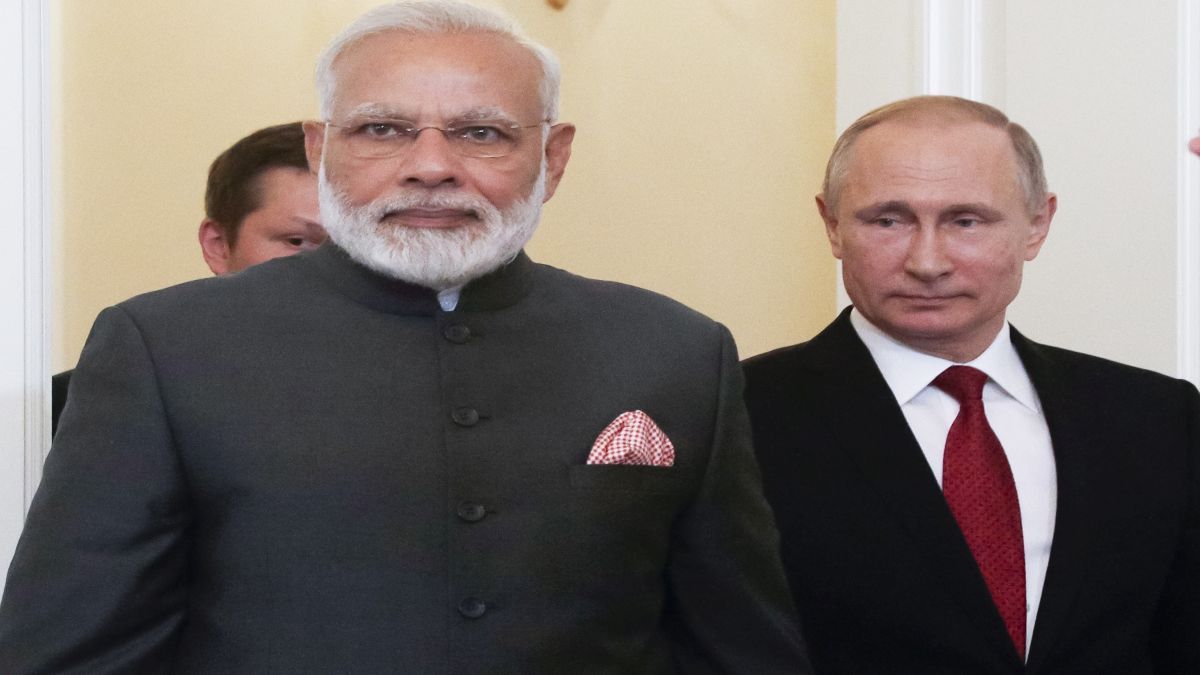
 "Ahead of Vladimir Putin's India visit, scheduled for December 4-5, the Russian lower house of parliament has okayed The Reciprocal Exchange of Logistic Support (Relos) agreement with India. File image/PTI")
The India-Russia defence partnership has already received a boost even before Russian President Vladimir Putin reaches Indian shores for his two-day visit. The European giant’s lower house of parliament, Duma, has ratified an important military pact with India on Tuesday (December 3), a day before Putin’s scheduled trip to New Delhi.
The ratification of the Reciprocal Exchange of Logistic Support (Relos) comes after the agreement was sent to the Duma last week by Prime Minister Mikhail Mishustin.
Speaking on the same, Vyacheslav Volodin, Speaker of State Duma, said: “Our relations with India are strategic and comprehensive, and we value them. We understand that today’s ratification of the agreement is another step toward reciprocity and, of course, the development of our relations.”
But what exactly is this Relos agreement? Why is it important to India? We explain it all.
What is the Relos agreement?
The Relos agreement allows for military aircraft, ships and other formations from both sides to use each other’s facilities for a range of activities, including joint exercises, training programmes, humanitarian operations and disaster-relief missions. The agreement will regulate not only the dispatch of troops and equipment but also their logistics.
What the Relos agreement essentially means is that Russian and Indian ships as well as aircraft will be able to operate in each other’s territories and be able to get fuel, oil, spare parts and maintenance support easily and without delays. Also, the Relos agreement will provide smooth maintenance support, especially during humanitarian missions and disaster relief work.
According to Duma documents, the defence pact also authorises both sides to use each other’s airspace and ports, including warship visits. This means it will give India access to the Arctic region where Russia has a widespread presence and operates a significant number of military facilities.
The ORF in one of its report writes that an agreement like Relos saves “enormous time” and also frees up the need for constant paperwork when one military obtains assistance on matters like refuelling, berthing, use of aviation infrastructure, etc, allowing for a rolling settlement of costs and fees.
The India-Russia Relos agreement isn’t a one of a kind — New Delhi has inked such agreements with multiple countries including the United States , United Kingdom, Japan, Australia, France, Singapore, South Korea, and Vietnam. In fact, it was only after 2016 when India signed the Logistics Exchange Memorandum of Agreement (LEMOA) that New Delhi saw the value in such agreements.
Interestingly, the India-Russia Relos agreement has been many years in the making. It was expected to be signed during Prime Minister Narendra Modi’s visit to Russia for the Eastern Economic Forum in Vladivostok in 2019. However, owing to delays, it was finally last June that New Delhi and Moscow approved the draft agreement.
How does India and Russia benefit from Relos?
Logistics agreements such as Relosare highly beneficial to India and Russia — as some note, it’s a win-win agreement for both.
How?
For India, the Relos agreement isn’t just a means to streamline military logistics support, making joint operations and long-distance missions more efficient and cost-effective, but also a strategic move.
A report by the Manohar Parrikar Institute for Defence Studies and Analyses (IDSA) explains the Relos agreement with Russia would grant “access to Russian naval port facilities in the Arctic ”, thus enhancing “Indian Navy’s reach and operational experience in Polar waters”.
It would grant India access to Russian naval ports along the Northern Sea Route, from Vladivostok to Murmansk. This improves the Indian Navy’s operational reach in polar waters — a region where it lacks presence. Moreover, the Relos agreement supports India’s scientific ambitions in the Arctic.
The Relos agreement is particularly beneficial to the Indian armed forces. With much of its hardware such as the Sukhoi fighter jets, T-90 tanks and S-400 air defence systems being imported from Russia, integration with Russian logistics networks allows for continuity.
As Girish Linganna, an award-winning science communicator and a defence, aerospace and geopolitical analyst, wrote in a DNA report, “If done right, Relos could give India the logistical backbone to truly become a global naval power.”
Russia also stands to benefit from the Relos agreement. It allows Moscow to maintain a global reach at a time when Western sanctions, as a result of the war in Ukraine, have isolated them. Just as India will have access to the Arctic region, so will Russia in the Indian Ocean. This means that the Vladimir Putin-led country can project its muscular strength in Asia and counter Chinese influence without having to establish permanent bases, which are an expensive and time-consuming affair.
Why are agreements like Relos important to India?
The Relos agreement with Russia comes after India debated the pros and cons of signing such pacts with other countries. In fact, it was only in 2016 that India finally agreed to such an agreement.
Many defence analysts note that India saw the benefit of such pacts as a result of China’s muscular posturing in the Indo-Pacific waters.
As Commdore Anil Jai Singh, a maritime analyst, has explained in a report by The Diplomat, the benefits of such agreements. “The Indian Navy has adopted a multi-mission deployment with 12-15 IN warships operating independently across the Indo-Pacific to monitor the critical chokepoints bordering the Indian Ocean, ensure the safe passage of trade, enhance maritime domain awareness, provide humanitarian assistance and disaster relief, combat non- traditional and sub-conventional security threats and a host of other functions. It is not possible for each ship to be accompanied by a logistic support ship – the availability of logistic and maintenance support in friendly ports is therefore essential for the success of such deployments.”
With inputs from agencies