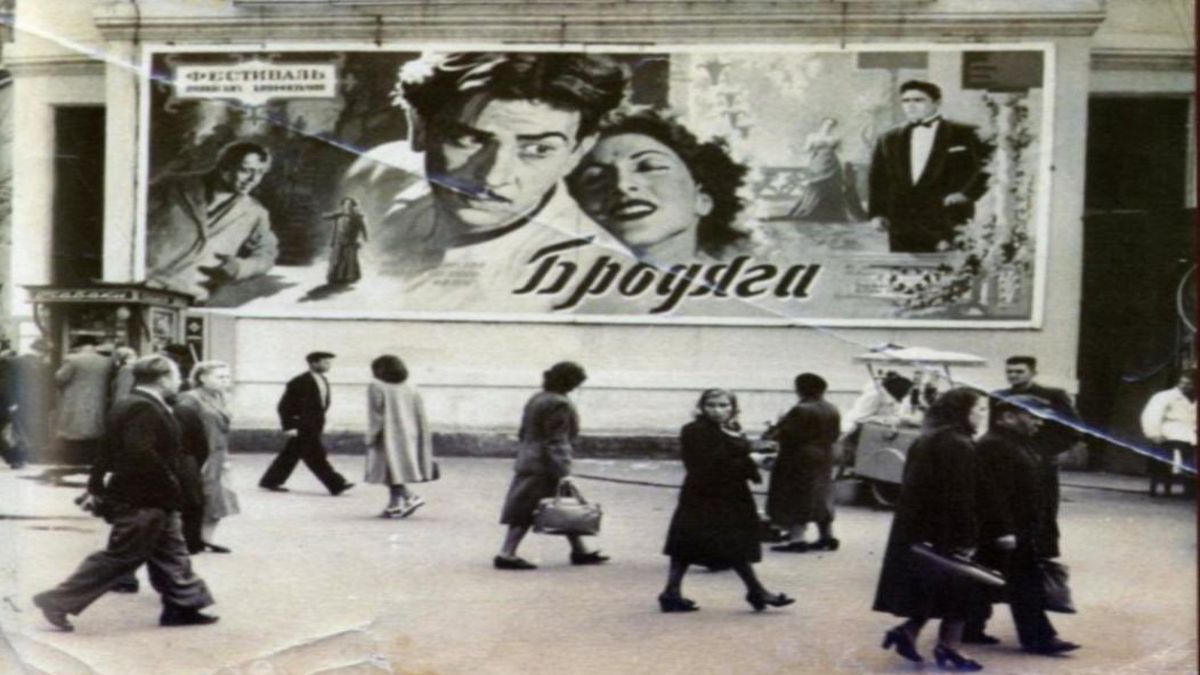
 "A poster of Raj Kapoor's Awaara in Moscow. The Indian film became a huge hit in Russia and established Raj Kapoor as a Russian superstar. Image Courtesy: @RasberryRazz/X")
When you think of India and Russia ties, one would naturally think of the defence ties between the two countries. After all, Moscow has long been an arms supplier to New Delhi — providing crucial weaponry that has been significant in India’s numerous wars and military operations, including Operation Sindoor.
However, not much is spoken of India and Russia’s cultural ties, despite the fact that India-Russia cultural relations were developed even before India gained its independence in 1947.
Now, ahead of President Vladimir Putin’s two day India visit, scheduled for December 4 and 5, we take a closer look at the two nations’ cultural ties that spans across Bollywood to scholarship programmes and dates back as far as the 1400s when a Russian merchant by the name of Afanasy Nikitin travelled across India and recorded his impressions in what is today known as A Journey Beyond the Three Seas.
Russia’s love affair with Bollywood
Indian movies, namely Bollywood (the Hindi filmmaking industry), has been a part of Russian culture for over 70 years. It has survived wars, political changes, and the rise of Hollywood. In fact, even Russian President Vladimir Putin has acknowledged this unique bond. “If we look at Brics member states, I think in this country, Indian films are the most popular. We have a special TV channel with Indian movies being shown on it round the clock. We have a lot of interest in Indian films.”
The love for Indian movies in Russia goes back to the 1950s. The erstwhile Soviet Union, still recovering from World War II, had a deep hunger for stories of survival, struggle, and hope. They found all of this in an Indian film called Awaara, which made its way to Russia in 1954.
The film’s protagonist, Raj Kapoor, reminded Soviet audiences of Charlie Chaplin. Moreover, the title track, Awara hoon, became an anthem with people singing it everywhere they went. Soon after when Raj Kapoor reached Moscow, the world woke up to just how much Russia loved Indian movies — thousands of Russians mobbed him at the airport. It was then known that Raj Kapoor wasn’t just an Indian star.
Kapoor’s later movies such as Shree 420 and Mera Naam Joker only deepened Russia’s love for him as well as the Indian film industry.
In the coming years, other Hindi movies received much praise in Russia. There’s the ever-loved Seeta aur Geeta, starring Hema Malini and also, in 1984, Mithun Chakraborty’s Disco Dancer instantaneously became a massive hit — it became the most successful film at the Soviet box office that year in 1984, the fourth biggest box office hit of the decade, and one of the top 25 biggest box office hits of all time.
Such was the love that this movie received that even Mikhail Gorbachev, the Soviet leader, told Rajiv Gandhi, “My daughter doesn’t care about Amitabh Bachchan. She only knows Mithun Chakraborty.” Years later, when Bappi Lahiri passed away in 2022, Russia honoured him as a legend — the man who gave them rhythm and the hit song ‘Jimmy, jimmy’.
In the 1990s, just as India fell in love with Shah Rukh Khan, so did Russia. Films like Dilwale Dulhania Le Jayenge, Kuch Kuch Hota Hai, and Kabhi Khushi Kabhie Gham made their way into Russian homes and hearts. Families gathered around their televisions to watch these films, and Russian girls fell in love with SRK’s signature open-armed pose.
And when Shah Rukh Khan visited Moscow in 2017, thousands of fans stood in the cold just to see him. They had waited for hours, hoping for a glimpse of their hero.
After a brief lull where Indian movies failed to capture the imagination of Russian audiences, it seems Indian movies are making a comeback in the European nation. Films such as Pathan, Pushpa, Bahubali and RRR found a large audience in Russia, rekindling the love affair.
Indian studies in Russia
Another reason why India-Russia cultural ties are so strong is the student exchange. There is a strong tradition of Indian studies in Russia. The Jawaharlal Nehru Cultural Centre, Moscow, established in 1989, has been mandated with the task of maintaining India’s cultural relations with Russia. Over the years, it has been working in close coordination with the number of Russian universities in organising a number of cultural events disseminating Indian culture in Russia.
There’s also the Mahatma Gandhi Chair on Indian Philosophy at the Institute of Philosophy, Moscow. About 20 Russian Institutions, including leading universities and schools, regularly teach Hindi to 1,500 Russian students. Apart from Hindi, languages such as Tamil, Marathi, Gujarati, Bengali, Urdu, Sanskrit and Pali are also taught in Russian Institutions.
Furthermore, there is general interest among Russian people in Indian dance, music, yoga and ayurveda. JNCC conducts classes in yoga, dance, music and Hindi for approximately 500 students every month.
Apart from this, both countries are known to house a sizeable number of foreign students. Each year, a large number of Indian students travel to Russia for medical education. In fact, Russia has been one of the top choices among Indian students aiming to pursue MBBS and other medical programmes because of the low fees, globally recognised universities, advanced infrastructure and English medium courses.
According to India’s Ministry of External Affairs, the number of Indian students in Russia has increased over the years —it was 19,784 in 2022, which rose to 23,503 in 2023, and further to 31,444 in 2024.
On the other hand, India offers a wide range of scholarships to Russian students. The Indian Council for Cultural Relations (ICCR) offers four types of scholarships to Russians: the Atal Bihari Vajpayee General Scholarship Scheme (A1201), the Lata Mangeshkar Dance & Music Scholarship Scheme (A1209), the Dr S Radhakrishnan Cultural Exchange Scholarship Scheme (A1206), and the AYUSH Scholarship Scheme. These fully funded programmes ensure a comfortable and rewarding academic experience, covering tuition fees, monthly living stipends, hostel accommodation, annual contingency grants, and medical benefits, with some also including international airfare.
Russian writers and Indian influence
India and Russian cultural ties have also been strengthened as a result of the impact that Russian literatures has had on Indian authors. For instance, the works of renowned Russian authors such as Fyodor Dostoevsky , Leo Tolstoy , and Anton Chekhov have been studied and revered at Indian universities and academic institutes for decades. These literary giants have inspired generations of Indian scholars to explore themes of existentialism, morality, and human nature in their own research and writings.
Apart from this, Russian literature has also seen a significant impact on Indian expression — be it art, or filmmaking. Russian literary masterpieces have been adapted into Indian languages and performed on stage and screen, bringing the timeless stories and characters to a new audience.
One such example would be Leo Tolstoy’s epic novel, War and Peace. In 1966, acclaimed Indian filmmaker Satyajit Ray embarked on an ambitious project to adapt Tolstoy’s magnum opus into a Bengali-language film titled Shatranj Ke Khiladi (The Chess Players ). Ray’s adaptation, set against the backdrop of British colonial India, received critical acclaim for its faithful interpretation of the novel’s themes of war, politics, and human folly.
There’s also Russian poetry that has been well received in India. The works of poets such Alexander Pushkin, Anna Akhmatova, and Boris Pasternak continue to garner praise in India.
Travel and tourism
Tourism between the two countries have also helped strength cultural ties. As recently as November, External Affairs Minister S Jaishankar inaugurated two new Indian consulates in Russia — one in Yekaterinburg and the other in Kazan.
The two countries are also nearing the rollout of a new travel arrangement that would let holidaymakers visit each other’s countries in officially arranged groups without needing individual visas.
The proposal is loosely based on Russia’s visa-waiver arrangement with China and aims to eliminate one of the main obstacles faced by Indian travellers: the Rs 4,500 single-entry visa fee. Under the emerging framework, Indian tourists who sign up with authorised group operators would be able to enter Russia without applying for individual visas — a change Moscow believes could trigger a significant surge in demand.
And despite India and Russia identifying new areas of cooperation, it is these cultural exchanges and people-to-people ties that have kept the Russian India friendship alive and kicking after all these years.
With inputs from agencies