 "From radiation to rocket malfunction: How Nasa will keep Artemis II mission astronauts safe in space")
Four astronauts blasted off from Florida’s coast on Wednesday (April 1) on Nasa’s historic Artemis II mission, which will take them on the voyage to circle the Moon. This is the first crewed Moon mission in 50 years and will take the astronauts some 406,000 km into space, the farthest humans have ever travelled.
Despite extensive preparation, human spaceflight is always risky. The Artemis II mission faced several challenges before Nasa’s Space Launch System (SLS) rocket thundered away, with four crew members, including three US astronauts and a Canadian astronaut, on board the Orion capsule, from the Kennedy Space Center in Cape Canaveral, Florida.
We take a closer look.
Artemis II faces issues before launch
The Artemis II mission was delayed by two months due to hydrogen leaks and unrelated helium obstructions.
During ground tests, the 32-storey SLS rocket leaked flammable hydrogen fuel, as per an Associated Press (AP) report. However, there was no such problem during the launch on Wednesday.
The launch team loaded over 700,000 gallons of fuel (2.6 million litres) into the rocket on the pad, paving the way for the Artemis II crew to board.
Nasa also faced some last-minute technical snags, such as bad battery sensors and commands not reaching through to the rocket’s flight termination system (FTS). But both of these issues were resolved quickly.
The FTS is a “safety system that allows engineers on the ground to send a signal to destruct the rocket if it were to veer off course during ascent, to protect public safety," according to Nasa.
Quick Reads
View AllThen there was also a problem with the launch abort system, a 44-foot-tall structure affixed to the top of the Orion crew capsule, before the scheduled takeoff. This system is important as it allows Nasa engineers to eject the astronauts and destroy the rocket in case of a malfunction. This problem was also taken care of before the launch.
Around 5:15 pm local time (2:45 am IST on April 2), the US space agency said in an update, “Engineers have now resolved an issue with the hardware that communicates with the flight termination system that would have prevented the ground from sending a signal to destruct the rocket if it were to veer off course during ascent, to protect public safety. A confidence test was performed to ensure that the hardware is ready to support today’s launch.”
How Nasa will keep astronauts safe
During their 10-day expedition, the four astronauts — Nasa’s Reid Wiseman, Victor Glover and Christina Koch, and Canadian Space Agency’s Jeremy Hansen — will face many threats, including radiation and space weather.
But from launch to splashdown, Nasa is ensuring that the crew members of the Artemis II mission remain safe.
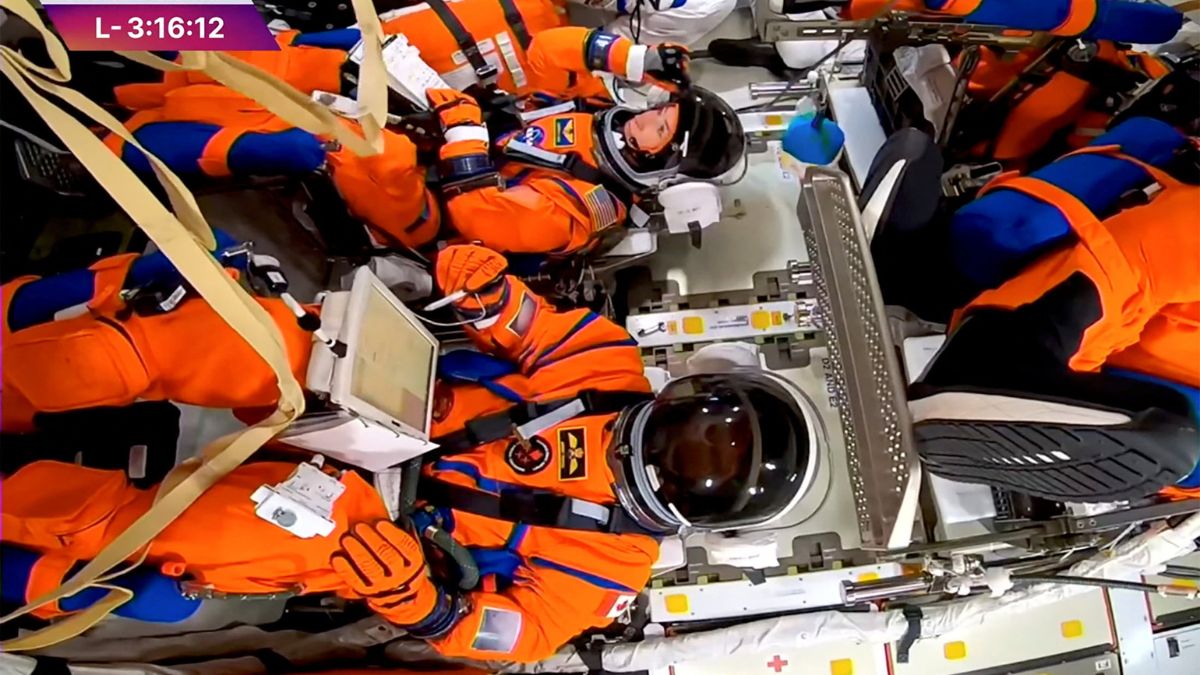
The four astronauts are donning customised bright orange spacesuits called Orion Crew Survival System (OCCS) suits. The spacesuit is accompanied by large, helmeted visors.
Nasa astronauts wear bright orange suits as it makes them easy to spot in the ocean during splashdown.
The Artemis II suits boast cooling capabilities, offer protection against depressurisation and are fire-resistant, ABC News reported, citing Nasa.
In the event of an emergency, the suit can keep the astronauts alive for nearly six days by removing carbon dioxide and providing breathable air.
The Launch Abort System will jump into action if the rocket acts up. In such a scenario, three powerful motors are designed to pull the crew capsule away, taking astronauts to safety.
We are all exposed to low levels of radiation on Earth every day. However, space travel exposes astronauts to varied and higher levels of radiation.
Moderate levels of exposure to space radiation can enhance an astronaut’s long-term risk of cancer. As the Artemis II crew is travelling beyond low-Earth orbit, they will leave Earth’s protective magnetic field. This will expose them to higher levels of space radiation.
To protect the astronauts, the Orion spacecraft is reportedly fitted with six radiation sensors, which are part of Nasa’s Hybrid Electronic Radiation Assessor system. It records radiation dose rates in different parts of the cabin.
Astronauts also have their own radiation trackers to alert them if radiation levels are too high.
The design of the Artemis II mission has a “built-in safety net” if the main engines fail, which includes a free-return trajectory. It is a flight path that depends on gravity to catapult the Orion spacecraft around the Moon and back towards Earth with minimal propulsion, reported ABC News.
Space weather prediction is still erroneous compared to weather forecasting on Earth. There is a higher risk involved during periods of greater solar activity.
But Nasa is prepared to protect the crew from unfavourable space weather. If there are powerful solar outbursts that could overload Orion’s shielding, the crew can build a “shelter” within 30 minutes of an alert, as per a Scientific American report.
This would involve moving bulky items out of stowage to line the capsule’s least-protected walls. Even if solar activity remains contained during the flight, the Artemis II crew will carry out a shelter-building dry run on day 8 of the mission.
“We do everything we can to bring risk as close to zero as we possibly can,” Nasa Administrator Jared Isaacman told ABC News. “But at some point, when you’re exploring the worlds beyond ours, there are some risks worth taking.”
With inputs from agencies


 "Iran Israel War News Live: Iran warns against ‘vicious cycle’ of war and ceasefires, vows to continue fight")
 "‘If Pakistan attempts any misadventure, India’s response will be unprecedented and decisive’: Rajnath")
 "Why is Iran targeting Gulf data centres? What does this mean for modern warfare?")
 "Floccinaucinihilipilification: The 29-letter tongue twister Delhi court used to dismiss Sitharaman defamation case")
 "Iran Israel War News Live: Iran warns against ‘vicious cycle’ of war and ceasefires, vows to continue fight")
 "‘If Pakistan attempts any misadventure, India’s response will be unprecedented and decisive’: Rajnath")
 "Why is Iran targeting Gulf data centres? What does this mean for modern warfare?")
 "Floccinaucinihilipilification: The 29-letter tongue twister Delhi court used to dismiss Sitharaman defamation case")