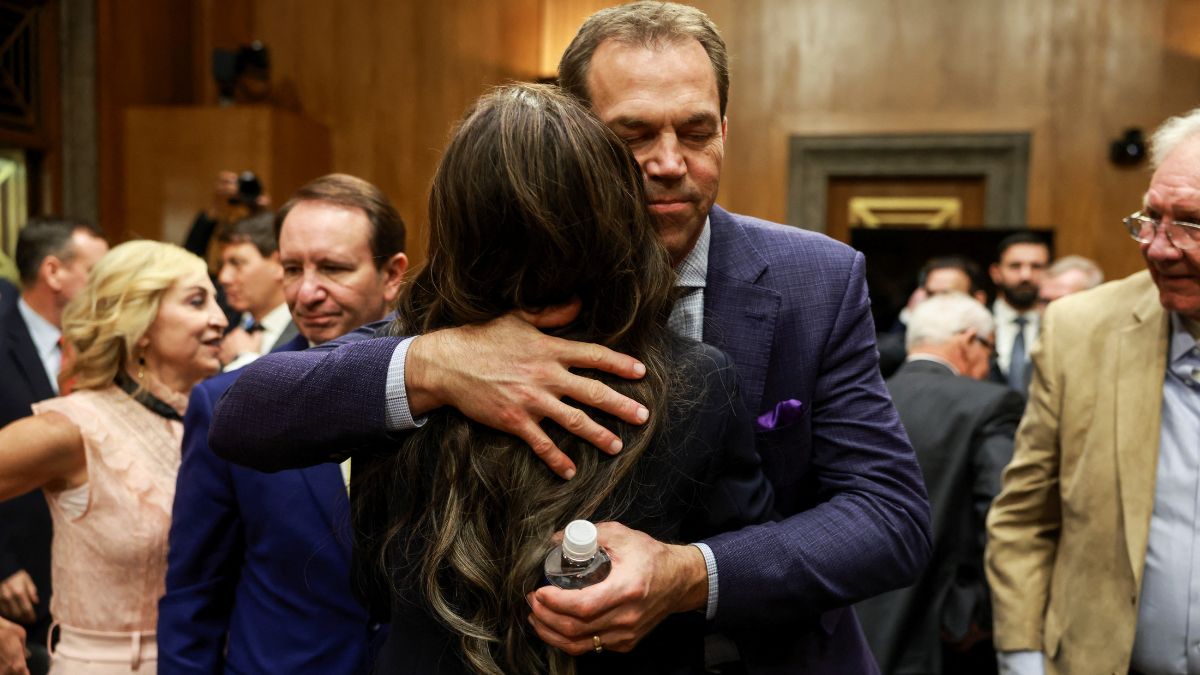
 "Kristi Noem, then US President-elect Donald Trump's secretary of Homeland Security nominee, hugs her husband Bryon Noem, on the day she testifies during a Senate Homeland Security and Governmental Affairs Committee confirmation hearing on Capitol Hill in Washington, US, January 17, 2025. File Image/Reuters")
A wave of revelations surrounding Bryon Noem, the husband of former United States Homeland Security Secretary Kristi Noem, has placed the family under the lens.
According to statements issued on behalf of Kristi Noem, the disclosures came as a shock. A spokesperson told the New York Post, “Ms. Noem is devastated. The family was blindsided by this, and they ask for privacy and prayers at the time.”
Kristi Noem was recently removed from her Cabinet position under Donald Trump following a series of controversies, including scrutiny over her official conduct and questions raised during congressional hearings.
The emergence of ‘Jason Jackson’ and a hidden online identity
At the core of the controversy is the claim that Bryon Noem operated under the alias “Jason Jackson” while engaging with online communities linked to fetish roleplay, first reported by the Daily Mail.
Reports suggest that this alternate identity was used to communicate with multiple women involved in the “bimbofication” scene, a niche subculture centred on exaggerated hyper-feminine aesthetics.
The alleged connection between Bryon Noem and the alias reportedly came to light through a series of interactions with one of the models.
According to claims cited in reports, a mistaken phone call led to a voicemail greeting associated with “Noem Insurance,” a business linked to Bryon Noem. This prompted further online searches, which ultimately connected the alias to the Noem family.
The investigation describes a pattern of communication involving messages, images, and repeated engagement over time. In these exchanges, Bryon Noem is said to have adopted a persona aligned with the themes of the community, expressing admiration for specific physical traits and participating in roleplay scenarios.
One message attributed to him reads, “you turn me into a girl,” reflecting the performative and identity-based nature of the interactions described in the reports. Additional exchanges reportedly included questions about clothing choices and appearance, reinforcing the roleplay dynamic.
While Bryon Noem is said to have acknowledged participating in online chats, reports indicate that he denied making certain statements attributed to him, particularly those relating to his wife’s political career.
At the same time, he is reported to have disclosed during some conversations that he had a family.
Financial transactions and digital trail
Another key aspect of the controversy involves financial transactions linked to these online interactions.
Reports claim that Bryon Noem transferred funds to women he communicated with, using platforms such as PayPal and Cash App. The total amount is said to have reached approximately $25,000, with individual payments ranging between $500 and $1,000.
These payments, combined with the alleged volume of messages and shared images, have been presented as evidence of sustained engagement with the online community. The records reportedly include hundreds, and in some accounts thousands, of messages exchanged over time.
In addition to text-based communication, the reports describe a collection of photographs allegedly shared by Bryon Noem.
These images are said to depict him wearing clothing and accessories designed to create an exaggerated feminine appearance. Some photos reportedly include the use of improvised props, such as balloons placed under clothing to simulate enhanced body features.
Descriptions of these images suggest that they were intended to align with the aesthetic conventions of the “bimbofication” subculture, which often emphasises exaggerated proportions and stylised femininity.
In some instances, Bryon Noem is described as posing with different facial expressions, ranging from neutral to playful or flirtatious.
Understanding ‘bimbofication’ and online roleplay culture
The term “bimbofication,” central to the controversy, refers to a specific type of roleplay or fetish that involves adopting an exaggerated form of femininity. This can include stylised clothing, enhanced physical features, and behavioural traits associated with a hyper-sexualised persona.
Author and podcaster Tina Horn provides insight into the concept in her book Why Are People Into That?. She explains, “Sometimes, you don’t want to be a fully integrated self during sex … Bimbofication offers a clear delineation between the moaning, cumming, uninhibited sex object you dream of being and the mild-mannered alter ego you have to be the rest of the time.”
Expanding on this idea, she adds, “You might not want to literally look and act like a dumb blond in bed, but the dumb blond can be a marvelous symbol of something many of us do want to be: someone whose simple existence is dedicated only to being admired and enjoying herself”.
Within online communities, such practices are often framed as forms of identity exploration or performance.
National security concerns raised by experts
Experts cited in reports have warned that private behaviour, if exposed or documented, could create vulnerabilities for individuals in positions of influence.
Former intelligence officials suggested that sensitive personal information could be used by hostile actors as leverage, particularly in cases involving high-profile political figures or their immediate family members. The risk, they noted, lies not necessarily in the behaviour itself, but in the potential for coercion if such information is not publicly known.
These concerns are particularly relevant given Kristi Noem’s former role overseeing homeland security, a position that involves access to sensitive information and decision-making responsibilities related to national defence and intelligence.
Hearings, controversies, and dismissal
The emergence of these allegations comes against the backdrop of ongoing political challenges faced by Kristi Noem. Her tenure as Homeland Security Secretary ended amid criticism and controversy, including questions raised during congressional hearings.
During one such appearance, she was pressed on issues ranging from departmental spending to her public profile. Reports indicate that Bryon Noem was present at the hearing, seated behind her as she addressed lawmakers.
At the time, Kristi Noem referenced her husband’s presence as part of an effort to highlight the strength of their relationship. The moment has since been revisited in light of the latest revelations.
Additional scrutiny has centred on her alleged association with Corey Lewandowski, a long-time political figure linked to Donald Trump. Both Noem and Lewandowski have denied rumours of a personal relationship, but the issue resurfaced during congressional questioning and subsequent media coverage.
Lewandowski’s presence alongside Noem at public events has also drawn attention, particularly in the context of the broader narrative surrounding her political and personal life.
Public reaction and political responses
The official account of the Democratic Party weighed in on the controversy with a remark that it was “cute they both liked to dress up,” referencing Kristi Noem’s public image and style. The comment reflects the extent to which the issue has entered the realm of political messaging and partisan commentary.
Meanwhile, Donald Trump offered a brief response when asked about the situation, stating, “Wow, well, I feel badly for the family. If that’s the case, that’s too bad.”
Social media platforms have also seen extensive debate, with users discussing topics ranging from privacy and consent to the responsibilities of public figures.
Family life and shifting public image
Kristi and Bryon Noem’s relationship spans several decades, with the couple having married in 1992 after meeting during their youth. They have three children — Kassidy, Kennedy, and Booker — and have often presented themselves as a close and supportive family.
In previous public statements, Kristi Noem emphasised openness about their personal lives. In a 2022 interview, she said, “We are such a transparent family,” adding that they are “an open book.” This portrayal of transparency has been a recurring theme in her public narrative.
The latest developments, however, have complicated that image.
Last week, Kristi Noem wrapped up a tour of Western Hemisphere nations in her new job as the US envoy to a coalition against drug cartels.
With inputs from agencies