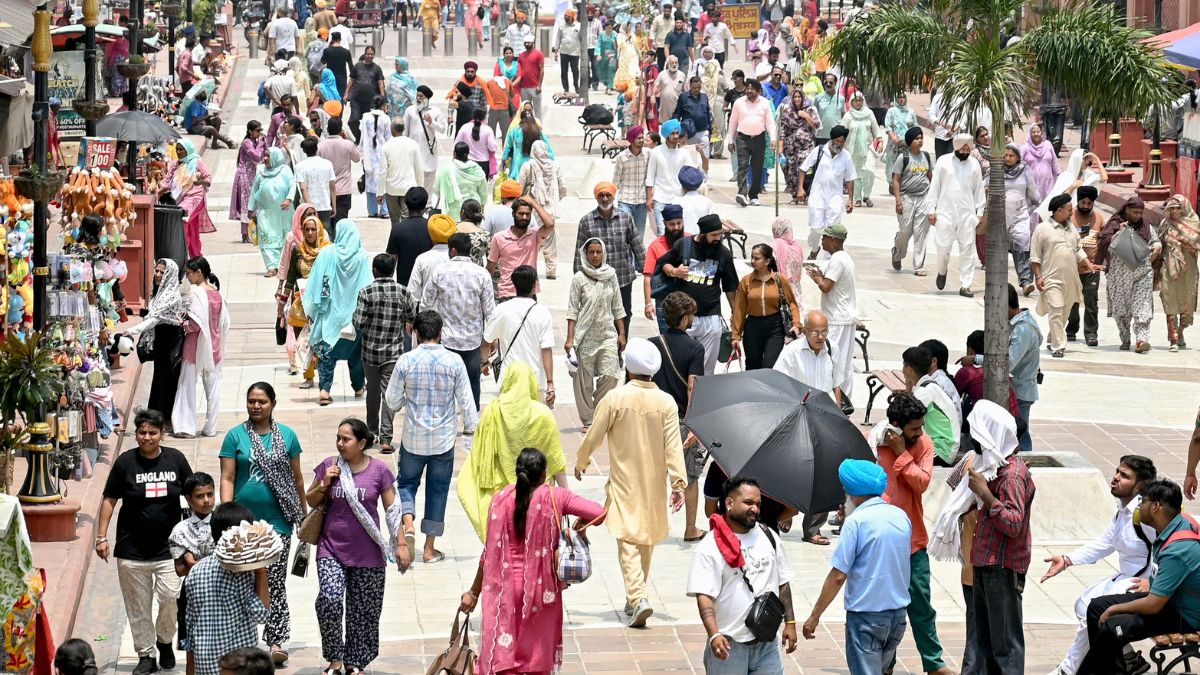
 "People visit the Heritage Street in Amritsar on July 11, 2025. File Photo/AFP")
India has launched the world’s largest census, which will see crores of people answering 33 questions, ranging from information about their living conditions to their marital status. This is the first fully digital census being carried out in the country, with the option of self-enumeration being offered for the first time.
This is India’s first population count in more than 15 years . The last Census was conducted in 2011. The next population enumeration was slated for 2021, but it was postponed due to the Covid-19 pandemic.
Here’s a comprehensive guide to Census 2027.
What is a census?
A census is a survey of the population of an area that collects details of a country’s demographics, including age, sex and occupation. It gives the government, policymakers and academics a better insight into the population, its makeup, and their socio-economic status.
India’s census gathers data on several factors such as religion, language, and region of the population.
The population count was started by the British in 1872, with the census listing all castes between 1881 and 1931.
The first census in independent India was conducted in 1951. But since then, castes have not been enumerated in the population count, with the exception of Scheduled Castes (SCs) and Scheduled Tribes (STs).
As per the last held census in 2011, India had a total population of 121 crore and the sex ratio was 940 females per 1,000 males.
India is now conducting its 16th census, the eighth since independence, which will include caste data.
The exercise assumes importance as the latest data will help shape policy and deliver the necessary socio-economic interventions more accurately.
Quick Reads
View AllHow will Census 2027 be executed?
India’s first fully digital census will be carried out in two phases. The first phase, known as the House Listing and Housing Census, has been rolled out from today (April 1) across eight states and Union Territories. These places include Andaman and Nicobar Islands, New Delhi Municipal Council and Delhi Cantonment Board, Goa, Karnataka, Sikkim, Mizoram, Lakshadweep and Odisha.
A house listing and housing survey will be held in these states and UTs between April 16 and May 15.
The first phase will gather information on housing conditions, amenities and household assets.
People in these areas can begin with the self-enumeration process by visiting the official portal on the census that displays tooltips and Frequently Asked Questions (FAQs) to guide users through the process.
After submitting their details online, users will get a unique Self-Enumeration ID, which they can share with census officials during verification visits. The first 15 days of the 45-day houselisting operations (HLO) period are dedicated to self-enumeration.
Over the next month, more than 30 lakh enumerators will make door-to-door surveys. They will use mobile applications available on Android and iOS platforms to gather data, ensuring a faster process. The app features 16 languages and works even without internet connectivity, making its accessible across rural and remote regions.
In a first, all buildings will be geo-tagged using Digital Layout Mapping (DLM) to enhance accuracy and planning.
The second phase is population enumeration, which will collect detailed data on demographics, education, migration and fertility. It will also include caste information , which will be recorded electronically for the first time in India’s decennial census. This phase will kick-start in February next year.
“Earlier, census data was first collected on paper and then digitised, making compilation a time-consuming process. Collection of data digitally will ensure Census 2027 datasets are out much faster,” Registrar General and Census Commissioner of India, Mritunjay Kumar Narayan, was quoted as saying by Times of India (TOI).
The reference date for the Census is midnight of March 1, 2027, except for snow-bound regions like Ladakh. These areas have a reference date of October 2026.
What are the 33 census questions?
In the first phase of Census 2027, citizens will have to answer 33 questions. The questionnaire will focus on building materials used in houses, types of cereals consumed and ownership of gadgets like computers and smartphones.
Citizens will have to provide details about building identification, housing materials (floor, wall, roof), sex of the head of household, number of residents, types of vehicles owned, water and sanitation facilities, cooking fuel, the number of married couples, and access to digital assets like internet and smartphones, as well as transportation modes like vehicles.
As per the FAQs on the census portal, live-in couples would be counted as married couples “if they consider their relationship as a stable union”.
The questions for the second phase, including caste enumeration, will be notified later, as per the Registrar General of India (RGI).
Which states/UTs will hold the census when?
The first phase of the Census 2027, which began today, will conclude by September across all 36 states and UTs, except West Bengal. “We expect Bengal to also notify its HLO schedule soon,” said Narayan.
State/UT: Andaman and Nicobar Islands, parts of Delhi (New Delhi Municipal Council and Delhi Cantonment Board), Goa, Karnataka, Lakshadweep, Mizoram, Odisha, and Sikkim.
Self-enumeration period: April 1 to April 15
Houselisting and Housing Census Period: April 16 to May 15
State/UT: Gujarat (subject to change), Dadra and Nagar Haveli and Daman and Diu
Self-enumeration period: April 5 to April 19
Houselisting and Housing Census Period: April 20-May 19
State: Uttarakhand
**Self-enumeration period:**10 April to 24 April
Houselisting and Housing Census Period: 25 April to 24 May
State/UT: Madhya Pradesh, Andhra Pradesh, Arunachal Pradesh, Chandigarh, Chhattisgarh, and Haryana
Self-enumeration period: 16 April to 30 April
Houselisting and Housing Census Period: May 1 to May 30
State: Bihar
Self-Enumeration Period: April 17 to May 1
Houselisting and Housing Census Period: May 2 to May 31
State: Telangana
Self-Enumeration Period: April 26 to May 10
Houselisting and Housing Census Period: May 11 to June 9
State: Punjab
Self-Enumeration Period: April 30 to May 14
Houselisting and Housing Census Period: May 15 to June 13
State/UT: Delhi (Municipal Corporation of Delhi), Maharashtra, Meghalaya, Rajasthan and Jharkhand (notification yet to be issued for HLO operations)
Self-Enumeration Period: May 1 to May 15
Houselisting and Housing Census Period: May 16 to June 14
State: Uttar Pradesh
Self-Enumeration Period: May 7 to May 21
Houselisting and Housing Census Period: May 22 to June 20
UTs: Jammu and Kashmir, Ladakh, and Puducherry
Self-Enumeration Period: May 17 to May 31
Houselisting and Housing Census Period: June 1 to June 30
State: Himachal Pradesh
Self-Enumeration Period: June 1 to June 15
Houselisting and Housing Census Period: June 16 to July 15
States: Kerala and Nagaland
Self-Enumeration Period: June 16 to June 30
Houselisting and Housing Census Period: July 1 to July 30
States: Tamil Nadu and Tripura
Self-Enumeration Period: July 17 to July 31
Houselisting and Housing Census Period: August 1 to August 30
State: Assam
Self-Enumeration Period: August 2 to August 16
Houselisting and Housing Census Period: August 17 to September 15
State: Manipur
Self-Enumeration Period: August 17 to August 31
Houselisting and Housing Census Period: September 1 to September 30
How safe is your data?
The government has ensured the safety of the citizens’ private data. It has stressed that people’s personal data is encrypted and protected under the Census Act, 1948.
The information shared by the individuals during the population count process cannot be shared with other departments or used in court. Just “aggregated" data, such as the total number of people in a village, is made public.
Narayan has also assured that individual data will be kept strictly confidential. “It cannot be shared with any government agency, accessed under RTI or produced before the courts. Only aggregated statistical data will be used for tabulation purposes,” he said.
With inputs from agencies
Senior Sub-Editor at Firstpost. She writes explainers on myriad subjects without the limitation of beats.