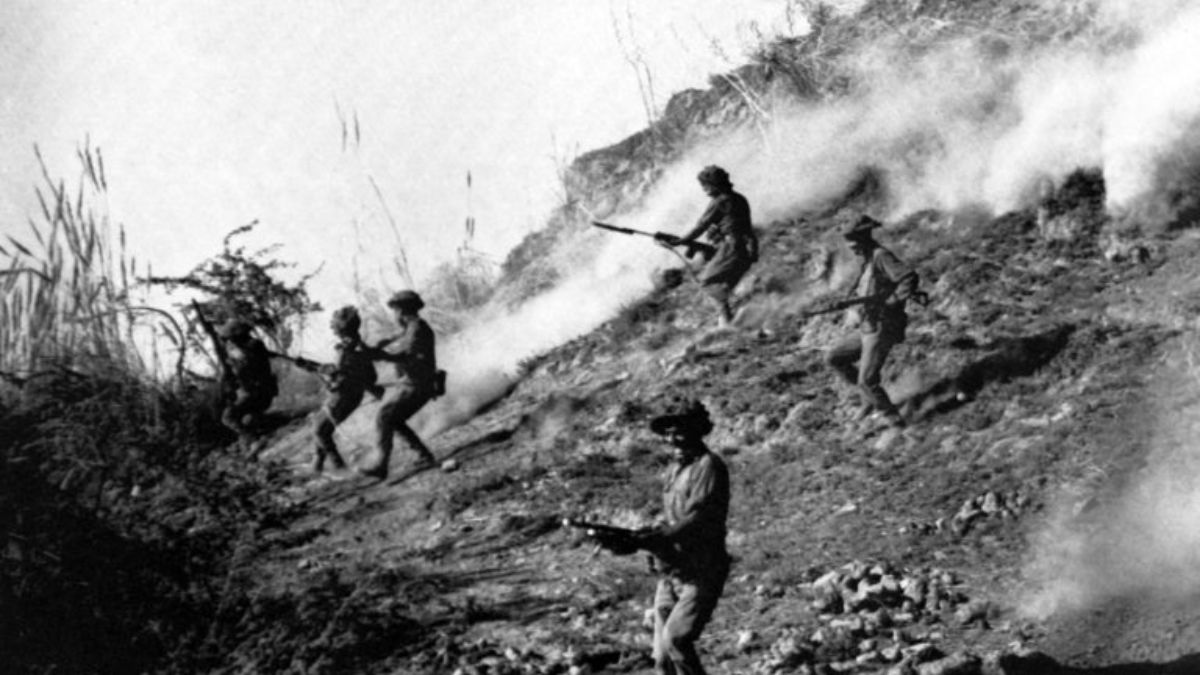
 "Indian army soldiers attacking Naya Chor in Sind in support of bengali rebels of the liberation army during the Indo-Pakistani War of 1971. File image/AFP")
Bangladesh became a part of Pakistan after Independence, but according to many Bangladeshis, their Pakistani counterparts never considered them equals. So, nearly 30 years later, East Pakistanis demanded the formation of Bangladesh from their Pakistani masters. But matters escalated on an international level on December 3, 1971, when the war officially began between then East Pakistan (present-day Bangladesh) and Pakistan.
If you are a history geek who loves to learn about important events from the past, Firstpost Explainers’ ongoing series, History Today will be your one-stop destination to explore key events.
On this day in 1992, the world’s first Short Message Service (SMS) text was sent. This marked a new era in digital communication and how people interacted across the world.
Here is all that took place across the world on this day.
India joined the 1971 Bangladesh Liberation
Although East Pakistanis had been fighting for their liberation from mainland Pakistan for a long time, December 3, 1971, is an important day as India officially became involved in the liberation efforts. It was on this day that a regional struggle for independence turned into an international conflict, which further accelerated the path to victory.
Tensions had been rising for months as millions of Bangladeshi refugees fled to India to escape the atrocities carried out by the Pakistani military during Operation Searchlight. By late 1971, India had begun offering direct military assistance to the Mukti Bahini, who were fighting bravely but facing a much larger and better-equipped army. The conflict reached a critical point when the Pakistani Air Force launched pre-emptive strikes on Indian airfields in the western sector on December 3, hoping to cripple India’s ability to intervene. Instead, the attack had the opposite effect.
India immediately declared that Pakistan’s action was an open act of war, and then-Prime Minister Indira Gandhi ordered full-scale military engagement on both the eastern and western fronts. This officially marked the beginning of the Indo-Pakistan War of 1971. In East Pakistan, Indian forces joined with the Mukti Bahini in a coordinated campaign that rapidly pushed the Pakistani army back. The combined operations, including land, air, and naval strikes, sealed Pakistan’s supply routes and weakened its defensive positions.
For Bangladeshis, December 3 symbolises the moment when global dynamics shifted in favour of their struggle. International recognition of the crisis grew, and the joint forces’ momentum made the liberation of Dhaka inevitable. Just thirteen days later, on December 16, 1971, Bangladesh finally emerged as an independent nation following Pakistan’s surrender.
The first SMS was sent
Most of us do not even use the SMS service anymore, but it was a groundbreaking technological development in the 90s. The world’s first Short Message Service (SMS) text message was sent on December 3, 1992.
The first SMS was sent by Neil Papworth, a 22-year-old software engineer working for Sema Group. The company was contracted by Vodafone to develop messaging technology for its GSM network. At the time, mobile phones did not yet have keyboards capable of composing messages, so Papworth typed the message on a computer. The recipient was Vodafone executive Richard Jarvis, who received the message on his Orbitel 901 mobile phone.
The content of that historic SMS was simple but iconic: “Merry Christmas.” Although it lasted only two words, this message represented a breakthrough that would eventually reshape communication habits worldwide. At the time, very few people could have predicted that texting would become one of the most widely used forms of communication.
In 1992, mobile technology was still in its infancy, and voice calls dominated the industry. The idea of sending short written messages over cellular networks was experimental, and network capacity was limited. Yet the success of that first SMS demonstrated the potential for fast and lightweight communication that did not require real-time voice interaction.
Over the following years, SMS grew steadily as mobile phones evolved to support text input and messaging services. By the late 1990s and early 2000s, texting had become a cultural phenomenon, especially among young people. It adapted to global usage with character limits, abbreviations, and eventually multimedia features that would inspire later platforms.
This Day, That Year
The first human heart transplant was performed by Christiaan Barnard at Groote Schuur Hospital in Cape Town on this day, 1967.
Illinois was admitted as the 21st state of the United States of America in 1818.