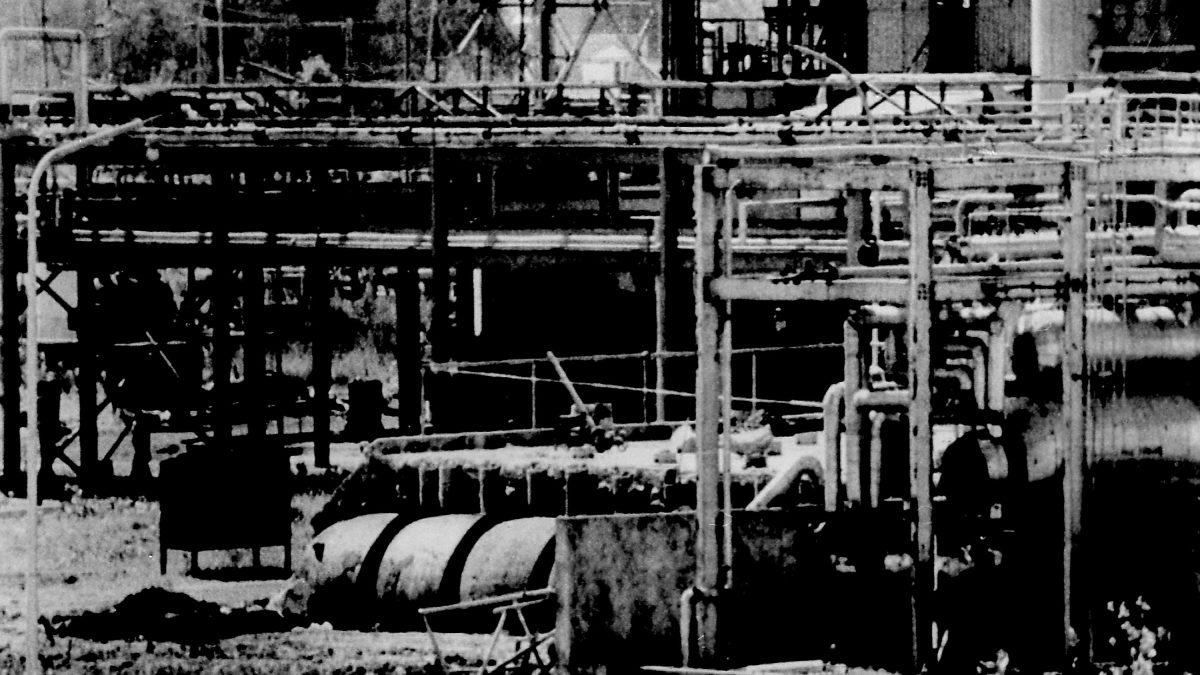
 "The underground three-flanged stainless steel tank (lower left foreground) at Union Carbide's Bhopal factory from which poison gas leaked. File image/Reuters")
One of the worst industrial disasters in India took place on the night of December 2, 1984. It was shortly after midnight that a massive leak of methyl isocyanate (MIC) gas escaped from a storage tank, leading to more than 40 tonnes of toxic gas into the air.
If you are a history geek who loves to learn about important events from the past, Firstpost Explainers’ ongoing series, History Today will be your one-stop destination to explore key events.
On this day in 1993, one of the most notorious drug leaders, Pablo Escobar, was killed in Colombia. Meanwhile, the United Arab Emirates (UAE) was officially formed on this day in 1971.
Here is all that took place on this day across the world.
Bhopal Gas Tragedy occurred in India
A massive leak of methyl isocyanate (MIC) gas escaped from a storage tank at the Union Carbide India Limited (UCIL) pesticide plant on the night of December 2-3. A combination of poor maintenance, faulty safety systems, and cost-cutting measures allowed water to seep into the tank, triggering a violent chemical reaction. Pressure built rapidly, and the tank’s safety valves burst and released more than 40 tonnes of toxic gas into the air.
As the dense cloud drifted over nearby residential areas, residents woke up coughing, choking, and gasping for breath, with many getting blinded temporarily or permanently. Within hours, thousands lay dead on the streets, in hospitals, and in their homes.
Official figures reported around 3,000 immediate deaths, but later estimates suggest that 15,000–20,000 people may have died from the effects of the gas over the following years. More than half a million people were exposed, leading to the development of chronic respiratory illnesses, eye disorders, neurological damage, and reproductive health issues.
Investigations found that critical systems like alarms, scrubbers, and refrigeration units had been shut down or were malfunctioning. Union Carbide Corporation (UCC) faced global outrage, and in 1989, it reached a settlement of $470 million with the Indian government, a sum widely criticised as inadequate given the scale of suffering.
Pablo Escobar was killed
One of the most notorious drug lords in the world, Pablo Escobar, was killed on December 2, 1993. Escobar had dominated the global cocaine trade throughout the 1980s, amassing billions of dollars in wealth and building a violent empire that challenged the Colombian state. His cartel orchestrated assassinations, bombings, kidnappings, and political intimidation, leaving thousands dead.
Escobar went on the run in 1992 after escaping from his self-designed luxury prison, La Catedral. His disappearance triggered an intense pursuit by a coalition of forces: the Colombian National Police’s elite Search Bloc, US intelligence agencies, and a vigilante group known as Los Pepes, made up of his rivals and victims’ families. The pressure around Escobar tightened as authorities dismantled his cartel and captured or killed his top lieutenants. Constant surveillance, intercepted phone calls, and betrayals from former allies slowly boxed him in.
It was on his 44th birthday on December 2, 1993, that Escobar was tracked to a middle-class neighbourhood in Medellín after he made a brief call to his son. Search Bloc forces quickly surrounded the house. However, Escobar attempted to escape across the rooftops but was shot and killed on a rooftop.
Escobar’s death marked the collapse of the Medellín Cartel and a turning point in Colombia’s bloody drug war. It brought temporary relief to the nation, although violence later shifted to the Cali Cartel and other traffickers.
The formation of UAE
History was made on December 2, 1971, when the seven emirates united to create a single and sovereign nation, called the United Arab Emirates.
Before unification, the region was known as the Trucial States, a collection of sheikhdoms that had signed protection treaties with Britain in the 19th century. For decades, Britain managed their foreign affairs, but by the late 1960s, the British government announced its intention to withdraw from “East of Suez,” leaving the emirates to determine their political future.
Recognising the need for stability and collective strength, Sheikh Zayed bin Sultan Al Nahyan of Abu Dhabi and Sheikh Rashid bin Saeed Al Maktoum of Dubai spearheaded efforts to form a federation. Their vision emphasised cooperation, modernisation, and economic development. The emirates of Abu Dhabi, Dubai, Sharjah, Ajman, Umm Al-Quwain, and Fujairah agreed to unite with Ras Al Khaimah joining shortly afterwards in February 1972, thus completing the seven-emirate federation known today.
So, on December 2, 1971, the rulers formally signed the Provisional Constitution in Dubai, establishing the UAE as an independent federal state. Sheikh Zayed was elected the first President, laying the foundation for a nation built on unity, resource development, and international cooperation. The UAE immediately began forging diplomatic ties and developing its infrastructure, banking on its oil wealth to drive rapid modernisation.
This Day, That Year
The music video of Michael Jackson’s ‘Thiller’ aired on MTV in 1983.
The first permanent artificial heart was implanted on this day in 1982.
In 1804, Napoleon crowned himself emperor of France in the presence of Pope Pius VII.