 "Has Iran rebuilt its nuclear programme as US claims?")
United States President Donald Trump has been arguing that Tehran is attempting to revive sensitive nuclear activities eight months after American and Israeli strikes that he previously described as having “obliterated” the programme.
The warnings come as Washington deploys large military assets to West Asia, revives indirect negotiations with Tehran in Geneva, and signals that further military action remains a possibility if diplomacy fails.
Iran, for its part, continues to deny any intent to build nuclear weapons, insisting its nuclear work is civilian in nature and warning of severe retaliation if attacked again.
From “obliterated” to “starting it all over”
Trump’s public position on Iran’s nuclear programme has evolved sharply since US and Israeli forces struck Iranian nuclear facilities in June 2025.
In the immediate aftermath of the operation, the US president repeatedly said the attacks had “obliterated” Iran’s nuclear infrastructure. The administration framed the operation as a decisive blow that severely curtailed Tehran’s ability to pursue any pathway toward a nuclear weapon.
However, now, Trump has adopted a more urgent tone. In his State of the Union address earlier this week, he argued that despite warnings not to attempt reconstruction, Iran was “starting it all over.”
While reiterating that his preference was to address the issue through diplomacy, he also said the United States would never permit Iran to obtain a nuclear weapon.
He added that although Tehran had signalled an interest in reaching an agreement during negotiations, “we haven’t heard those secret words, ‘We will never have a nuclear weapon.’”
These remarks followed weeks of contradictory messaging from Washington over why the United States might again consider military action against Iran.
When Trump first threatened renewed strikes last month, the justification publicly cited by the White House focused on Iran’s violent suppression of nationwide protests.
More recently, the emphasis has shifted back to nuclear concerns. When asked why another strike might be necessary after last year’s operation had been portrayed as a success, White House press secretary Karoline Leavitt said, “Well, there’s many reasons and arguments that one could make for a strike against Iran.”
US intelligence assessments have not always aligned neatly with the president’s rhetoric. In March 2025, the US intelligence community assessed that Iran was “not building a nuclear weapon.”
Despite that assessment, the Trump administration proceeded with airstrikes in June 2025 targeting Iran’s nuclear facilities.
Now, even after Trump’s repeated claims that those strikes were devastating, the administration is again raising the prospect of military action based on assertions that Iran is dangerously close to nuclear weapons-related capabilities.
Critics argue that the evolving explanations have made it difficult to determine Washington’s precise objectives — whether the goal is to force incremental concessions from Tehran on its nuclear programme, to curtail Iran’s broader military and missile capabilities, or to pursue more maximalist aims related to regime change in Tehran.
What last year’s strikes achieved, and what they did not
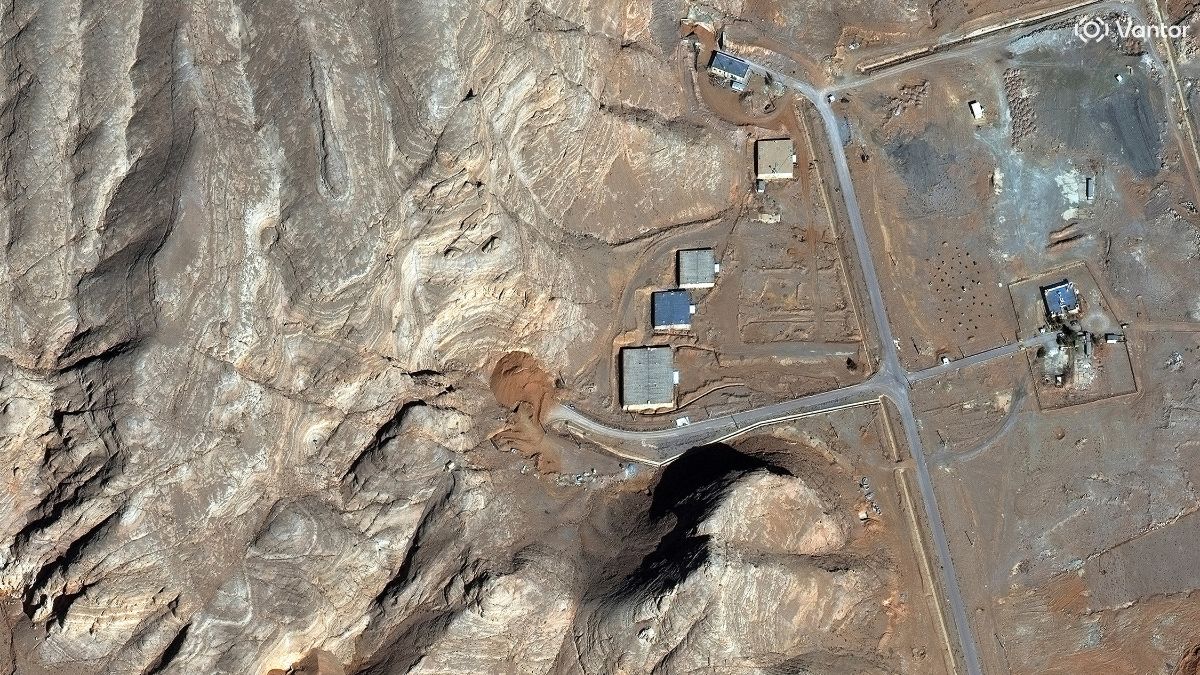
US and Israeli strikes in June 2025 targeted several Iranian nuclear sites. An initial American assessment after the operation concluded that one uranium enrichment facility had been largely destroyed, while two other targeted locations were significantly damaged but not eliminated.
According to that assessment, the strikes set back Iran’s nuclear progress by several months rather than permanently dismantling its capacity to enrich uranium.
The assessment also indicated that Iran had taken steps to reduce potential losses ahead of the strikes.
Much of the country’s stockpile of highly enriched uranium was believed to have been moved from some sites before they were hit, limiting the extent to which the attacks could degrade Tehran’s overall nuclear capability.
Rafael Grossi, the head of the International Atomic Energy Agency, later said that the nuclear programme had been badly damaged by the US and Israeli operation, but that large quantities of enriched material were likely relocated in advance.
The US operation was framed by Trump as a success. In his State of the Union speech, he referred to the strikes as Operation Midnight Hammer and said they had achieved their objectives.
However, the administration’s more recent warnings about Iran rebuilding its programme implicitly acknowledge that the strikes did not eliminate the country’s ability to resume sensitive nuclear work over time.
Iran has repeatedly said that the attacks were acts of aggression and has warned of serious retaliation in response to any future strikes, even if limited.
Tehran has also maintained that the strikes did not change the fundamental nature of its nuclear policy, which it says is aimed at civilian energy production rather than weapons development.
Foreign Minister Abbas Araghchi reiterated this position, saying Iran would “under no circumstances ever develop a nuclear weapon.”
What we know about Iran’s nuclear enrichment levels
Before the June 2025 strikes, Iran had accumulated a stockpile of uranium enriched to levels far exceeding what is required for nuclear power generation.
While civilian nuclear reactors typically use uranium enriched to less than 5 per cent, Iran had enriched uranium to nearly the purity required for weapons use.
In 2024, Grossi warned that Tehran was “dramatically” accelerating enrichment to 60 per cent purity, approaching the roughly 90 per cent level generally associated with weapons-grade material.
Steve Witkoff, the US special envoy involved in the current round of diplomacy, said Iran could be as little as a week away from possessing “industrial-grade bomb-making material,” citing enrichment levels of 60 per cent. Iranian officials dismissed that claim as a “verbal mistake.”
Experts caution that enrichment levels alone do not equate to a nuclear weapon. Darya Dolzikova of the Royal United Services Institute said that possessing highly enriched uranium is only one element in a much longer and more complex process.
“Just enriching to 90 per cent isn’t enough. You need to actually build the nuclear warhead. You need to put it on the delivery system,” she told US media outlet NBC News.
Dolzikova also noted that even if Iran were close to producing highly enriched material, military strikes and other counterproliferation actions do not always permanently halt nuclear progress, pointing to the limited long-term impact of last year’s attacks.
How Iran is fielding nuclear-capable missiles
Trump has said Iran had already fielded missiles capable of threatening Europe and US military installations overseas, and that Tehran was working to develop missiles that could eventually reach the United States.
The US Defense Intelligence Agency has reported that Iran is developing space launch vehicles that could provide the technical foundation for intercontinental ballistic missiles.
According to the agency’s assessment, Iran could potentially field up to 60 ICBMs capable of striking across the US homeland by 2035, if Tehran chose to pursue such a capability. The DIA stressed that this outcome would depend on a political decision by Iran to move in that direction.
Analysts differ over how imminent this threat is. Kelsey Davenport of the Arms Control Association said there was “little indication, if any” that Iran had begun testing or developing missiles designed to reach the United States.
“If Iran does intend to do that, I think it’s years away,” she told NBC News.
US Secretary of State Marco Rubio has argued that Iran’s refusal to discuss its ballistic missile programme in negotiations is a “major problem” that would eventually need to be addressed, saying the missiles are “designed solely to strike America” and pose a threat to regional stability.
Rubio has also suggested that progress on nuclear issues will be difficult if Iran remains unwilling to engage on missiles.
How US-Iran nuclear talks are faring
Indirect talks between the United States and Iran are resuming in Geneva on Thursday. The negotiations are being mediated by Oman’s foreign minister Badr Albusaidi, who has been shuttling proposals between the two sides.
The US delegation is expected to include Witkoff and Trump’s son-in-law Jared Kushner, while Araghchi will represent Iran.
Araghchi has said Iran is seeking a rapid and equitable agreement, but has made clear that Tehran will not relinquish what it views as its right to peaceful nuclear technology. “A deal is within reach, but only if diplomacy is given priority,” he said.
Reuters has reported that Iran is offering new concessions in exchange for the lifting of sanctions and formal recognition of its right to enrich uranium. However, officials on both sides have acknowledged that significant disagreements remain, including over how quickly and extensively US sanctions would be eased.
Trump has set a tight deadline, warning that Iran must agree to a deal within 10 to 15 days or face severe consequences.
This compressed timeline has raised concerns among diplomats that negotiations may be overshadowed by the looming threat of military action, potentially complicating efforts to reach a durable agreement.
Grossi is also expected to be in Geneva during the talks, as he was during previous rounds, to hold discussions with both delegations.
Also Watch:
With inputs from agencies


 "PM Modi Israel Visit Live Updates: PM Modi pays respect at Holocaust memorial, to meet President Herzog shortly")
 "Explained: The significance of Yad Vashem, Holocaust memorial, Modi is visiting in Israel")
 "Trump vowed to end Ukraine war in 24 hours, but he still can’t — Putin’s maximalist goals to blame?")
 "India vs Zimbabwe: Why Chepauk could boost Samson; Axar in contention for must-win clash")
 "PM Modi Israel Visit Live Updates: PM Modi pays respect at Holocaust memorial, to meet President Herzog shortly")
 "Explained: The significance of Yad Vashem, Holocaust memorial, Modi is visiting in Israel")
 "Trump vowed to end Ukraine war in 24 hours, but he still can’t — Putin’s maximalist goals to blame?")
 "India vs Zimbabwe: Why Chepauk could boost Samson; Axar in contention for must-win clash")