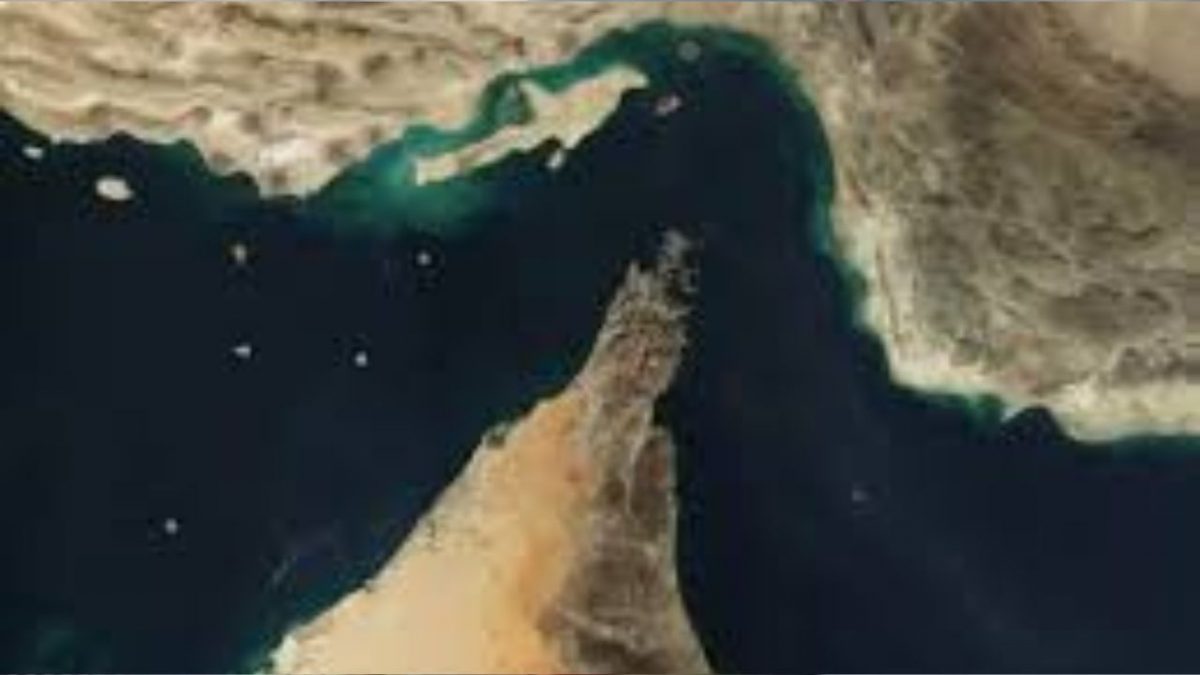
 "Why Hormuz, not Fordow, is the real centre of gravity in the Iran crisis")
The current policy debate on Iran in Washington is framed as a choice between a comprehensive nuclear agreement and a calibrated military strike. This framing is incomplete. The present confrontation is better understood as the interaction of three structural forces. First are the limits of coercive diplomacy. Second is the regime-survival calculus in Tehran. Third is the systemic vulnerability of global energy flows. Once these are examined together, it becomes evident that the real spotlight is not Iran’s nuclear infrastructure but the Strait of Hormuz.
From the perspective of coercive diplomacy, the United States has already satisfied the condition of escalation credibility. Financial sanctions have sharply constrained Iran’s access to foreign exchange, contributed to elevated inflation, and exacerbated domestic economic instability. Concurrently, Washington has deployed the largest concentration of air and naval assets in the Middle East since 2003. However, coercion requires not only credible punishment but also credible assurance that compliance reduces existential risk. That second condition is increasingly absent. If Tehran perceives that compliance on enrichment or missiles merely delays regime degradation rather than ensuring survival, then resistance becomes the rational equilibrium.
This misalignment has direct implications for escalation dynamics. The prevailing assumption in much Western analysis is that retaliation can be kept proportional and contained through limited strikes. That assumption holds only when both parties accept a bounded conflict. Once the confrontation is framed in Tehran as a threat to regime survival, escalation behaviour shifts. Iran’s deterrence architecture is explicitly designed for horizontal expansion rather than vertical dominance: ballistic and cruise missiles, drone saturation strategies aimed at exhausting interceptor inventories, proxy networks across multiple theatres, cyber capabilities, and maritime disruption tools. Under such conditions, even a narrowly defined military action risks triggering wider cost-imposition strategies.
The Strait of Hormuz is the critical transmission channel for such escalation. Approximately one quarter of global seaborne oil trade and nearly one fifth of global liquefied natural gas exports transit this chokepoint. The physical characteristics of the strait—narrow shipping lanes, shallow waters, and proximity to Iranian territory—make it inherently vulnerable to disruption. Iran does not need to impose a formal blockade to generate systemic effects. Persistent harassment, limited missile or drone strikes, mining activity, or sustained GPS interference would be sufficient to raise insurance premia, slow transit, and inject a substantial risk premium into energy markets. In this context, the economic impact arises less from physical scarcity than from heightened uncertainty.
Quick Reads
View AllThe implications of such disruption are sequential and material. First, energy prices would adjust sharply. Even short-lived interference could push crude prices well above current levels, reintroducing inflationary pressures at a moment when global monetary policy remains restrictive. This would complicate disinflation trajectories in advanced economies and intensify balance-of-payments stress in energy-importing emerging markets. Second, financial spillovers would follow.
Higher energy costs would weaken growth expectations, elevate risk aversion, and increase volatility in currency and debt markets, particularly for economies with large external financing needs. Third, geopolitical externalities would accumulate. Europe’s dependence on LNG flows through Hormuz, especially from Qatar, would resurface as a strategic vulnerability, while higher hydrocarbon prices would generate windfall gains for other exporters, including Russia, with attendant geopolitical consequences.
For the United States, these dynamics impose strategic trade-offs. Sustained military operations in the Gulf would draw on finite stocks of precision munitions and air-defence interceptors, constrain naval deployment flexibility, and compete with resource requirements in the Indo-Pacific. The risk is erosion of strategic bandwidth across regions. The assumption that Middle Eastern contingencies can be managed without affecting broader force posture is increasingly untenable.
The implications for India are particularly acute. First, India’s energy security is directly exposed. With a substantial share of crude imports transiting the Gulf, a sustained price shock would widen the current account deficit, exert downward pressure on the rupee, and complicate inflation management. Second, India’s external stability would face secondary stresses through remittance flows and the welfare of a large Indian workforce in Gulf economies, should regional instability affect economic activity or physical security.
Third, India’s strategic connectivity initiatives, including investments linked to Chabahar and the International North-South Transport Corridor, depend on predictable maritime conditions. Prolonged uncertainty in Hormuz would delay or undermine these projects.
Thus, the central policy variable is not the technical status of Iran’s enrichment programme but the stability of a critical global chokepoint. Nuclear facilities can be degraded and rebuilt over time. Confidence in the security of global energy arteries, once disrupted, is far harder to restore. The strategic question facing Washington is therefore not whether limited force can be applied, but whether its application at this juncture increases or diminishes overall leverage.
In the current configuration, the balance of risk suggests that escalation into the energy system would impose costs far beyond the immediate adversaries. Hormuz, not Fordow, is the determinant of whether this crisis remains contained or becomes globally consequential.
(Aditya Sinha [X: @adityasinha004] writes on macroeconomics and geopolitics. Views expressed in the above piece are personal and solely those of the author. They do not necessarily reflect Firstpost’s views.)

 "‘Want to come back home, but can’t’: Why Indian medical students are reluctant to leave Iran")
 "Four years later, how close is Russia to achieving its goals in Ukraine?")
 "What is Trump’s Dalilah Law that targets Indian-origin truck drivers?")
 "After Kerala gets nod for Keralam, will Bengal be renamed Bangla?")
 "‘Want to come back home, but can’t’: Why Indian medical students are reluctant to leave Iran")
 "Four years later, how close is Russia to achieving its goals in Ukraine?")
 "What is Trump’s Dalilah Law that targets Indian-origin truck drivers?")
 "After Kerala gets nod for Keralam, will Bengal be renamed Bangla?")