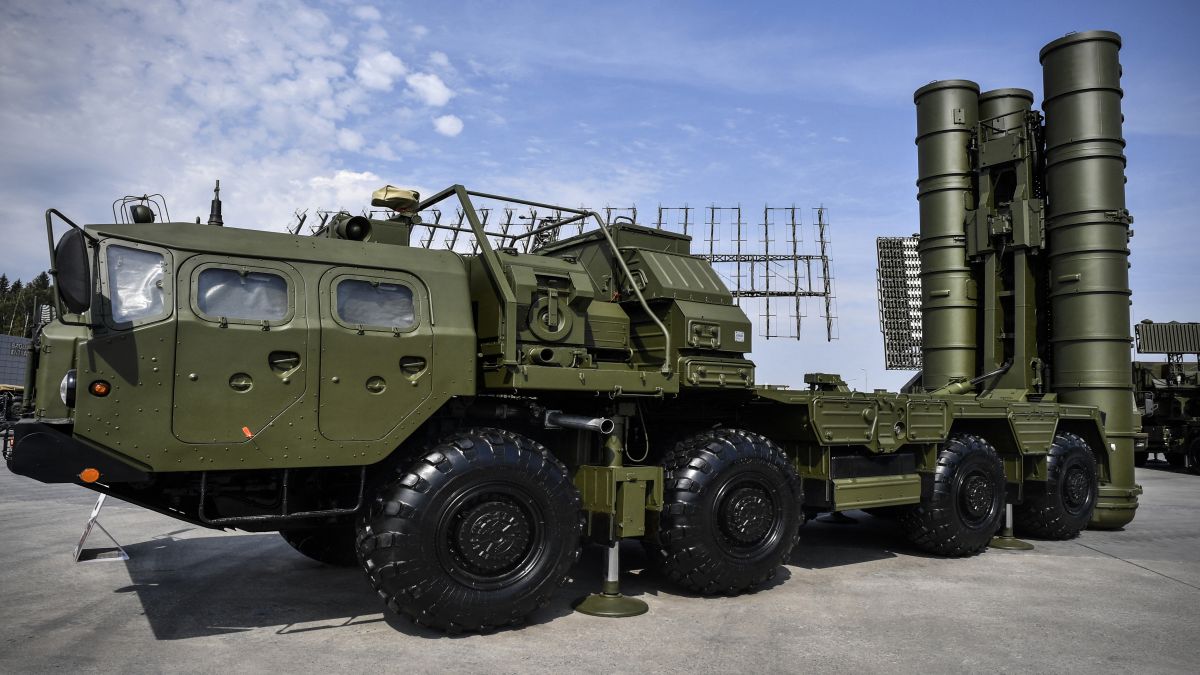
 "Russian S-400 anti-aircraft missile launching system displayed at the exposition field in Kubinka Patriot Park outside Moscow. This defence system proved its mettle during Operation Sindoor against Pakistan. File image/AFP")
Time is counting down for Russian President Vladimir Putin’s visit to India — the Russian strongman is scheduled to visit the Indian Capital on December 4 and 5. This will be the Russian leader’s first visit to the country since the onset of the Russia-Ukraine war, and one of the main agendas of the visit will be to strengthen defence ties that date back to pre-Independence.
It is reported that a new S-400 weapons system (dubbed the S-500) contract will be at the forefront of discussions when Prime Minister Narendra Modi sits down with Russia’s Vladimir Putin in the Indian capital. Sources close to the Indian establishment note that New Delhi is expected to press for a fresh procurement of more advanced S-400 air-defence regiments.
But what exactly is this weapon and why does India covet it?
The S-400 weapons system, explained
The S-400 is a long-range surface-to-air missile system developed by Russia’s Almaz Central Design Bureau. Also known as the SA-21 Growler by Nato troops, it is considered among the most advanced air defence systems across the globe with capabilities of detecting, tracking, and engaging a variety of aerial threats including drones, stealth aircraft, cruise missiles, and ballistic missiles.
This weapon was made operational in 2007, and defence experts note it to be even more dangerous than the US-developed Terminal High Altitude Area Defence system (THAAD) . The S-400 boasts of various features, making it a deadly weapon to have in one’s arsenal:
- It can engage aerial threats at ranges up to 400 kilometres and altitudes up to 30 kilometres.
- The system can track up to 160 targets and engage 72 simultaneously.
- The S-400 can be deployed within five minutes unlike US-made systems that take longer to deploy.
The S-400 is made up of four components — a long-range surveillance radar, a command and control post mounted on a vehicle, an engagement radar and a launch vehicle carrying missiles. When it comes to the missiles, the S-400 has four types — the short-range missile with a 40-km range, the medium-range missile having a 120-km range, the long-range missile having a 250-km range and the very long-range missile with a range of 400 km.
The S-400 is believed to be highly lethal — in exercises and trials, the weapons system has an 80 per cent kill rate against enemy aircraft.
Countries that possess the lethal S-400
Besides Russia, the S-400 has been sold to many countries with China being the first foreign buyer back in 2014.
In 2017, Turkey also purchase the S-400 weapons system, resulting in a row with its Nato partners. Algeria has also reportedly acquired and deployed the S-400, though details remain sparse. Belarus also received units from Russia, with some managed directly by Russian personnel.
India’s purchase of Russia’s S-400
It was in 2018 that India bought five squadrons of the S-400 – each comprising 16 vehicles – from Russia at a cost of $5 billion (Rs 35,000 crore). Deliveries for the same began in 2021.
However, India’s purchase of the weapons system was far from smooth sailing, all thanks to the United States.
In 2017, Donald Trump in his first term signed into law the Countering America’s Adversaries Through Sanctions Act (CAATSA) . The legislation, a punitive measure against Russia for its annexation of Crimea in 2014 and alleged meddling in the 2016 US presidential elections, allowed for sanctions to be levied on Iran, Russia, and North Korea and countries doing business with them.
When it came to Russia, it specifically imposed sanctions on those buying major hardware from Moscow. As a result, India’s deal for the S-400, thus, potentially fell foul of the Act.
But New Delhi refused to bow down to US demands with officials noting that the S-400 would be key to India protecting and controlling its airspace. It was after much negotiations that in January 2022, the US House of Representatives passed an amendment, granting India a waiver from the CAATSA sanctions.
India’s successful use of the S-400 during Operation Sindoor
India first used the S-400 successfully in Operation Sindoor , India’s military action against terror camps in Pakistan and Pakistan-occupied Kashmir in May.
Known as the Sudarshan Chakra in India, the S-400 was deployed when Pakistan retaliated during Operation Sindoor. According to defence analysts, the S-400 successfully neutralised incoming drones and aircraft, effectively thwarting Pakistan’s attempts to escalate the conflict. According to ANI, it created a record of sorts by successfully hitting an aircraft at a range of over 300 kilometres.
Later, in August, Indian Air Force Chief Marshal Amar Preet Singh confirmed that India shot down five Pakistani fighter jets using it. He called it a game-changer, saying: “Our air defence systems have done a wonderful job. The S-400 system, which we had recently bought, has been a game-changer. The range of that system has really kept their aircraft away from their weapons like, those long-range glide bombs that they have, they have not been able to use any one of those because they have not been able to penetrate the system.”
India eyes more advanced version of S-400
Now, with Putin expected in India, New Delhi is looking not only to expand its S-400 regiments, but also looking to purchase the more advanced version of it known as the S-500 Prometheus.
The S-500 is considered the next generation variant of the S-400; it boasts of a range of up to 600 km and can engage threats at altitudes up to 200 km, giving it a coverage envelope much broader than most existing air-defence platforms.
Moreover, the S-500 is believed to counter not just aircraft, drones and cruise missiles, but also long-range ballistic missiles as well as hypersonic glide vehicles. Experts also note that Russia’s S-500 deploys the 77N6-N1 missiles, which has the ability to shoot down China’s J-20 fighter aircraft.
But as a result of its advancements, the S-500 is way more expensive than the S-400 as well as more difficult and expensive to maintain.
We will just have to wait and watch as to how talks unfold between Modi and Putin to see if India secures a deal for the S-500. But one thing is certain: India already has a substantial capability as a result of the S-400.
With inputs from agencies