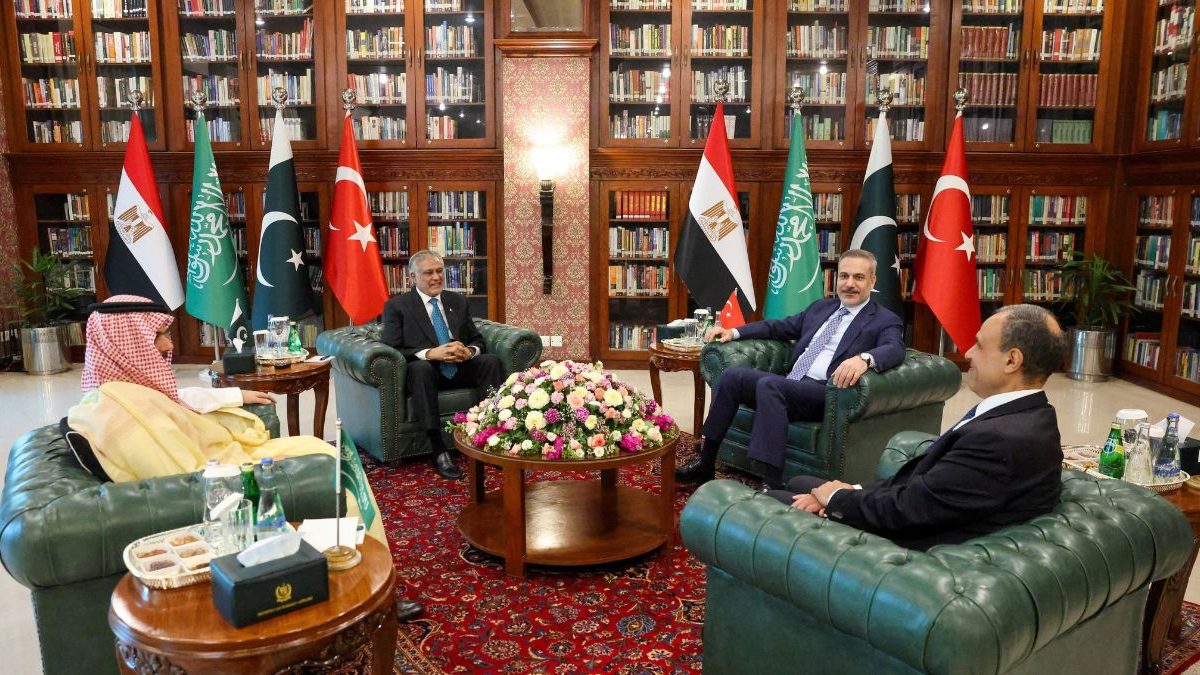
 "Foreign Ministers Badr Abdelatty of Egypt, Prince Faisal bin Farhan Al Saud of Saudi Arabia, Ishaq Dar of Pakistan and Hakan Fidan of Turkey meet to discuss regional de-escalation, amid the U.S.-Israel conflict with Iran, in Islamabad, Pakistan, March 29, 2026. Image Credit: Reuters")
A high-level meeting of regional powers in Islamabad has been described as “very productive,” with leaders pushing for diplomacy as the only viable path to end the ongoing Iran conflict.
Foreign ministers from Egypt, Saudi Arabia, Turkey and Pakistan convened on Sunday, signalling a coordinated regional effort to de-escalate tensions.
Pakistan’s Foreign Minister Ishaq Dar said the talks focused on “possible ways to bring an early and permanent end to the war in the region.”
Dar added that Pakistan is ready to host direct negotiations between the United States and Iran in the coming days, noting that both sides have expressed support for potential talks, though no formal confirmation has been announced.
Push for diplomacy and unity
The four countries represented by Foreign Ministers Badr Abdelatty of Egypt, Prince Faisal bin Farhan Al Saud of Saudi Arabia, Ishaq Dar of Pakistan and Hakan Fidan of Turkey on Sunday agreed that the ongoing war benefits no one and risks widespread destruction across the region.
In a joint understanding, they emphasised that dialogue and diplomacy remain the only sustainable route to peace.
The ministers also highlighted the importance of unity among Muslim-majority nations during the crisis and expressed concern over the war’s growing humanitarian and economic toll.
Strait of Hormuz in focus
A key area of discussion was the reopening of the Strait of Hormuz, a vital global energy corridor that has been effectively blocked, contributing to rising oil and gas prices worldwide.
According to reports, several proposals were discussed, including introducing a Suez Canal-style fee mechanism and forming a consortium involving Turkey, Egypt and Saudi Arabia to manage oil transit through the strait. Pakistan was reportedly invited to join such an arrangement but has declined.
Some of these proposals had already been shared with the United States ahead of the meeting.
Rising tensions despite diplomatic push
The diplomatic efforts come amid escalating tensions on the ground. Iran has accused the United States of preparing for a possible ground invasion, dismissing talk of negotiations as a cover.
Iran’s parliament speaker Mohammad Bagher Qalibaf warned that Iranian forces were prepared to respond forcefully if American troops entered the conflict zone.