 "Could damage to US E-3 AWACS affect the offensive against Iran?")
When the United States and Israel launched the war on Iran on February 28, Tehran responded swiftly and with force. The Islamic Republic rained down missiles and drones at Israel and US assets in Gulf countries, expanding the conflict in one of the most important energy-producing regions in the world.
In the past month, Iran has incurred heavy damage on US assets and bases across West Asia, namely in the Gulf countries, with one BBC analysis pegging the damage to be worth $800 million in just the first two weeks of fighting.
And on Friday, Iran launched a barrage of missiles and drones at the Prince Sultan Air Base in Saudi Arabia, during which an American E-3 Sentry AWACS was damaged. The Iranian attack left more than 10 service members injured, including two seriously, and also damaged aerial refuelling tankers stationed at the base.
- Catch live updates from the Israel-US-Iran war here
Images, published by Iran’s Press TV, show the body of the plane damaged, with only the head and tail intact. The attack reportedly involved six ballistic missiles and 29 drones.
But why is this significant? Why does this matter as the war enters its second month?
What do we know of the incident?
Last Friday, Iran took aim at the Prince Sultan Air Base in Saudi Arabia, raining down missiles and drones at it. The airbase, which is 96 kilometres away from the Saudi capital of Riyadh, has come under Iranian fire earlier too, injuring 14 US troops.
Following the strike, satellite images published by Iran’s English-language news channel Press TV showed the destruction of several aircraft at the airbase after the Iranian strikes.
Newly released images capture the damage caused to an American E-3 AWACS plane in Iranian retaliatory strikes on Prince Sultan Air Base in Saudi Arabia.
— Press TV 🔻 (@PressTV) March 29, 2026
Follow Press TV on Telegram: https://t.co/LWoNSpkc2J pic.twitter.com/ftFLmC5wuB
At least 10 US personnel were wounded, with two reported in serious condition, Associated Press reported. Multiple refuelling aircraft were also damaged in the attack, preliminary reports indicate.
The US Central Command (CENTCOM) has not commented on the incident so far.
Meanwhile, on Sunday, Iran’s IRGC-linked Fars news agency said a Shahed drone had struck the E-3 aircraft.
What are AWACS?
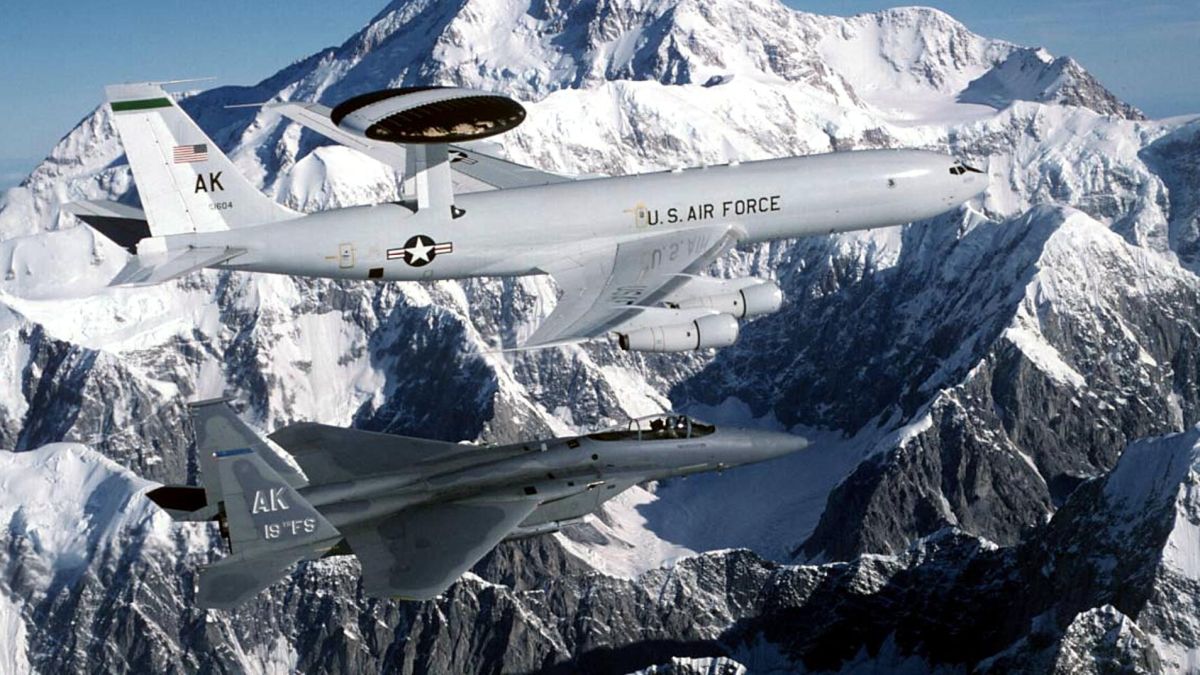
Multiple images show significant damage to the US’ E-3 Sentry airborne warning and control system (AWACS) aircraft. According to Air & Space Forces Magazine, six E-3s were stationed at the Prince Sultan Air Base before the incident.
The Boeing AWACS — it’s an acronym for Airborne Warning and Control System — is a modified Boeing 707/320 commercial plane, having a distinctive rotating radar disc mounted on the rear of its fuselage. This radar has a range of more than 375 kilometres, which enables it to provide “situational awareness of friendly, neutral and hostile activity, command and control of an area of responsibility”, according to the US Air Force.
This radar enables it to detect and track potential targets at long ranges, providing an early warning of possible threats during combat operations. The aircraft gives “information for commanders of air operations to gain and maintain control of the air battle”, according to the USAF website.
Developed in 1977, the AWACS have a storied history, playing a crucial role in many major conflicts. The US air force has flown AWACS in Operation Desert Storm, the Kosovo war, the wars in Iraq and Afghanistan, and the counter-Islamic State campaign known as Operation Inherent Resolve.
What makes the E-3 AWACS even more important to the US Air Force is its ability to carry out missions that last for more than eight hours without needing any refueling.
It is for these reasons that the E-3 AWACS is considered among the most precious assets in America’s conventional arsenal.
Why does Iran’s strike on the AWACS matter?
In the fighting that has now continued for a month, Iran has targeted several US military assets in the Gulf countries. And Friday’s strike on the E-3 AWACS is significant for multiple reasons.
The E-3 AWACS has dwindled down to just 16 and is expected to stay operational until 2035. So, for the US to lose one of its increasingly rare AWACS is a loss for the US. According to The Telegraph, a direct replacement for the high-tech aircraft would cost $500 million in today’s money. However, there is no existing production line. Boeing’s E-7 Wedgetail, the nearest equivalent, has a $700 million price tag.
New image reportedly showing the USAF E-3 Sentry destroyed in an Iranian attack at Prince Sultan Airbase on Friday.
— OSINTtechnical (@Osinttechnical) March 29, 2026
Matches 81-0005, an E-3C seen deployed to the base in recent weeks. pic.twitter.com/zRVzzkEPeU
However, the monetary loss is just one aspect. Losing an E-3 in the war could hamper the US campaign against Iran. “It’s a significant loss for the war in the short term,” said Kelly Grieco, a defence policy expert and senior fellow at the Stimson Center think tank, to Air & Space Forces Magazine.
“That has a consequence. There are going to be coverage gaps.”
She was also quoted as telling The Telegraph: “Iran didn’t just hit a plane. It hit a battle management layer, and at the moment when that layer is needed most.”
Heather Penney, a former F-16 pilot and director of studies and research at AFA’s Mitchell Institute for Aerospace Studies, also told Air & Space Forces Magazine that the loss of an E-3 is problematic. “Given how crucial these battle managers are to everything from airspace deconfliction, aircraft deconfliction, targeting, and providing other lethal effects that the entire force needs for the battle space.”
“The value of the E-3 and the battle managers is they see the big picture,” Penney said. “They’re the chessmaster, while [fighter pilots] are the bishops.”
US Air Force Colonel John “JV” Venable (retired) also stated that the loss of an E-3 is a huge deal. “It hurts the US’ ability to see what’s happening in the Gulf and maintain situational awareness,” he was quoted as telling The Journal.
The strike also highlights Iran’s asymmetric warfare in which it has used not just its conventional arsenal, but also deployed its proxies as well as launched cyberattacks.
But John Phillips, a British safety, security, and risk adviser and a former military chief instructor, told Al Jazeera that he believed that while the loss of an E-3 AWACS was significant, the overall impact is moderate and recoverable within weeks.
What else has Iran targeted so far?
Since the war began on February 28, the US has sustained significant losses. It has lost 12 MQ-9 Reaper drones.
Iran has also claimed to have downed a US F-35 stealth fighter jet. However, the US has not confirmed that the fighter had come under Iranian fire.
But despite the losses, it doesn’t seem to slow down the fighting. Speculation about a ground invasion has increased. On Sunday, US President Donald Trump told the Financial Times that he could “take the oil in Iran” and seize Iran’s export hub of Kharg Island.
In the interview, Trump said that “my favourite thing is to take the oil in Iran, but some stupid people back in the US say: ‘why are you doing that?’ But they’re stupid people.”
“Maybe we take Kharg Island, maybe we don’t. We have a lot of options,” Trump said. “It would also mean we had to be there [in Kharg Island] for a while.”
With inputs from agencies


 "Iran War Live Updates: Trump claims progress in US-Iran talks via Pakistan, signals quick deal possible")
 "Is the US preparing for ground offensive in Iran?")
 "Trump declares ‘regime change’ in Iran, assures a deal to end war")
 "Israel approves 2026 budget with major defence spending amid West Asia conflict")
 "Iran War Live Updates: Trump claims progress in US-Iran talks via Pakistan, signals quick deal possible")
 "Is the US preparing for ground offensive in Iran?")
 "Trump declares ‘regime change’ in Iran, assures a deal to end war")
 "Israel approves 2026 budget with major defence spending amid West Asia conflict")