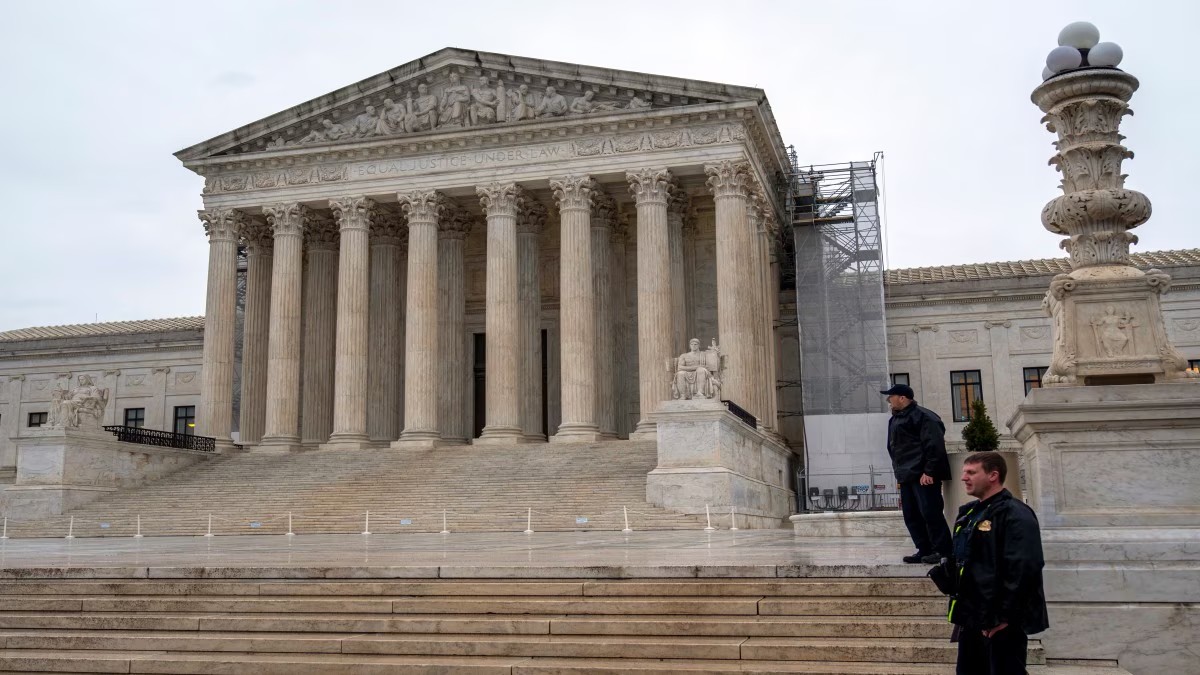
 "The US Supreme Court- File.")
In a significant development in one of the remaining legal battles tied to the January 6 riot, a US federal judge has ruled that President Donald Trump is not shielded from civil lawsuits accusing him of encouraging the 2021 attack on the Capitol.
In his decision, US District Judge Amit Mehta said Trump’s speech at the “Stop the Steal” rally—delivered shortly before the violence unfolded—could reasonably be interpreted as inciting the crowd. As such, the remarks may not be protected under the First Amendment, which typically safeguards political speech.
The ruling draws a distinction between Trump’s actions as a public official and his conduct as a political figure addressing supporters. Mehta concluded that the rally speech did not fall within the scope of presidential duties, meaning it cannot be covered by official immunity.
Limits of presidential immunity under scrutiny
“President Trump has not shown that the Speech reasonably can be understood as falling within the outer perimeter of his Presidential duties,” Mehta wrote. “The content of the Ellipse Speech confirms that it is not covered by official-acts immunity.”
The decision is not the court’s first ruling that Trump can be held liable for the violence at the Capitol and it is unlikely to be the last given the near-certainty of an appeal. But the 79-page ruling sets the stage for a possible civil trial in the same courthouse where Trump was charged with crimes for his Jan. 6 conduct, before his 2024 election ended the prosecution.
Mehta previously refused to dismiss the claims against Trump in a February 2022 ruling that Trump was not entitled to presidential immunity from the claims brought by Democratic members of Congress and law enforcement officers who guarded the Capitol on Jan. 6. In that decision, Mehta also concluded that Trump’s words during his rally speech plausibly amounted to incitement and were not protected by the First Amendment.
Quick Reads
View AllThe case returned to Mehta after an appeals court ruling upheld his 2022 decision. He said Tuesday’s ruling on immunity falls under a more ”rigorous” legal standard at this later stage in the litigation.
Mehta, who was nominated by Democratic President Barack Obama, said his latest decision is not a “final pronouncement on immunity for any particular act.”
“President Trump remains free to reassert official-acts immunity as a defence at trial. But the burden will remain his and will be subject to a higher standard of proof,” the judge wrote.
Trump spoke to a crowd of his supporters at the rally before the mob’s attack disrupted the joint session of Congress for certifying Democrat Joe Biden’s 2020 electoral victory over Trump. Trump closed out his speech by saying, “We fight. We fight like hell and if you don’t fight like hell, you’re not going to have a country anymore.”
Trump’s lawyers argued that Trump’s conduct on Jan. 6 meets the threshold for presidential immunity.
Path opens for trial over Capitol attack claims
The decision sets the stage for a possible civil trial involving claims brought by Democratic lawmakers and police officers who were present during the attack. The plaintiffs argue that Trump’s actions were driven by political motives tied to his reelection efforts, rather than official presidential duties.
The lawsuits stem from the disruption of Congress’s certification of Joe Biden’s 2020 election victory, when a mob of Trump supporters stormed the Capitol, leaving more than 100 law enforcement officers injured.
Notably, these civil proceedings remain unaffected by Trump’s sweeping clemency measures issued at the start of his second term, which addressed criminal cases related to the riot.
Legal experts say the ruling reinforces the principle that presidential immunity has limits, particularly when conduct overlaps with campaign activity. For the plaintiffs, the decision marks a key step toward holding Trump accountable in court, while the president is expected to challenge the ruling as the case moves forward.