

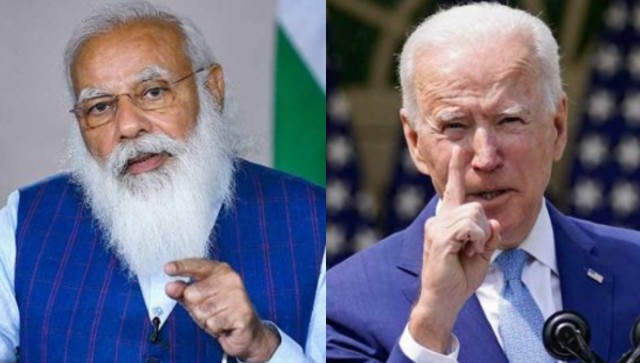
 "Here's why 2022 will not witness India and US becoming global strategic partners")
The US is a global power—militarily the strongest, technologically the most advanced, besides being the world’s largest economy. It has shaped the post Second World War order according to its needs. It believes in the universality of its values and its exceptionalism is interventionist and controls in many ways the international political and financial institutions. It extends its domestic law to foreign countries as necessary to achieve its foreign policy goals, using the threat of sanctions to obtain compliance. The status of the US dollar as the world’s reserve currency gives the US tremendous financial clout through the control it exercises on all global financial transactions in dollars. It can block foreign funds, limit access to its capital markets and impact the world with its monetary policies.
America’s military power was challenged by the Soviet Union during the Cold War. After the Soviet Union’s collapse, the Russian challenge has diminished. The US looks upon Russia today as a regional power, not a global one, and has humiliated it with repeated sanctions and threats of more if its conduct does not meet American approval. The US has abandoned many of the critical Cold War-era disarmament agreements such as the ABM (Anti-Ballistic Missile) and the INF (Intermediate-Range Nuclear Forces) treaties, implying that it no longer sees it as a strategic equal. Nato has been expanded to the borders of Russia despite its opposition.
China is now challenging US power in ways the Soviet Union could not. China today is the second-largest economy, the biggest exporting country, and the world’s manufacturing hub. It is the biggest trading partner of the US, which places a limit on the US capacity to confront it, unlike in the case of the Soviet Union or Russia with which the US had or has minimal economic ties. America has created dependencies on China that it cannot shed. China controls many of the critical global supply chains for raw materials and manufacturers, a reality that the COVID-19 pandemic drove home to the US and the rest of the world. China is using its huge financial resources and capacities in building infrastructure to expand its international reach through the Belt and Road Initiative. It now possesses deterrent military capabilities and is expanding them with space-based technologies, maritime power and nuclear arsenal.
All this is relevant for India as it rises and aspires to play a leading role in international governance in the years ahead. How much of India’s ambitions can be met by relying increasingly on the US, which will inevitably result in constraining India’s foreign policy choices, or maintaining the independence of its foreign policy as much as possible at the cost of some dilution of support from the US for the achievement of our political, economic and security goals remains a key question. Is it possible to maintain a balance between our ties with the US and other power centres in a way that we can gain the most and lose the least?
Quick Reads
View AllCharting a New Course
Our relations with the US have since 2005 entered into a new course and have become steadily stronger. With no other country our ties are today so wide-ranging. The US is our biggest single country trade, investment and technology partner. Our knowledge economy is closely tied to the US. Economic management, regulatory and reform ideas flow to us from the US. On the defence side, a major transformation has taken place, with massive Indian acquisitions of US defence equipment, signing of foundational agreements, expanding military exercises—bilateral as well as plurilateral—easier access to American military and dual-use technologies, shared strategic concepts such as the Indo-Pacific and membership of forums such as the Quad. Both countries underline shared values of democracy and human freedoms as binding factors, which has resonance in the context of the rising threat of authoritarianism to the international system. The people to people ties with the US are deep with the over 4 million-strong Indian American community, almost 200,000 Indian students in US universities and strong academic ties.
At the same time there are undercurrents in our relations that cause irritations, raise doubts and affect the relations negatively. The liberal press in the US contributes to creating negative perceptions about India by its biased reporting. US human rights organisations target India on minority, religious freedom and democracy issues. US laws have interfered with our relations with Russia and Iran. America’s Afghanistan policy has disregarded our security interests, while its soft policy towards Pakistan remains a source of concern.
While the US has been supportive during our stand-off with China in Ladakh diplomatically as well as by way of supply of some needed equipment and intelligence sharing, the principal axis of our strategic ties is in the maritime domain. This no doubt serves our interests as China’s maritime challenge is slated to grow and has to be met bilaterally and through the Indo-Pacific concept and the Quad as well. We should continue this cooperation, knowing that US support for our land-based confrontation with China will be limited.
The signals from Afghanistan are clear. The US is not taking any position on sovereignty issues in Ladakh. Even in the East and South China Seas, the US is not taking a position on such issues even though it involves its allies, whereas India is not one. In the Indian Ocean, the US is looking for burden-sharing which India can provide, given its geographical position and the strength of its navy. India has expanded choices in this regard, as it is already cooperating with France in the Indian Ocean. With the EU, UK, Germany also developing their Indo-Pacific strategies, broader cooperation in this zone to deter China’s expansionism is taking shape.
Retaining Freedom of Choice
The question of the US walking the talk in 2022 of India is a global strategic partner suggests that India is ready to be one in all domains but the US is reticent. The reality is that both countries want to retain their freedom of choice in this regard. The US does not want to assume responsibility for India’s defence and India is not looking for it either. For the US this would mean a fundamental change in its policy towards Pakistan and broadening the risks of a direct conflict with China. For us the handling of our ties with Russia, which remains our biggest defence partner, with more long-term relations being built in this area, would become unmanageable, given the deepening adversarial relationship between it and the US. Already the Russia-China strategic nexus is becoming stronger. If India and the US boost their ties to levels that effectively an alliance-like situation develops, the strengthening of the Russia-China axis could well become a response.
US and Indian policies are also not congruent in all areas. Becoming a global strategic partner would imply India partnering in policies, areas and issues, including in the UN, on which our interests as a regional power and a developing country differ from those of the US as a global power and an advanced economy. In any case, if the assumption is that we need the US to counter China with which our relations have entered into a period of uncertainty and prolonged tensions because of its open hegemonic conduct, we would be making a strategic mistake. We have to take into account the growing opposition in the US to involvement in wars abroad and the need felt there to devote more attention to solving problems at home.
So far, India has preserved its strategic options fairly effectively by strengthening ties with the US without loosening its ties with Russia and indeed looking for ways to broaden those ties in the economic domain, and keeping the channels of dialogue open with China despite the military confrontation on the border. India is conducting itself already as a major power in some sense, demonstrating its capacity to manage conflicting relationships. It subscribes to the Indo-Pacific concept, has deepened its commitment to the Quad, has instituted 2+2 dialogues (Foreign and Defence Ministers) with the US, Japan and Australia (now also with Russia), is developing another Quad eastwards with US, Israel and the UAE, and is, at the same time, a member of BRICS and SCO and still participates in the Russia-India-China dialogue. This policy is best suited to advance India’s interests as a rising country in whose future all other major powers have some stake. With this policy India can still strengthen its ties with the US in areas of mutual interest and benefit. Despite differences, the nature of ties with the US has changed from lack of trust and feelings of grudge to friendly and constructive engagement.
A global strategic partnership between the US and India means a strong understanding on global issues and a sharing of global responsibilities. If India supports multipolarity, wants a reform of the international system hitherto dominated by the West, has developing country perspectives in negotiations on various issues confronting the international community, wants international inequities to be reduced, such an across-the-board strategic partnership is an unrealistic proposition. What can be achieved and is in the process of becoming a reality is closer alignment on issues of shared concern and a non-contentious, friendly dialogue on issues on which we still have different perspectives and interests.
The author is a former Foreign Secretary. He was India’s Ambassador to Turkey, Egypt, France and Russia. The views expressed in this article are those of the author and do not represent the stand of this publication.
Read all the
Latest News,
Trending News,
Cricket News,
Bollywood News,
India News and
Entertainment News here. Follow us on
Facebook,
Twitter and
Instagram

 "PM Modi speaks with Venezuela’s Rodríguez, vows to 'expand bilateral partnership' amid US tensions")
 "Trade rifts with Washington drive US allies to reset ties with Beijing")
 "Congress committed 'grave mistake' by pushing FTA with China, failed deals with Japan and Korea: Goyal")
 "China boosts grip over EV battery minerals with $200 million graphite project in Mozambique")
 "PM Modi speaks with Venezuela’s Rodríguez, vows to 'expand bilateral partnership' amid US tensions")
 "Trade rifts with Washington drive US allies to reset ties with Beijing")
 "Congress committed 'grave mistake' by pushing FTA with China, failed deals with Japan and Korea: Goyal")
 "China boosts grip over EV battery minerals with $200 million graphite project in Mozambique")



