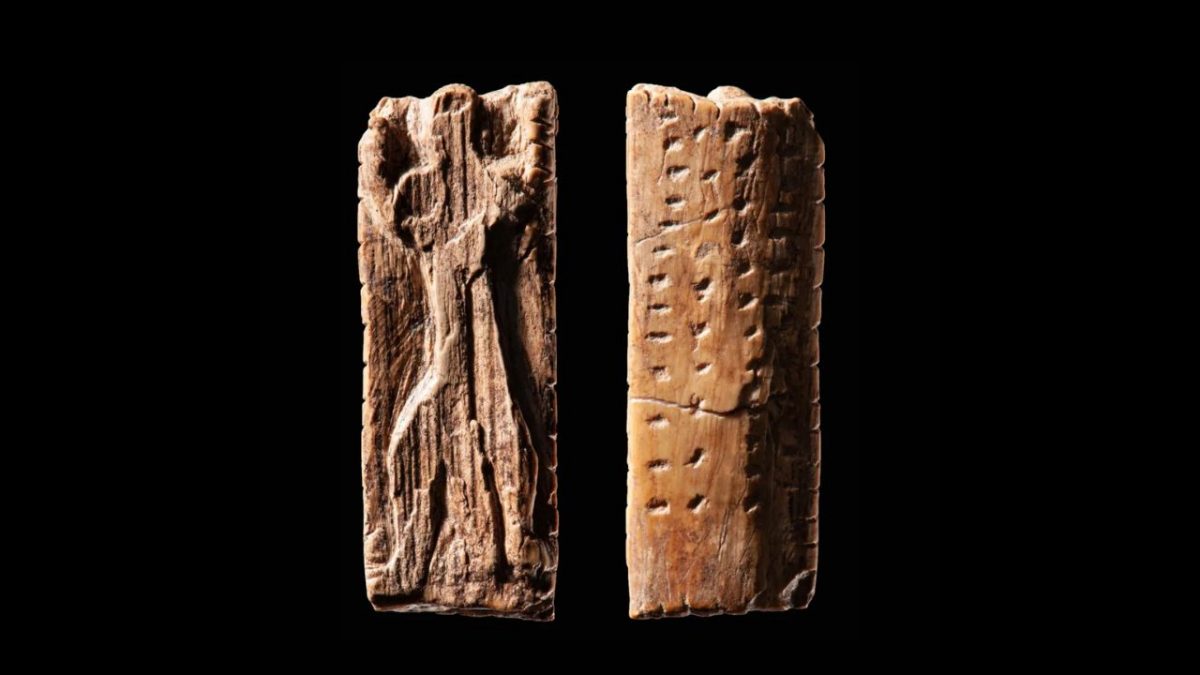
 "Did European hunter-gatherers, not Egyptians, record first ‘writing’? Scientists study 40,000 year-old signs")
The pursuit of understanding how humans first began to store information outside their own minds takes us back tens of millennia. Long before the invention of the alphabet or the printing press, our ancestors were already marking surfaces to communicate across time and space.
A recent comprehensive study has delved into an extraordinary collection of mobile artefacts from the Swabian Aurignacian culture, located in what is now southwestern Germany. These items, dating to the deep past, feature complex sequences of geometric signs. By applying modern computational tools and statistical models usually reserved for linguistics, researchers have uncovered that these early hunter gatherers possessed a sophisticated system of conventional signs.
This discovery suggests that the cognitive foundations for high density information encoding were present in Europe far earlier than previously assumed, challenging our traditional timelines for the evolution of human communication.
The nature of Paleolithic signs
The research focuses on a vast collection of objects, including ivory figurines, tools, and personal ornaments, adorned with thousands of geometric markings. These signs are not merely random scratches or the byproduct of butchery. Instead, they are intentional and nonutilitarian modifications like lines, crosses, dots, and zigzags.
To ensure accuracy, the scientists used microscopic analysis to classify these markings, achieving high agreement scores among experts. The study defines a sign in this archaeological context as a modification of a surface which can be perceived and interpreted by an intelligent viewer. This broad definition allows for the inclusion of various mark types while specifically filtering out those created during practical tasks like hide scraping or meat cutting.
Comparative statistical analysis
To understand where these ancient sequences sit on the spectrum of human communication, the team compared them to three distinct groups: the earliest protocuneiform from Mesopotamia, later developed cuneiform, and a diverse sample of many modern languages.
Quick Reads
View AllBy measuring type token ratios and entropy rates, they established a statistical fingerprint for each. The results were striking. The Aurignacian signs share almost identical statistical properties with the earliest protocuneiform tablets.
Both systems feature low entropy and high repetition rates. In contrast, modern writing systems show much higher complexity and significantly lower rates of adjacent sign repetition. This suggests that while the Paleolithic signs were not a full writing system, they were a highly structured method of information storage.
Information density on figurines
One of the most significant findings involves how these signs were applied to different objects. The researchers used multiple regression models to see if variables like object volume or preservation influenced the complexity of the sign sequences. They discovered that ivory figurines, particularly those depicting animals or humans, carried a significantly higher information density than utilitarian tools or musical instruments.
For instance, zoomorphic figurines like mammoths and lions had sequences notably more complex than those found on scrapers. This implies a deliberate choice by the carvers to use these artistic pieces as primary carriers for important data, likely relating to social or spiritual concepts.
The debate over writing and decoration
A common question in archaeology is whether such markings should be classed as art or a form of proto writing. The study argues that these categories are not mutually exclusive. Sign systems can be decorative while still maintaining high information value, much like modern calligraphy. However, when applying the strict philological definition of writing, the Aurignacian signs fall short.
Because the Paleolithic signs do not structurally mirror the sounds or grammar of a spoken language, they cannot be called writing in the truest sense. Yet, they do meet a broader functional definition because they served the purpose of human intercommunication by means of conventional visible marks.
Exploring the meaning of ancient codes
While we may never fully decode the specific messages left by these hunter gatherers, several theories exist. Some marks might be numerical tallies for hunting or lunar calendars tracking the seasons. Others appear to be symbols of ritual importance. For example, crosses are frequently found on mammoth and horse figurines but never on human forms. Conversely, dots are common on human and lion depictions but absent from tools.
This suggests a rigid set of cultural conventions passed down through generations. Some scholars have even suggested these could be phenological calendars, where specific signs denote the birth cycles of prey animals. Although decipherment is hindered by the passage of time, the statistical evidence proves these were not random doodles but a stable, systematic method of sharing knowledge.
Cognitive capacity and evolution
The fact that these sign sequences remained stable for thousands of years speaks to a highly conservative and successful cultural tradition. The study suggests that the people of the Aurignacian already possessed the information capacity to create systems as complex as those used by the first city states in Mesopotamia.
Entropy acts as a measurable restriction on how much information a system can encode. The findings show that the hardware required for complex symbolic communication was fully online long before the first cities were built.
This would mean that writing is a device for the recording of speech and that all the stages in which writing does not serve this purpose are only feeble attempts in the direction of writing but not real writing. This restriction of the definition of writing is unsatisfactory because it does not take into account the fact that both stages have one identical aim which is human intercommunication by means of conventional visible marks.
Legacy of the Swabian caves
The caves of the Lone and Ach valleys have provided a window into a lost world of technical skill and symbolic depth. These early Europeans were not just surviving they were recording their world through flutes, beads, and ivory carvings. The presence of hybrid creatures like the lion man suggests a rich mythological life. By proving that their sign sequences match the complexity of early administrative tablets in the Near East, this research elevates our understanding of Paleolithic intellect.
While these systems eventually disappeared without evolving into a phonetic script like cuneiform did, they represent a monumental step in the human journey toward the information age. They remind us that the urge to store data outside the human brain is a fundamental part of what makes us modern.


 "PM Modi Israel Visit Live: PM Modi says India-Israel united against terrorism")
 "Anthropic faces blacklisting by Pentagon. Why is the AI firm battling with Trump administration?")
 "Trump vowed to end Ukraine war in 24 hours, but he still can’t — Putin’s maximalist goals to blame?")
 "Samsung Galaxy S26 Ultra’s Privacy display is not a gimmick, here is why")
 "PM Modi Israel Visit Live: PM Modi says India-Israel united against terrorism")
 "Anthropic faces blacklisting by Pentagon. Why is the AI firm battling with Trump administration?")
 "Trump vowed to end Ukraine war in 24 hours, but he still can’t — Putin’s maximalist goals to blame?")
 "Samsung Galaxy S26 Ultra’s Privacy display is not a gimmick, here is why")