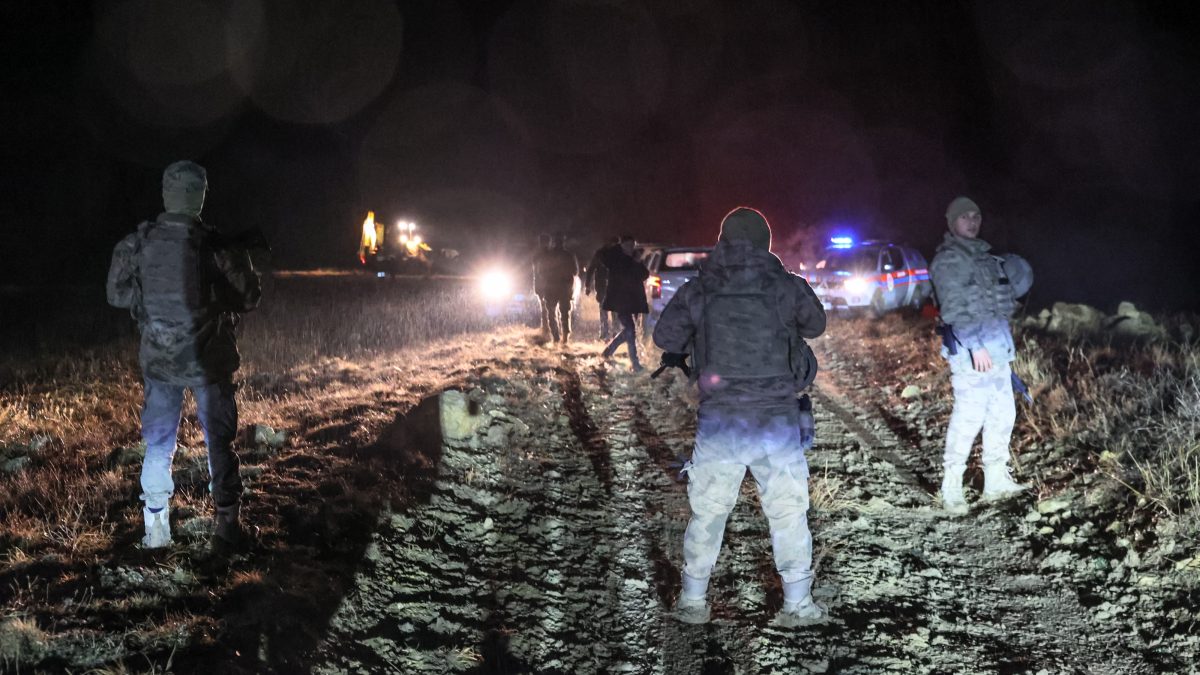
 "Turkish soldiers stand guard at the wreckage site of a Libya-bound business jet as search and rescue operations continue following the crash of a Falcon 50 aircraft carrying Libyan Chief of Staff General Muhammad Ali Ahmed Al-Haddad, found about 1.2 miles (2 km) south of Kesikkavak village in the Haymana district of Ankara on December 23, 2025. (AFP)")
Turkish authorities have recovered the cockpit voice recorder and flight data recorder from a private jet crash that killed Libya’s army chief and four of his aides, officials said on Wednesday, as investigators begin piecing together what went wrong shortly after takeoff.
The Falcon 50 jet had departed from Ankara on Tuesday and was headed back to Tripoli when it requested an emergency landing, citing an electrical failure just minutes into the flight.
Soon after, contact with the aircraft was lost. The wreckage was later found by Turkish security teams in the Haymana district, south of the capital.
Interior Minister Ali Yerlikaya, speaking at the crash site, confirmed that both critical recording devices had been retrieved. “The examination and evaluation processes of these devices have been initiated,” he said.
Transport Minister Abdulkadir Uraloglu said the investigation would involve international cooperation to ensure credibility. “The analysis of the voice recorder and flight data recorder to determine the cause of the aircraft’s crash will be carried out in a neutral country,” he wrote on X.
The results, he added, would be shared “with our nation and the entire world with full transparency”.
Analysis ‘may take months’
Lieutenant General Mohammed al-Haddad, Libya’s chief of general staff, was among those killed. He and four aides were returning from meetings in Ankara with Turkish military officials. There were eight people on board the jet, including three crew members.
Quick Reads
View AllLibyan Prime Minister Abdulhamid Dbeibah said he felt “deep sadness and great sorrow” over the loss of the senior military leader.
Yerlikaya said recovery efforts were continuing at the site, which spans roughly three square kilometres, and confirmed that a 22-member Libyan delegation, including five family members of the victims, had arrived in Ankara.
“We pray for God’s mercy upon those who lost their lives in this tragic accident and extend our condolences to their families,” he said.
More than 400 personnel from Turkey’s disaster agency AFAD, along with police and health services, have been deployed. Drones are providing real-time images to aid the operation. Meanwhile, the Ankara prosecutor’s office has formally opened an investigation.
Aviation expert Tolga Tuzun Inan of Istanbul-based Bahcesehir University noted that a single electrical failure alone is unlikely to plunge an aircraft into total darkness.
“When multiple triggering factors combine with meteorological conditions, such a situation may occur,” he told private NTV broadcaster, adding that black box analysis could take months.
Haddad had served as army chief since August 2020. President Recep Tayyip Erdogan conveyed his condolences to Dbeibah in a phone call, according to his office.
Libya remains divided between the UN-backed government in Tripoli and a rival eastern administration led by Khalifa Haftar, a split that dates back to the 2011 uprising that toppled Moamer Kadhafi. Turkey, a key ally of the Tripoli government, has also recently sought limited engagement with the eastern leadership.