

 "China’s obsession with Arunachal, growing defence ties with Pakistan: Why Pentagon’s report is a big worry for India")
China is seeking to take advantage of reduced border tensions with India to prevent the strengthening of New Delhi-Washington ties, the Pentagon said in its annual report to the United States Congress on military developments related to China. The US Department of Defense’s latest annual report, released on Tuesday (December 23), flagged China’s claim over Arunachal Pradesh as part of Beijing’s stated “core interests”.
While China has decreased tensions with India along the Line of Actual Control (LAC), it is still bolstering its military cooperation with Pakistan. China is also increasing its own nuclear capability.
We take a look at the Pentagon report in detail.
China’s motive behind improving ties with India
The US Department of War’s report has found that China is seeking to capitalise on reduced tensions along the LAC to stave off deeper ties between India and the US.
This comes as America has for years seen India as a counterweight to China’s increasing influence in the Indo-Pacific.
The report also said that Beijing was looking to use the thaw to stabilise its bilateral relations with New Delhi.
India’s ties with China had plunged after the troops of both sides clashed in Ladakh’s Galwan Valley along the Line of Actual Control in 2020. The border flare-up resulted in the death of 20 Indian soldiers, while Beijing claims to have lost four soldiers.
After the military tensions, both sides held many rounds of discussions at political, military and diplomatic levels to resolve the border dispute. Demchok and Depsang had remained points of contention.
Quick Reads
View AllIn a chapter on the Pentagon’s view of Chinese strategy and the US-China relations, the report noted that New Delhi and Beijing had last October announced a patrolling arrangement along the Line of Actual Control, “leading to the disengagement” of the two militaries in eastern Ladakh.
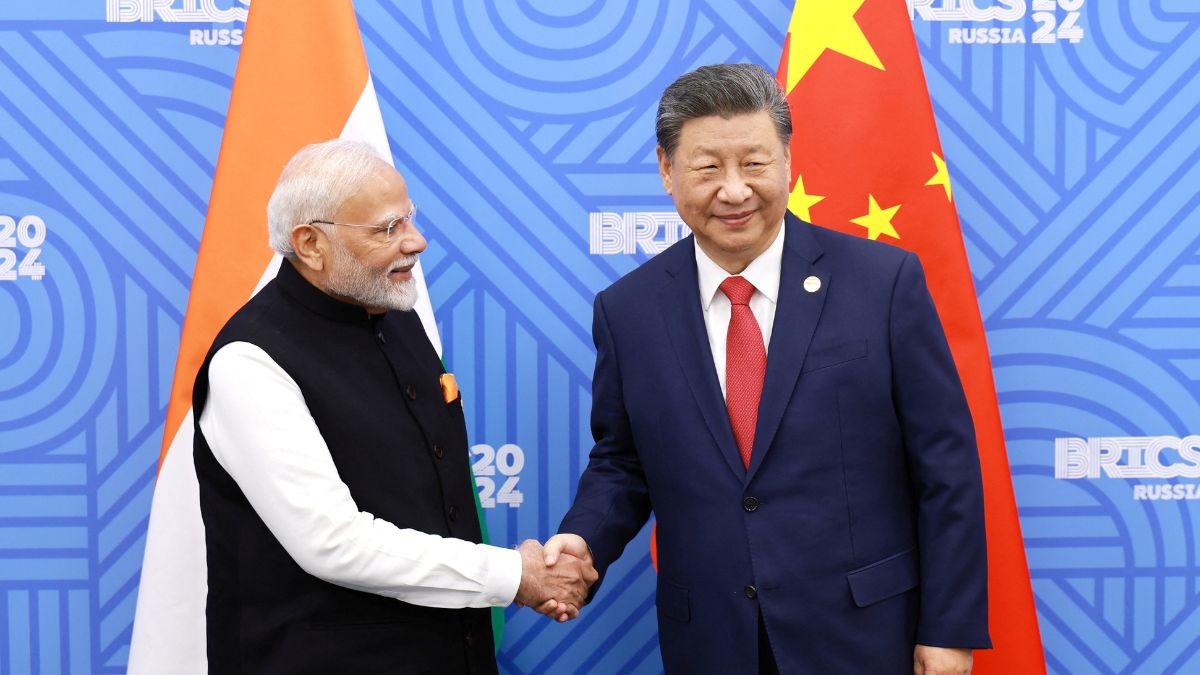
This paved the way for Prime Minister Narendra Modi and Chinese President Xi Jinping’s meeting on the sidelines of the BRICS Summit in Kazan, Russia, that month. This was their first formal meeting since the 2020 military clashes.
The report stated that the meeting between the leaders “marked the onset of monthly high-level engagements between the two countries”, where the two sides discussed border management, as well as steps to improve the bilateral relationship.
These measures included the resumption of direct flights between India and China and the reopening of visa services.
The US report pointed out that India is likely wary of China’s intentions.
India “probably remains sceptical of China’s actions and motives”, the report said. “Continued mutual distrust and other irritants almost certainly limit the [India-China] bilateral relationship,” it added.
China’s alarming Arunachal obsession
The Pentagon’s report also highlights China’s obsession with expanding its territory.
As per the US Department of Defense, the Chinese leadership has extended the term “core interest” to include Beijing’s sovereignty claims to include Taiwan, Arunachal Pradesh, nearly the entire South China Sea and the Senkaku Islands “amid territorial disputes”.
China claims the entire state of Arunachal Pradesh as its territory, which it calls “Zangnan, the southern part of Tibet”. New Delhi has rejected Beijing’s claims over Arunachal Pradesh, reiterating that the northeastern state is an integral part of India.
The document underlined that China considers three “core interests” necessary for its national rejuvenation, to which it is closed off to negotiation or compromise.
These include the control of the Chinese Communist Party (CCP), promoting the country’s economic development, and the defence and expansion of Beijing’s sovereignty and territorial claims, as per ANI.
Chinese officials believe the unification of China and disputed territories, especially Taiwan, is a “natural requirement” for national rejuvenation. Beijing sees Taiwan as part of China, which has to be reunited even by force if necessary.
The Pentagon report, however, claimed that Beijing is not totally confident that it could invade and take control of Taiwan. While the US does not recognise Taiwan as an independent state, it could intervene to support the self-ruled island if it were attacked.
According to the report, Chinese leaders “remain unsure of the [People’s Liberation Army] PLA’s readiness to successfully seize Taiwan while countering US involvement.” Still, China “continues to refine multiple military options to force Taiwan unification by brute force,” it added.
China’s deepening military cooperation with Pakistan
While Beijing is making efforts to mend ties with New Delhi, it is also strengthening military cooperation with Pakistan. The Pentagon report noted that China is supplying advanced platforms, including frigates and combat aircraft, to Pakistan.
As of May 2025, China delivered 20 of the 36 J-10C multirole fighter jets to Pakistan. It has also provided Pakistan with strike-capable Caihong and Wing Loong unmanned aerial vehicles (UAVs).
The US Defense Department-linked assessments, accessed by CNN-News18, found that China and Pakistan are working together to pressure India through coordinated grey zone operations, where adversaries use coercive tactics without triggering an open war.
This strategy was reportedly deployed during
Operation Sindoor in May when Pakistan launched strikes and drone attacks against India, while China operated behind the shadows.
Beijing is believed to have helped Pakistan with intelligence support, cyber activity, electronic surveillance and information warfare.
US intelligence sources described Islamabad as China’s “pressure valve” against India, which is being used to keep New Delhi strategically distracted, dampen growing India-US defence cooperation and test hybrid warfare models.
China’s alignment with Pakistan is emerging as a low-risk strategy to apply multi-domain pressure without triggering a full-scale conflict.
China’s growing nuclear arsenal
China has been increasing its stockpile of nuclear warheads by about 100 a year, according to the Pentagon report.
The document on China’s armed forces estimated that its warhead count was in the “low 600s” by the end of 2024, “reflecting a slower rate of production.”
But Beijing is projected to have about 1,000 nuclear warheads by 2030, which could be mounted on missiles, submarines and bombers.
Overall, the report said that China’s “historic” military build-up has made the US increasingly vulnerable.
With inputs from agencies


 "Zelenskyy takes a step back to push peace plan with Russia forward, offers a demilitarised Donetsk")
 "How ‘bankrupt’ Pakistan stays afloat on foreign loans")
 "Myanmar junta controls only half the country as it holds first post-Suu Kyi election on Sunday")
 "Bangladesh at the brink: How Islamist extremism threatens the nation’s Bengali soul")
 "Zelenskyy takes a step back to push peace plan with Russia forward, offers a demilitarised Donetsk")
 "How ‘bankrupt’ Pakistan stays afloat on foreign loans")
 "Myanmar junta controls only half the country as it holds first post-Suu Kyi election on Sunday")
 "Bangladesh at the brink: How Islamist extremism threatens the nation’s Bengali soul")



