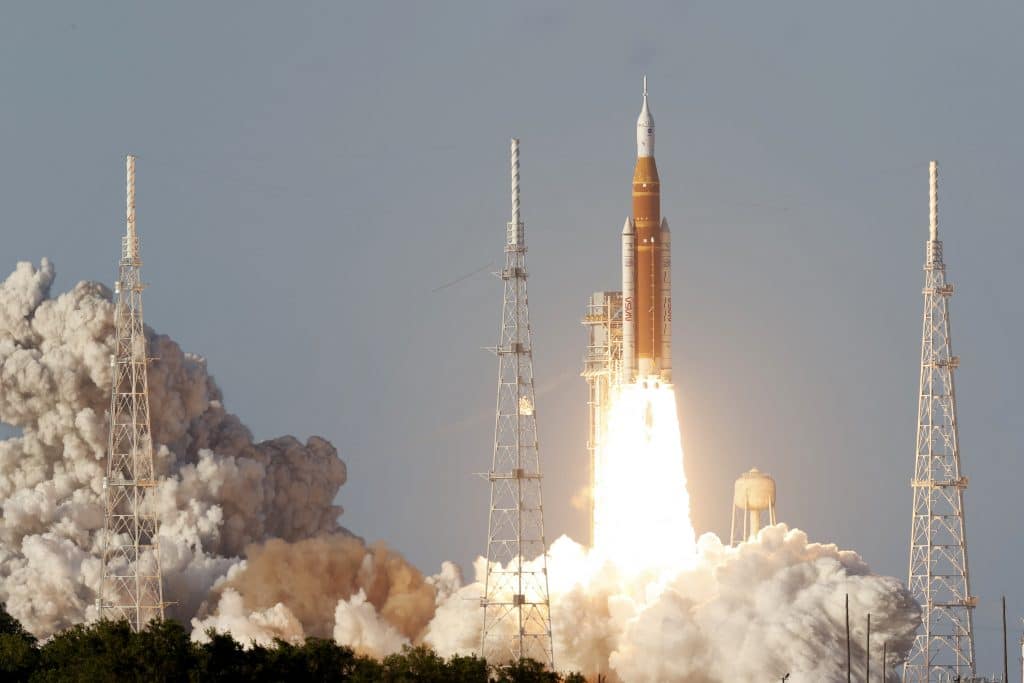
Over the next ten days, the four astronauts will put their Orion spacecraft through its paces on a long, looping voyage that will sling them out to lunar distance before gravity guides them back to Earth.
After a day of checks in high Earth orbit, they’ll fire the European‑built service module engine in what’s known as a “trans‑lunar injection” burn – the crucial manoeuvre that will push them away from the safety of home and commit them to deep space.
For several minutes the spacecraft accelerates hard. This is the big shove that tips Orion out of Earth orbit and sets it on a curved path towards the Moon – the combined gravity of Earth and Moon will naturally loop the spacecraft back home without another big engine burn.
If something serious goes wrong, the crew can effectively coast back along that track – a built-in safety feature that makes sense for a first crewed test.
It takes about four days to cruise out to the Moon. During that time, the astronauts will work through emergency drills, including how they would ride out a major solar radiation storm.
At its furthest, the trajectory takes the crew to around 230,000 miles from Earth, looping them behind the far side of the Moon.
After the flyby, Orion makes a series of gentle course correction burns to line up its path for the return to Earth.
Roughly four days later, Orion separates from the European Service Module and heads for home.
The capsule slams into the upper atmosphere at high speed, its heatshield glowing white hot as it sheds the energy of the trip.
Parachutes then unfurl, slowing the spacecraft for splashdown in the Pacific Ocean, where US Navy ships will be waiting to fish the crew and their capsule out of the water.
)
 "Artemis II set to launch four astronauts on historic mission around the Moon in decades")
 "FirstUp: Nasa's Artemis II Moon mission launch, India to kick off first digital census... News of the day")