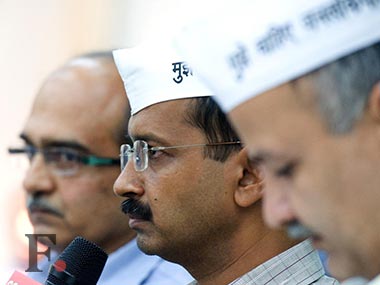
 "Kejriwal breaks the silence on business-politics links")
Arvind Kejriwal’s press conference today, in which he targeted Mukesh Ambani of Reliance Industries, is one more signal that politics and business cannot continue on the old assumptions: that it is something that should be done behind closed doors. Or that the public need no concern itself with these details.
Thanks to a procession of scams - from 2G to CWG to Coalgate, Vadragate and Nitin Gadkari’s Purti capers - the credibility of politicians has never been lower. What Kejriwal did today was to link politicians to businessmen - you cannot have political corruption without a corporate side to it. And who better to tell this story with than India’s biggest businessman - Mukesh Ambani.
The businessman-politician linkage has been the elephant in the bedroom, and Kejriwal brought this out clearly, even though it is difficult to prove the nexus except through circumstantial evidence.
While it served Kejriwal’s purpose to paint both the Congress and the BJP with the same brush - which creates the space for his own political ambitions - the critical point is this: business cannot henceforth be done non-transparently.
However, Kejriwal pushed the envelope too far when he tried to link broader ideological and macroeconomic issues with corruption and profiteering. He also took a giant leap from Reliance’s gas pricing lobbying to increases in power tariffs - another battle he is waging in Delhi.
Some of the ideological positions he staked out are also problematic. For example he and Prashant Bhushan are on record to say that natural resources should be auctioned. This was the entire basis for calling Coalgate a scam - even though favourtism to some of those allocated coal blocks for free is another angle that could be truly scandalous.
But the purpose of giving blocks for free was to keep power tariffs low. If coal blocks are given at market prices, power prices would rise. This does square with Kejriwal’s argument that power prices should be cut when coal blocks should be given out at market prices to mine developers.
He also missed out on economic points. It makes no sense to import gas at $14 and then deny the same price to domestic producers. This is exactly what is happening with ONGC. We import at $110, and give ONGC less than half that price. The net result is ONGC does not have enough resources to take up exploration and bring down our import dependence.
Kejriwal deserves kudos for bringing out the issue of a cosy relationship between politicians and businessmen, but the need is for transparency on government and corporate processes. The economics of selling coal or gas at less than market prices has its own costs.

 "This Week in Explainers: Why South Korea's incentives to women to have babies isn't working")
 "Opinion | Anant Ambani: New-age industrialist or an old-school biz icon?")
 "Anant Ambani and Radhika Merchant’s pre-wedding: The Ambani family grooves with Rihanna on stage")
 "Anant Ambani-Radhika Merchant's pre-wedding festivities: Stebin Ben shares an inside glimpse with a heartfelt note for the couple")