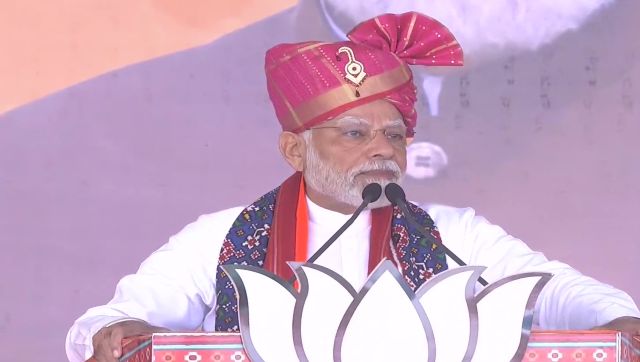
 "Not for or against incumbents, poll results are indicative of people’s trust in intent of their leaders")
As it became evident on Wednesday afternoon that Bhartiya Janta Party (BJP) is all set to sweep the polls in Gujarat, reporters working at newspapers and new channels rushed to BJP leaders for their bytes. When one of the reporters asked Defence Minister and former BJP President Rajnath Singh how did BJP manage to wean off the 27 years of anti-incumbency, Defence Minister gave a prompt reply, “there was no anti-incumbency in Gujarat rather there was ‘pro-incumbency’ for the BJP government”.
Rajnath Singh through his assertion added a new word to the political lexicon and a new tool for political analysis.
BJP won a massive mandate in Gujarat by winning 156 out of a total of 182 assembly seats with the principal opposition party Indian National Congress (INC) being completely routed out. This victory of the BJP becomes important for several reasons but the one being most important is that it registered this phenomenal win after 27 years of being in power; a fact which could have made ‘anti-incumbency’ the most potent force working against BJP’s re-election.
Apart from the term “free and fair” used by the Election Commission of India (ECI) to define Indian elections, another word that is used frequently in the analysis of Indian elections by political pundits is “anti-incumbency”. Ruchir Sharma in his book titled ‘Democracy on the Road: A 25-Year Journey through India’ writes that the word ‘anti-incumbency’ was popularised if not coined in India and if you google it, the first few dozen hits come mainly from India, including definitions of the word in dozen different Indian languages".
Sharma writes that while this phenomenon of anti-incumbency is prevalent in other democracies also it is “particularly acute” in India. Sharma cites the existence of a “broken state” that translates into the state’s failure to deliver “competent services” to its over a billion population as a reason behind this anti-incumbency phenomenon.
Quick Reads
View AllSharma’s analysis of the factors behind the anti-incumbency vote-outs is right to a larger extent, with the most decipherable factor being the inability of the ruling party and the government to build confidence among its electorate that is it working for the people.
The problem with using anti-incumbency as a tool for electoral analysis is that for a long-time it has been portrayed as a phenomenon resulting from the indecisiveness and inconsistency of the electorate. It was projected as if the people are generally fickle-minded and are tempted to change the governments at the drop of a hat. It was said that the voters were impatient and wanted the big social and economic change to happen as soon as possible. Failing to see those changes taking place on the ground they prefer to vote the incumbents out of power and give another party the chance to yield the magic.
This is true that in a democracy people want their representatives to work, and their governments to perform but at the same time, people are not that impatient to not give their leaders ample time to bring in necessary changes. What is required is that the people should be convinced of the intentions of those in power.
If the voters feel the intent of the government is right, they always extend their support and patience. The re-election Modi government in 2019 at the centre and the repeat of the BJP governments in states like UP and Uttarakhand in 2022 is a perfect example of this.
When in 2017, BJP won a decisive mandate in UP, there were many developmental and law and order-related issues confronting the state. In five years of its functioning, the UP government led by Chief Minister Yogi Adityanath initiated many reforms that started showing some results.
Then the outbreak of Covid-19, the imposition of lockdown and the huge challenge of providing medical care to over 20 crore people of India’s most populous state became a very big challenge for the UP government. Years of neglect of developing medical infrastructure by the previous governments proved to be a bottleneck for the Yogi government in providing relief to those at the receiving end of the pandemic in spite of its best efforts.
The doomsayers predicted the defeat of the BJP government in the assembly election held early this year in the shadow of the second wave of Covid that caused innumerable loss of lives and suffering to the people. Still, the BJP was voted back to power and that too with a clear majority.
When the BJP government led by Prime Minister Narendra Modi won the second mandate in 2019 it was not metaphorically or rhetorically but in actual terms a historic win. It was for the first time in 48 years that an incumbent prime minister heading a majority government was voted again in the power and that too with an absolute and thumping majority.
It was not that the first tenure of the Modi government was spot on. There were many tight spots. There were several decisions that created controversies and there were some which caused extreme hardships to the people. Demonetisation was one such decision that faced huge criticism and backlash. But still, people voted Modi to power.
The reason was simple as Ajay Singh, author of the critically acclaimed book The Architect of the New BJP: How Narendra Modi Transformed the Party writes in his book. “Modi perhaps stands alone in contemporary politics for having taken decisions that entailed hardships for people. Demonetisation and the lockdown amid the pandemic are good examples. But he always owns up his responsibility for each of them and never indulges in passing the buck. None of those difficult decisions have caused any erosion in people’s trust in Modi or in the credibility of his government. Because people do not find any fault with his intentions”, writes Ajay Singh.
He adds, “Right since the beginning, Modi has kept emphasising three critical aspects of his working style to win the trust of the masses. First: ‘I will have no stone unturned for the benefit of the people and the nation’. Second: ‘I will do nothing for personal gain.’ Third: ‘I may make bona fide mistakes but won’t do anything with bad intentions. These three messages from him seem to have hit home, not only with the ever-growing party cadre but also among the party base. As a result, BJP has achieved a scale of dominance attained by the Congress immediately after independence that continued for decades”.
The historic performance of BJP in Gujarat or for that matter in states like Uttar Pradesh and Uttarakhand has a clear message for all the political parties and their leaders: the government which works for its people with true intent would retain the trust and support of the people in spite of the pitfalls of circumstances. Yes, the onus of building this trust is upon the leaders. But once this trust is built and honoured with true intent anti-incumbency as a factor deciding electoral fates becomes redundant.
The writer is a journalist and researcher based in Delhi. He has worked with The Indian Express, Firstpost, Governance Now, and Indic Collective. He writes on Law, Governance and Politics. Views expressed are personal.
Read all the Latest News, Trending News,
Cricket News, Bollywood News,
India News and Entertainment News here. Follow us on
Facebook,
Twitter and
Instagram.

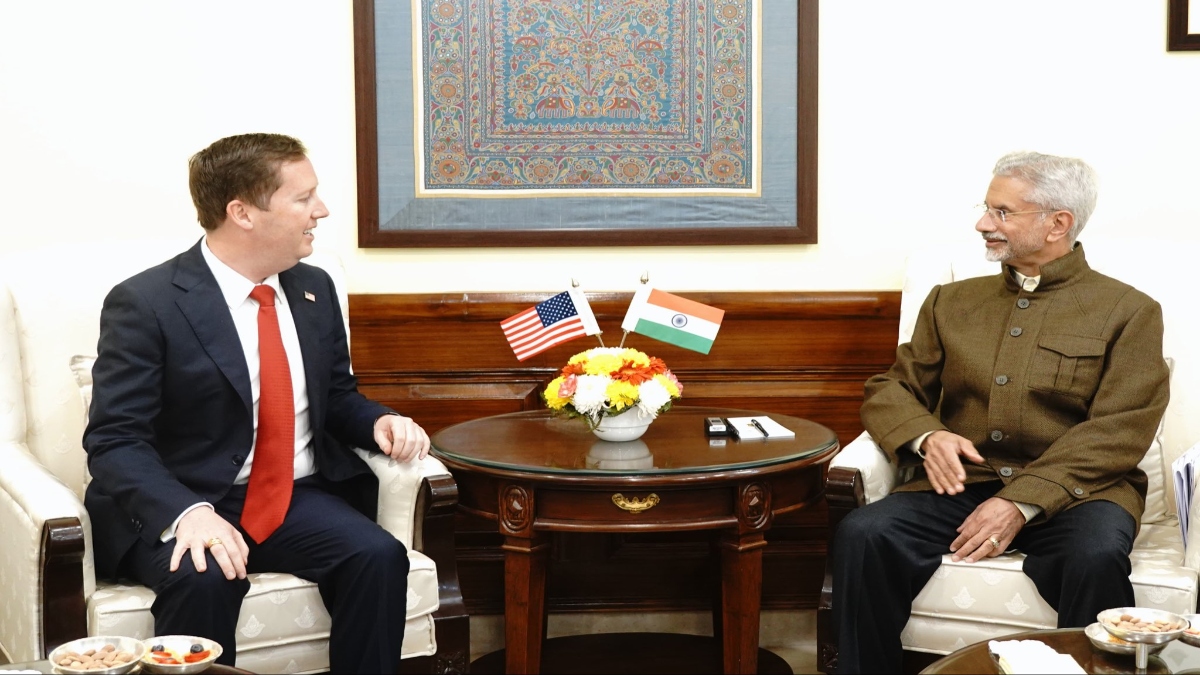 "Jaishankar meets Sergio Gor ahead of US visit, says discussed 'many dimensions of our partnership'")
 "As Trump shakes up Nato, Europe aims to go self-sufficient in weapon production")
 "EU to list Iran’s Revolutionary Guards as terrorist group alongside al-Qaeda and Hamas")
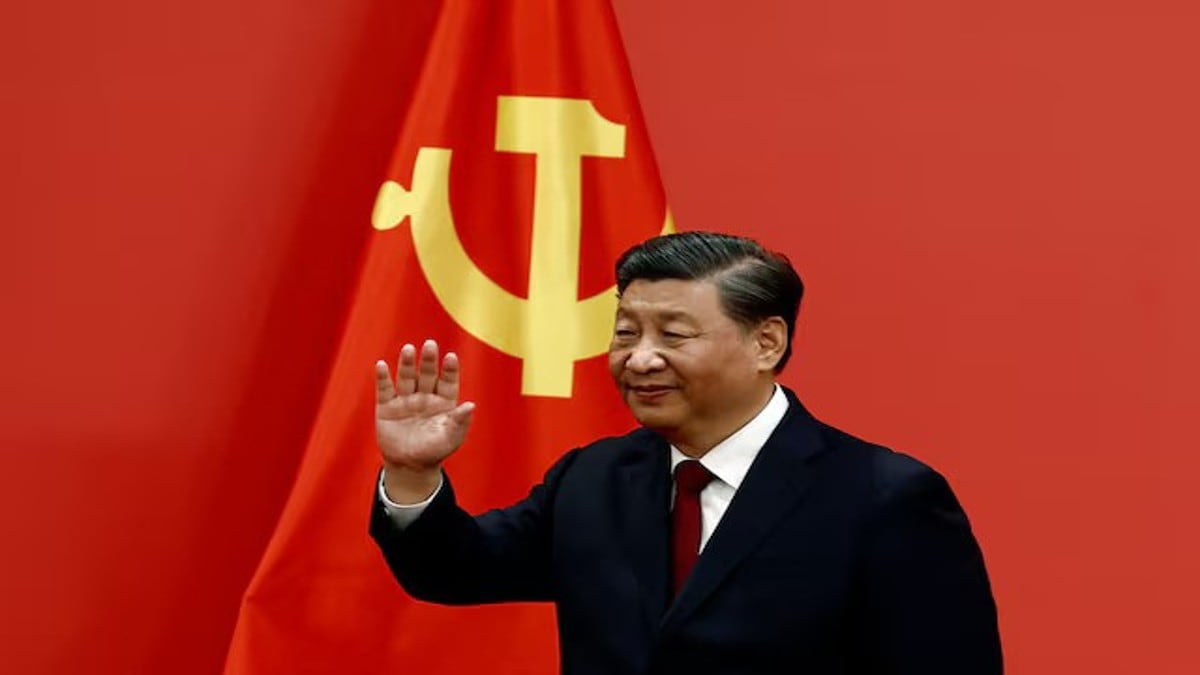
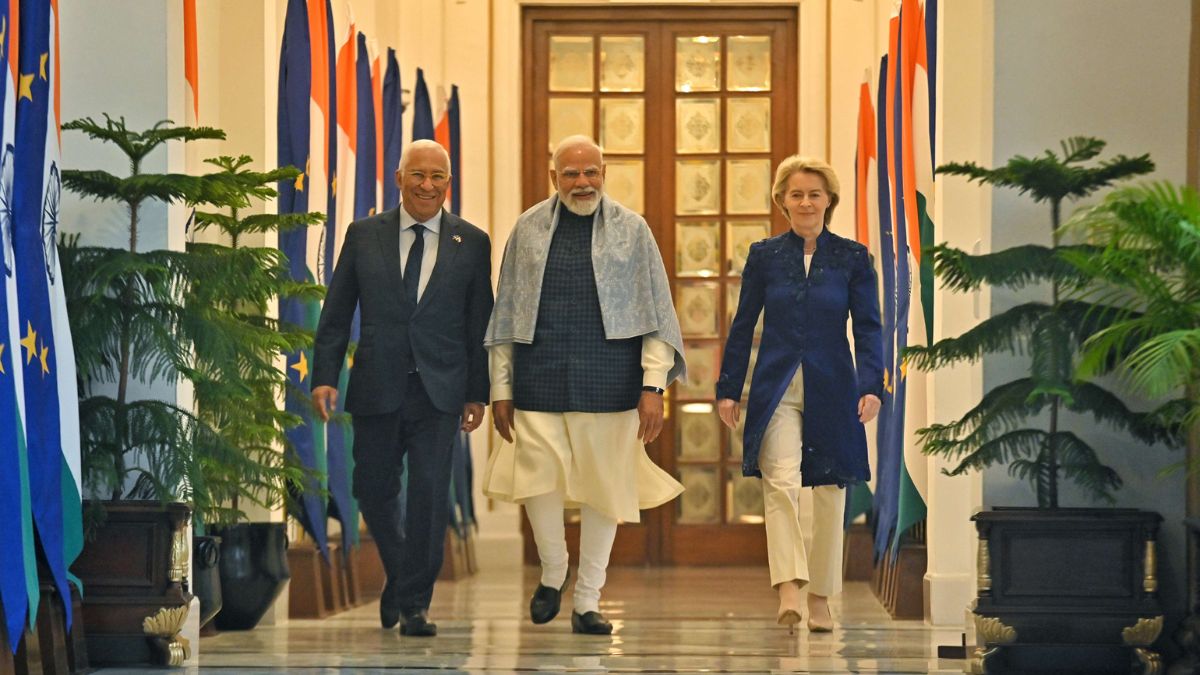 "With new security pact, India and EU eye win-win defence ties as US, China rival in arms race")
 "Jaishankar meets Sergio Gor ahead of US visit, says discussed 'many dimensions of our partnership'")
 "As Trump shakes up Nato, Europe aims to go self-sufficient in weapon production")
 "EU to list Iran’s Revolutionary Guards as terrorist group alongside al-Qaeda and Hamas")
 "With new security pact, India and EU eye win-win defence ties as US, China rival in arms race")