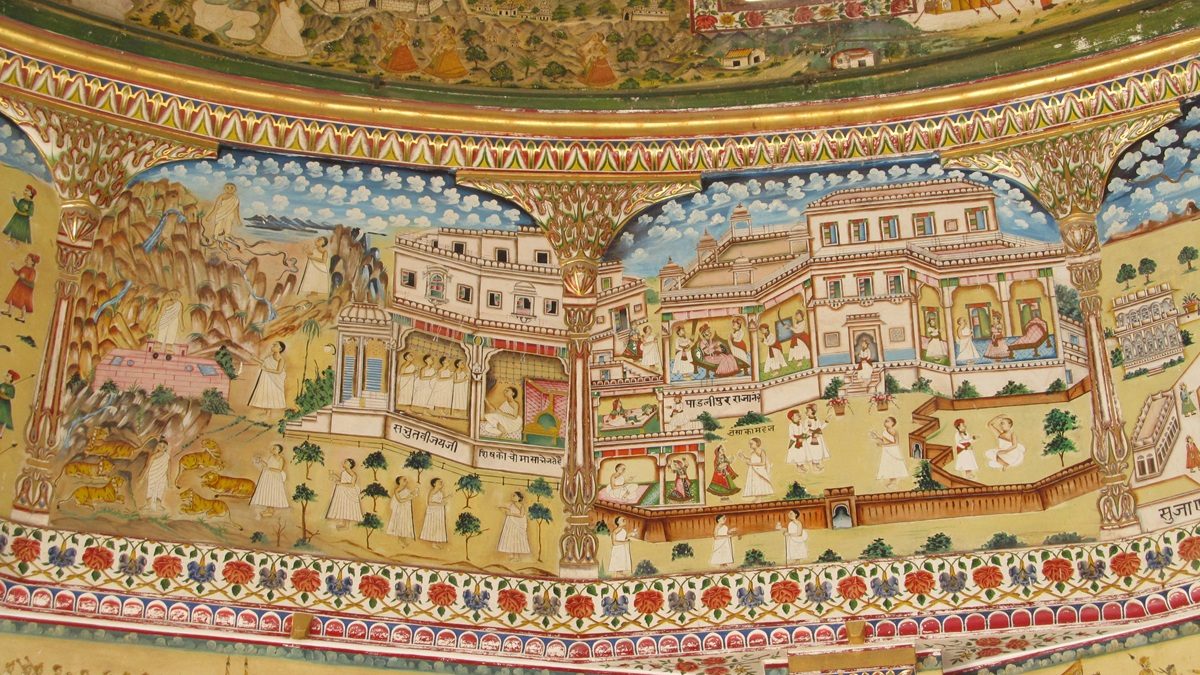
 "As many as 12 entire stories are painted on the walls of a Jain temple in Bikaner.")
It’s that time of the year again when conversations about AQI are top of everyone’s list, especially if they happen to be residents of India’s national capital. It is also the time for people to share videos of nightmarish traffic jams in Himalayan hill towns, triggered not by mountain avalanches but an avalanche of vehicles seeking to escape from Delhi. With the New Year around the corner, we present a set of offbeat heritage options which offer not just a low AQI, but peace as well.
Morena, Madhya Pradesh (316 km south of Delhi): Once the hub of dacoits, Morena district’s countryside now offers a unique perspective on temple development in north-central India. Atop a hill in Mitaoli village is a 10th–11th century CE Chaunsath Yogini Temple built in a circular design which may have served as the prototype for India’s old Parliament building. Close by is Padhawali, home to an equally ancient shrine which has spectacular sculpted iconography on its inner walls and ceiling. Behind a hill lies the vast site of Bateshwar, where excavations have unearthed over a hundred shrines. Nearby villages, such as Bhensora and Ardoni, contain small but elaborately carved shrines of their own, making this less-visited region a heritage jewel box.
Closer to Gwalior and hidden away in low hills and vegetation is the temple complex of Naresar, home to numerous shrines that are nearly a thousand years old. Closer to Morena town lies the lofty Kakanmath Temple, over 150 feet in height. And once you have had your fill of heritage shrines, take a river safari on the Chambal to glimpse crocodiles lazing in the sun. And round it off with a flavour of local cuisine while relaxing at a rural homestay.
Bundi, Rajasthan (477 km south of Delhi): Tucked away in a land of elaborate forts and stunning palaces lies tiny Bundi. The majestic Taragarh is more fort-palace than mere fortress, and it spreads out over the hills here, almost as if it had grown organically. Begun at the fag end of the 13th century and added to over the next two hundred years, it is the repository of some of India’s finest traditional wall paintings. While inside the Bada Mahal and Chitrashala, don’t forget to look up, as even the ceilings are painted.
Quick Reads
View AllBundi’s other significant feature comprises a wealth of structures dedicated to water conservation – stepwells and stepped tanks. While the Raniji ki Baoli is striking in its embellishment, the Nagar-Sagar pair of stepwells, the Nawal Sagar and Phool Sagar lakes, the Dabhai Kund and others make it a special place for conservationists. Bundi’s best-kept secret, however, lies outside the town. This comes in the form of painted rock shelters dating back to a prehistoric era. Ask your hotel to organise a tour of the sites to appreciate man’s early creativity.
Shivpuri, Madhya Pradesh (467 km south of Delhi): Base yourself at the lakeside Tourist Village here to explore the region at ease. The forests around merge into the balmy Madhav National Park, home to leopards, wolves, and several varieties of deer. Watch out for migratory birds along the Sakhya Sagar Lake. On a hill within the park is the George Castle, built in 1911 for a British royal who eventually did not turn up.
To see an older fortification and one with greater historic significance, drive out to explore Narwar Fort, a vast bastion that was built up from the 10th century onwards and remained a key fortress to control the region till the early 19th century. To the east is Surwaya, home to brilliantly sculpted 10th-century temples and a monastery. Several centuries later, a local ruler built a protective fort around the shrines, adding his own layer to the place’s history. Closer to Shivpuri town are the Scindia Cenotaphs, set in a tranquil spot. And if you get truly adventurous, drive out to the Kuno National Park, where cheetahs have been introduced from Namibia and are thriving. You might just get lucky and spot one of them!
Bikaner, Rajasthan (461 km west of Delhi): Stay in a palace-turned-hotel in charming Bikaner, which has all the magic of a desert town without the noise of Jodhpur or the crowds that throng Jaisalmer. Kick off your exploration at Junagarh, an unusual fort-palace that has none of the traditional defences that characterise most of Rajasthan’s bastions. It is not on a hilltop, nor does it have a forest around it. Walk through the 16th-century fort to take in the details of its many palaces, such as the Anup Mahal, Ganga Mahal, Phool Mahal and others. The Chandra Mahal is especially luxurious with elaborate mirror work and paintings.
Within the city, enjoy the paintings and designs of the Bhanda Shah Jain Temple and the city’s historic merchant mansions, such as the Rampuria Havelis. More murals can be seen on the cenotaphs of Bikaner’s rulers, at Devikund Sagar, at the edge of the city. Get a glimpse of how the royals lived at the hunting lodge-turned-heritage hotel at Gajner, located in a wildlife sanctuary. Pray at the revered Karni Mata Temple. Drive over to nearby Nagaur to see the vast Ahhichatragarh Fort, which has won awards for restoration. And before you leave Bikaner, make sure you sample its speciality dishes, such as Gatte-ki-sabzi and Papad-ki-sabzi topped off with sharbat and kesar kulfi.
(The author is a heritage explorer with a penchant for seeking obscure sites. A brand consultant by profession, he tweets @HiddenHeritage. Views expressed in the above piece are personal and solely those of the author. They do not necessarily reflect Firstpost’s views.)