

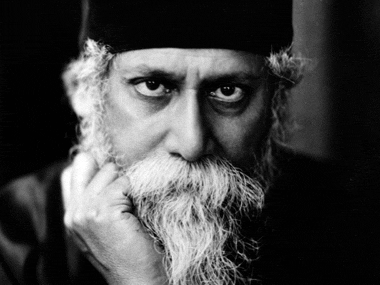
 "On Rabindra Jayanti, a plea for recovering our civilisational inheritance")
Tuesday, 9 May 2017, is Rabindra Jayanti — the birthday of Rabindranath Tagore. In the land where he was born, the day is celebrated not as per the Gregorian calendar, but by the local calendar. It is Pochishe Baishakh. There are different ways of remembering the man. The usual homage will be paid, at least in West Bengal (or Bengal, if that singular achievement of the state assembly is accepted by the Union government). Essay and drawing competitions would have been held, and his songs passionately sung, for they are the most popular and loved of his oeuvre. There could be yet another piece on his views on nationalism since visiting and revisiting his essay has been occupationally fruitful for scholars. But there is another Rabindranath. The manishi Rabindranath, steeped in the Upanishads, with reverence for nature and its place in our civilisation, and the seeker of beauty. That is the Rabindranath one remembers when confronted with the wanton destruction of our environment, the desolation of our public spaces, and the soulless and ugly urban agglomerations that we are creating. [caption id=“attachment_3433754” align=“alignnone” width=“825”] 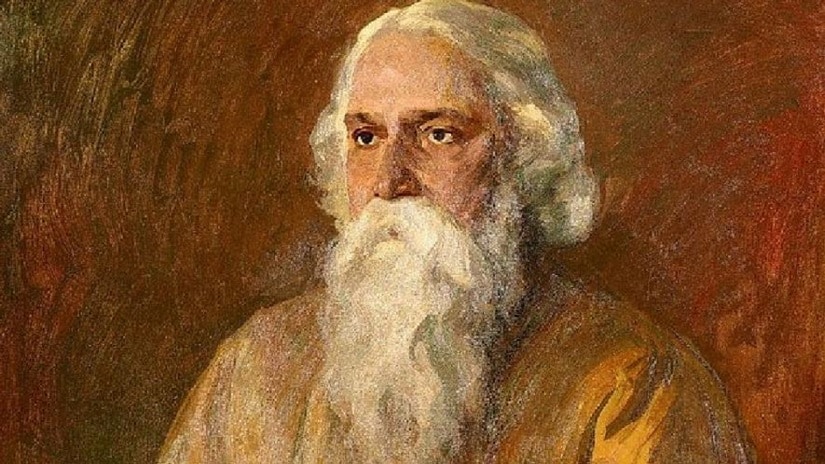 Walther Illner’s portrait of Rabindranath Tagore[/caption] In an essay titled “The relation of the Individual to the Universe”, he writes that the Indian civilisation — unlike that in most other places — was a product of the forest, and not of the city. Even if one were to steer away from the historical premise of how the Aryan invasion may have made this so, which is how he begins, the argument that Rabindranath makes is about the indivisibility of the relation between an individual and the world, and not the world as a means for man’s aggrandisement. Alluding copiously to the religious tradition to which he belonged — and he was as religious a man as one would find, if we forget for a moment the new-age distinction between religiosity and spiritualism — he writes that the Indian civilisation was marked by not merely a preference for harmony, but a reverence for every being in the world. He writes that for India “the great fact is that we are in harmony with nature; that man can think because his thoughts are in harmony with things; that he can use the forces of nature for his own purpose only because his power is in harmony with the power which is universal, and that in the long run, his purpose never can knock against the purpose which works through nature.” And thereafter he quotes from the scriptures: “We are enjoined to see whatever there is in the world as being enveloped by God, and then “I bow to God over and over again who is in fire and in water, who permeates the whole world, who is in the annual crops as well as in the perennial trees.” His poetry and songs speak of seasons, trees, flowers, and the communion between man and nature. The question to ask is whether there is even a fig leaf in our attempt to create harmony between nature and humans in our life as a nation despite all the customary claims, now become more regular, to being inheritors of a tradition. So there is an artificial island in the sea with a statue that will signal pride, forests can be denuded for roads or sheds, open spaces can be dispensed with in our cities, public transport networks can be designed for cars — the list is endless. Each of these tasks, nominally covered by environmental impact assessments, is built on the premise of us becoming like some other country. Rabindranath again offers us a thought. Every nation has a unique heritage, a unique way of addressing problems. We cannot and should not be like them. Rabindranath reminds his reader: “Civilisation is a kind of mould that each nation is busy making for itself to shape its men and women according to its best ideal.” So what is our best ideal? Well, if we are to believe our leaders, our ideals are not even ours. The marquee leaders of every political party without exception want to make the country, or the region, or the city into some other country, region or city. On any given day, someone wants to convert Mumbai to Shanghai, Kolkata to London, and pretty much every city to Singapore. The sheer absence of political and social imagination is staggering. Do we ever envision our country as being built on some ideals that we the people of India have dreamt of or imagined? This is not a nativist impulse. This is a question of borrowing freely, working and reworking our own traditions and placing them in our crucible to create for ourselves. Not to imagine ourselves as poor translations of others’ dreams. Yet, that is where we are stuck. On the track, as it were, where we are supposedly years behind them, and where we will always be behind them, because we are still running on those very rails. And an unhappy result of such translations is our urban space. No wonder then, another strain of Rabindranath’s thought, which was his appreciation of that which is beautiful, stares at us by its absence. Make a list of all the monuments or areas or spaces, which you want to visit, and ask the simple question: how many of these were created or built in the last 70 years? You may not need more than a few fingers. If, in the early years of our republic, there was a desire to create functional soulless spaces, now it has been replaced by the urge to make buildings that are in search of a skyline. New urban agglomerations comprise either steel and glass — Lego constructions dismantled and reassembled from cities of our imagination — or dingy lanes and bylanes. Our best efforts are attempts at preserving things of beauty rather than building them. Is there anything called a modern Indian urban aesthetic? To an untrained eye, there seems none. One hankers for beauty where we live — a sense of beauty that would pervade when you take the train or a bus, or stroll around your neighbourhood. For the vast majority it is not just squalor, it is despairing ugliness that greets them. What about a saundarya sankalpa, then? No, not a state abhiyan, but a personal pledge. Now that is something that Rabindranath offers us. Imagine every Indian city with a sacred grove, a modern vanrai, a shantiniketan. The poet has his uses other than making us stand as one of his songs is sung.
Rabindranath Tagore has his uses, other than making us stand as one of his songs is sung.
Advertisement
End of Article

 "US ready to ‘impose costs’ on Russia if war in Ukraine drags on, says Hegseth")
 "US tells Hamas to stop violence against Gaza civilians and disarm 'without delay'")
 "China seizes 60,000 maps mislabelling Taiwan, omitting South China Sea islands")
 "Syria’s Sharaa pledges to honor Russia ties, seeks economic and military support in Kremlin visit")
 "US ready to ‘impose costs’ on Russia if war in Ukraine drags on, says Hegseth")
 "US tells Hamas to stop violence against Gaza civilians and disarm 'without delay'")
 "China seizes 60,000 maps mislabelling Taiwan, omitting South China Sea islands")
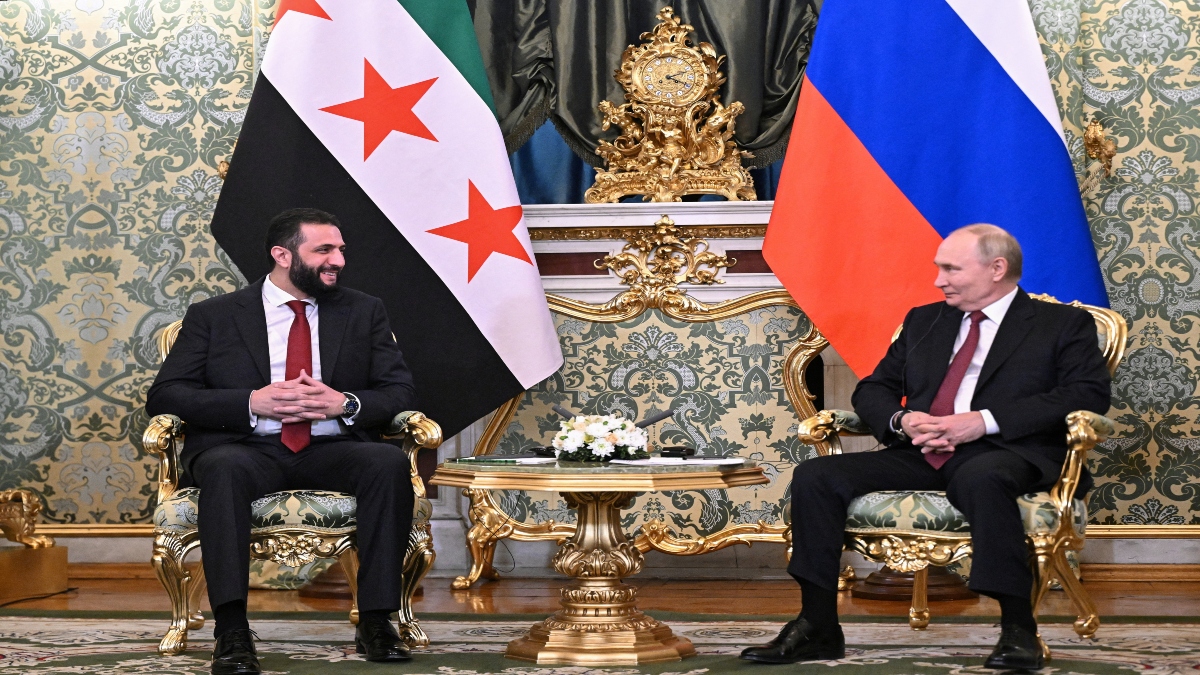 "Syria’s Sharaa pledges to honor Russia ties, seeks economic and military support in Kremlin visit")



](https://images.firstpost.com/wp-content/uploads/2017/05/Walther_Illner_Portr%c3%a4t_Rabindranath_Tagore-825.jpg)