

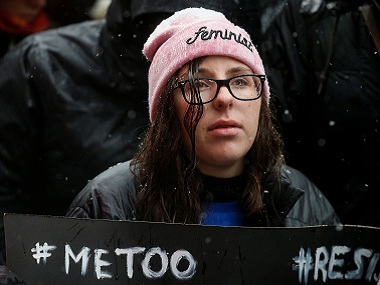
 "#MeToo campaign to Raya Sarkar's list: How the feminist movement changed in 2017")
This article is part of our 2017: A Year In Review series 2017 was a watershed year for Indian feminists. It was a year when the word ‘feminist’, which had sunk into some sort of disrepute over the years, was dusted out and given a new sheen. Twenty-four-year-old law student Raya Sarkar’s 'List' naming well-known Indian academics as sexual harassers came out with a splash on social media at the fag end of 2017. This happened soon after the internationally famous Harvey Weinstein revelations shook Hollywood and had a ripple effect all over that country. Harvey Weinstein, the powerful Hollywood mogul, was accused of harassment by a large number of women who graphically described how he sexually abused them. The Weinstein episode set off a tornado of sorts, with women and men coming out with stories of their own exploitation by not just Weinstein, but also other Hollywood biggies, politicians, professors and powerful men from various walks of life. [caption id=“attachment_4194353” align=“alignnone” width=“825”]  Raya Sarkar’s list created a chasm between older feminists who advocated for due process, and younger ones, who did not trust it. Image source: Facebook[/caption] Raya, who is in the US on a fellowship, started her list because she found that academia in India was full of similar predators — powerful men who exploited their students and colleagues. While she made the names of the accused predators public, she kept the names of the accusers and their accusations secret. She felt that making the names of the students public would jeopardise their nascent careers. This, however, created a chasm within the feminist sorority . Soon there were the pro-listers and the anti-listers, and each side was passionately defensive about its stand. Young and older women wrote to Raya about their own experiences and asked her to add more names to her list.
Was this disagreement the manifestation of a generational gap between the old guard and the new? Or between those who believed in due process and those who did not? Or was it something deeper?
Perhaps a little bit of everything. Feminists, after all, are not just one cohesive mass. Dame Rebecca West, pioneering journalist and feminist who died in 1983 at the age of 90 once famously said, “I myself have never been able to find out precisely what feminism is: I only know that people call me a feminist whenever I express sentiments that differentiate me from a doormat.” She said this in 1913, when she was just twenty years old. Now, more than 100 years later, has anything changed? Also read: From tweeting to following 'due process', 2017's lessons on battling sexual harassment Indian feminism came of age in the 1970s. The battles which were fought and won by the older feminists in those “stone ages” (some of us older feminist journalists have dubbed ourselves ‘Journosauruses’!) often seem irrelevant to the younger women who take many of the fruits of those victories for granted. Our battles were marginally different from our sisters in the West. We never had to fight for voting rights, but we had to fight for other types of basic gender justice just like they did. The right to gain employed in any profession, the right to get married and stay employed, to get maternity leave and equal pay for equal work were just some of the more obvious issues we focused on. In those very early days, sexual harassment at the workplace was not even recognised as an offence, and victim blaming and shaming was the norm. Today’s feminists might cringe at the term ’eve-teasing’, but not too long ago it was an acceptable term and sexual harassment in the street was considered a kind of “fun” activity, not by the feminists of course… but then feminists were mostly viewed as a humourless lot by society at large! [caption id=“attachment_4279241” align=“alignnone” width=“825”] 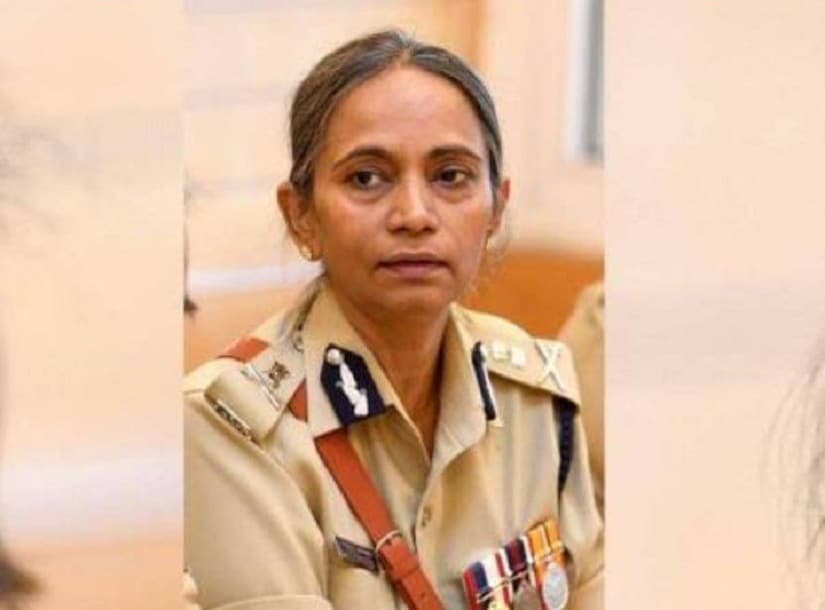 Neelmani Raju is Karnataka’s first ever woman IGP. Image from Twitter/@IPS_Association[/caption] Things changed over the years, slowly but surely. Changes were brought about thanks to the untiring efforts of many women and men who came from all walks of life. Some called themselves feminists. Others did not. There were many people involved in bringing about this slow change — grass root activists, thinkers, law makers, writers, academics. The change may have been slow and undramatic, but there was solid change. For example, in 2017 the Chief Secretary and Inspector General of Police for the state of Karnataka were both women. And yet, up until a few years ago, policewomen and women in civil services were asked to leave if they got married. Today, India has some of the best maternity leave provisions for women, far better than many “advanced” countries. We also have excellent laws which address issues such as sexual harassment at the work place, domestic violence, custodial rape and so on. But the process involved in accessing and utilising these legal provisions is long and cumbersome, and the young in particular have lost faith in them.
In 2017, after America’s watershed moment, things changed in India as well. Talking openly about harassers who were in powerful positions was no longer taboo. Suddenly there were new battles to be fought and the feminist armor could once more be worn with pride.
The approach of this generation was different, and so were the ground rules. The old battles were fought for basic gender justice, but now the central issues are different. The new age technology-and-social-media-savvy feminists are fighting battles over trolling and stalking, both online and on the streets, and discrimination at work. The whisper networks of yore which warned against lecherous bosses gave way to public lists shared on social media. ‘Zero tolerance’ became the buzz word. Young women who had lost faith in “due process” were loud and clear about “naming and shaming” their aggressors and predators. Words like ‘mansplaining’ (which describes the act of a man explaining something to a woman in a condescending manner) and ‘manel’ (panel of experts consisting of only men) crept into the new feminist vocabulary, while ancient terms like ‘MCP’ (male chauvinist pig) and ‘feminazi’ sank into well-earned oblivion. Hashtag activism, which took the form of campaigns such as #MeToo , made feminist issues more visible and offered a certain amount of anonymity to those women who may have hesitated to speak out in a public off-line forum. Issues like gay rights, which were not spoken about even in hushed tones in the old days, now became central to the discourse. [caption id=“attachment_4279231” align=“alignnone” width=“825”] 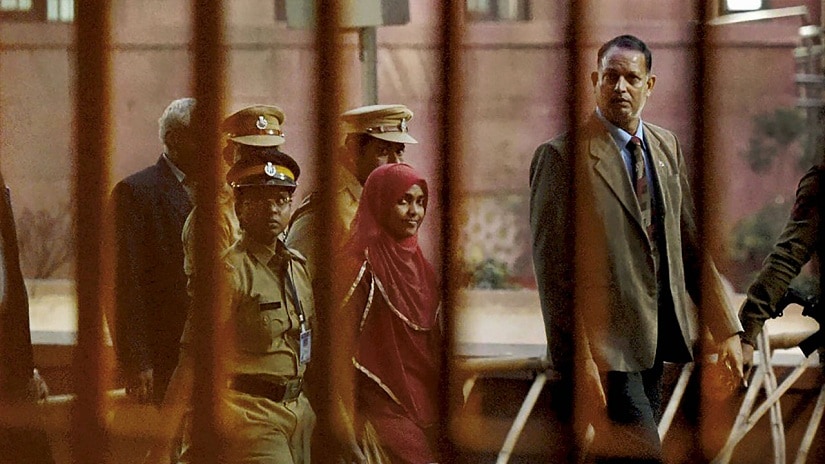 Despite what larger society said, Hadiya stood up for her rights to convert to another religion, to marry the man of her choice and live with him. Image from PTI[/caption] 2017 was certainly a tumultuous year for feminism in India. Women cutting across caste, creed and class lines found their voices and stood up for themselves. Hadiya stood up for her right to convert to another religion, and marry and live with the man of her choice. Others had done it before her, of course, but thanks to the changed social and political climate in the country, her case was splashed across the media. Women who had suffered the brunt of triple talaq spoke openly on TV about the need to abolish the archaic practice. Marginalised groups like sex workers and the transgender community spoke up for themselves, as did surrogate mothers. In Kerala, women tea estate workers formed their own union and women in Malayalam cinema formed their own collective. Actresses spoke out in public about the casting couch. The year ended on a note of hope; feminism in India was alive and thriving!

 "‘I’d love to do it’: Trump refuses to rule out third term — despite constitutional limit")
 "What is the ‘Golden Fleet’ of navy ships that Trump wants to counter China with?")
 "‘Ramayan country’: Why Trinidad and Tobago wants to build a large Ram temple")
 "How China's rare earths choke changed America's trade deals")
 "‘I’d love to do it’: Trump refuses to rule out third term — despite constitutional limit")
 "What is the ‘Golden Fleet’ of navy ships that Trump wants to counter China with?")
 "‘Ramayan country’: Why Trinidad and Tobago wants to build a large Ram temple")
 "How China's rare earths choke changed America's trade deals")



](https://images.firstpost.com/wp-content/uploads/2017/11/raya-Sarkar_8251.jpg)
](https://images.firstpost.com/wp-content/uploads/2017/12/karnataka-igp.jpg)
](https://images.firstpost.com/wp-content/uploads/2017/12/Hadiya_PTI1.jpg)