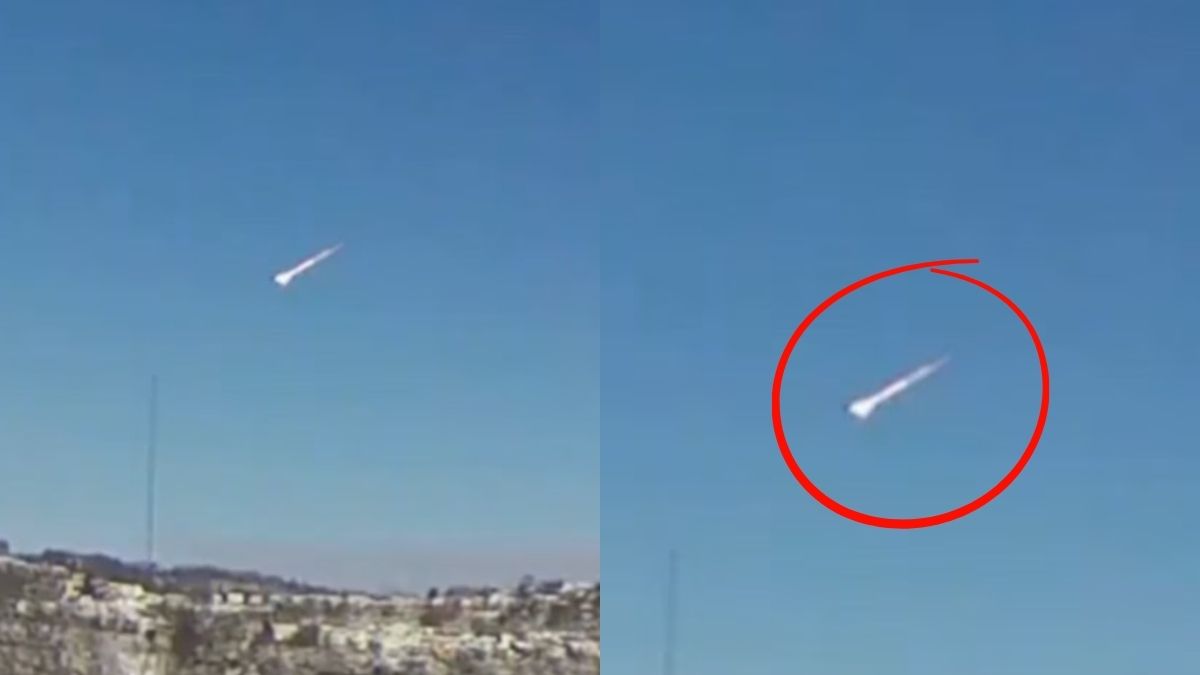
 "Why meteors hit Earth: The science behind the Cleveland, Ohio meteor event")
A rare daytime meteor lit up the skies over the eastern United States on March 17. The object was about 2 meters wide and weighed around 6 metric tons. That makes it closer to a small asteroid than a typical meteoroid.
It entered Earth’s atmosphere at around 40,000 mph and began burning up over Lake Erie. It broke apart about 30 miles above Valley City near Akron.
The explosion created a bright flash that lasted up to seven seconds. People across multiple states reported seeing it. Many also heard a loud sonic boom that shook homes and rattled windows.
A loud boom was heard in the Cleveland area when the fast-moving meteor broke through the sound barrier, according to the National Weather Service.
What made this event unusual
Most meteors burn up high in the atmosphere and go unnoticed. This “fireball” was different. It was large and fast. It survived deeper into the atmosphere where sound can travel to the ground.
This is why people heard the explosion. Robert Lunsford, a meteor observer with American Meteor Society, explained: “When an extraordinarily large meteor (beach ball size or larger) enters the atmosphere, it often survives down to the lower atmosphere where the air molecules are dense enough to carry sound.” He added that the sonic boom is “a good indication that the fireball produced fragments on the ground.”
How scientists tracked the meteor
This event was recorded by multiple instruments. Weather radars in Cleveland and Pittsburgh detected falling debris. A satellite lightning sensor also observed the flash from space.
Scientists mapped the path of the object as it moved north to south over western Cleveland. The data helped them estimate where meteorite fragments may have landed.
Quick Reads
View AllThe fall happened during cloudy weather with snowfall. This limited observations to radar data above the clouds.
Where the meteorites may have landed
Fragments likely fell across a curved area called a strewn field. Scientists use models to estimate where pieces of different sizes land. Larger pieces fall faster and land closer to the main path.
Smaller ones are carried by wind and fall farther away. In this case, strong winds pushed lighter fragments toward the northeast.
Heavier pieces followed a more direct path and landed farther south. The result is a curved pattern shaped by both gravity and wind.
Why this asteroid was not detected earlier
Skywatch programs are getting better at spotting incoming objects. But this one slipped through. It approached Earth at a steep angle.
Most detection systems focus on objects moving along the flat plane of the solar system. This made the asteroid harder to see in advance.
This shows that some space rocks can still arrive without warning.
What happens when a meteor enters Earth’s atmosphere
A meteor is the streak of light we see when a space rock enters the atmosphere. It heats up due to friction with air. National Geographic notes, the heat causes gases around the meteoroid to glow.
This creates the bright trail often called a shooting star. Most meteors burn up in the mesosphere, about 50 to 80 kilometers above Earth.
Faster and larger meteors glow brighter and longer. Some last only a second. Others can be visible for minutes.
Fireballs and sonic booms
This Ohio event was a fireball. Fireballs are larger and brighter than typical meteors. They can be as big as a small car.
When such objects break apart, they release energy that creates shockwaves. If the explosion happens low enough, people on the ground can hear it.
In this case, the pressure wave was strong enough to be recorded by earthquake sensors in Ohio.
Why meteors hit Earth
Earth is constantly moving through space. It passes through dust and debris left by comets and asteroids. Most of these particles are tiny and harmless. But occasionally, larger rocks enter the atmosphere.
Meteor showers happen when Earth passes through a trail of debris from a comet. These create many small streaks in the sky. Larger impacts like the Ohio fireball are less common. But they are part of the same process.
A reminder from space
This event shows that Earth is still exposed to space activity. Even with modern tracking systems, some objects go undetected.
But events like this help scientists improve detection and understand how meteors behave. They also remind us that space is not as empty as it seems.


 "Israel-Iran War News: Iranian lawmakers propose tax on ships passing through Straight of Hormuz")
 "Hours after Qatar LNG strike, Saudi Aramco’s Samref refinery in Yanbu targeted in aerial attack")
 "'Unacceptable': China reacts for first time after Ali Larijani's killing, warns conflict could spiral")
 "Sensex tumbles 2,500 points, Nifty drops 3.3% as Iran war escalation, oil surge trigger market rout")
 "Israel-Iran War News: Iranian lawmakers propose tax on ships passing through Straight of Hormuz")
 "Hours after Qatar LNG strike, Saudi Aramco’s Samref refinery in Yanbu targeted in aerial attack")
 "'Unacceptable': China reacts for first time after Ali Larijani's killing, warns conflict could spiral")
 "Sensex tumbles 2,500 points, Nifty drops 3.3% as Iran war escalation, oil surge trigger market rout")