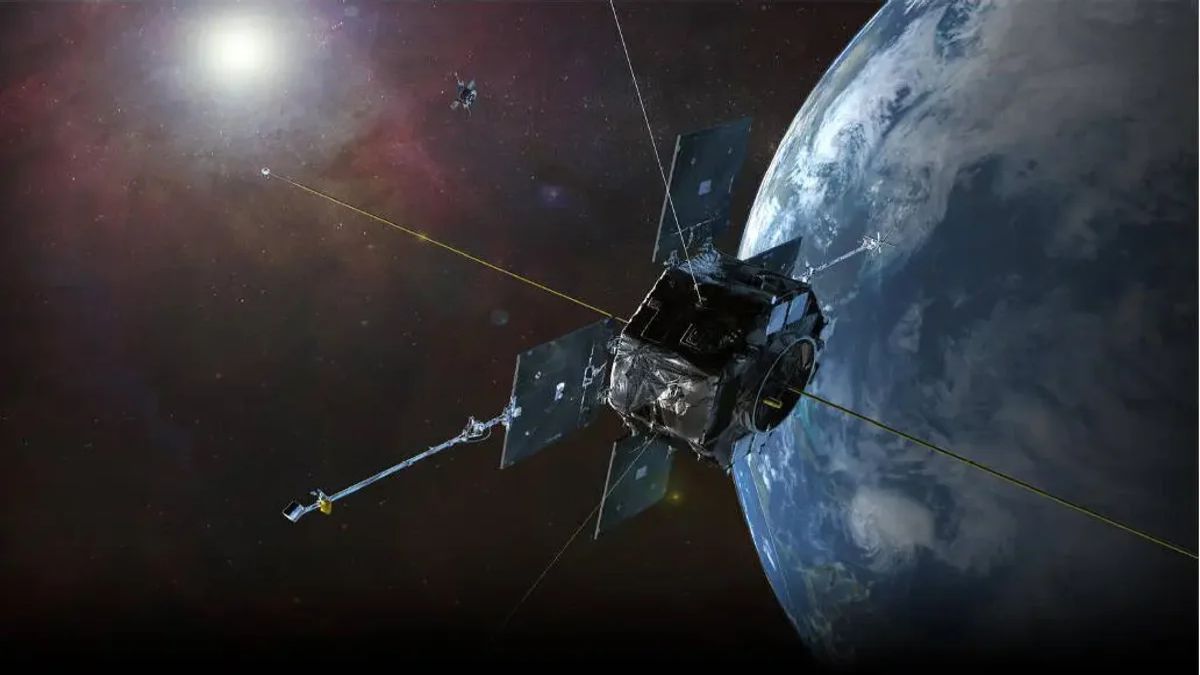
 "What happens if 600-kg Nasa satellite crashes into Earth")
If the Iran war wasn’t giving enough doomsday vibes, a Nasa satellite hurtling down into Earth is bound to make you feel like the world is coming to an end.
The American space agency had earlier stated that the Van Allen Probe A satellite would come crashing back to Earth after a 14-year journey through space. The agency predicted that the probe would begin re-entry around 7:45 p.m. ET on Tuesday (March 10) but said that the time may be off by as much as 24 hours, meaning it could come down at any point in the next day or two.
This has got people asking: Will the crashing satellite cause any damage?
Here’s what we found out.
What is the satellite plunging back to Earth?
The Van Allen spacecraft, which is more than 600 kilogrammes, is expected to re-enter Earth’s atmosphere almost 14 years after its launch.
According to Nasa, the Van Allen Probe A and its twin, Van Allen Probe B, were launched on August 30, 2012, to study the radiation belts around Earth after which they are named. The pair was designed to fly through and study rings of high-energy radiation particles that are trapped by Earth’s magnetic field.
Through the mission — which was supposed to last just two years but the spacecraft managed to continue operating until 2019 — numerous discoveries were made about the features and composition of radiation belts. Moreover, a “transient” third radiation belt that can form during periods of intense solar activity was also uncovered.
As Nelofar Mosavi, the Van Allen Project manager at Johns Hopkins Applied Physics Lab, said at the time, “This mission … broke all the records for a spacecraft to tolerate and operate in that hazardous region, all with no interruptions. This mission was about resiliency against the harshest space environment.”
Sasha Ukhorskiy, a project scientist at Johns Hopkins Applied Physics Lab, went further, saying: “The Van Allen Probes rewrote the textbook on radiation belt physics.”
The data provided by the Van Allen probes is being used to measure and predict the impact of solar winds and radiation on communications systems, navigation satellites, power grids, and even astronauts in space.
Why and where will the Nasa satellite crash on Earth?
When the Van Allen spacecraft ran out of fuel in 2019, Nasa deemed the mission to be completed. Since then, the Van Allen Probe A and Van Allen Probe B have been languishing in orbit ever since.
Originally, Nasa stated that the two probes would re-enter Earth’s atmosphere in 2034. However, higher-than-normal solar activity has caused our planet’s atmosphere to expand and frictional drag on orbiting satellites to increase.
This has resulted in a shortened time in space for the Nasa satellite. Notably, Probe B isn’t expected to re-enter before 2030.
It is not immediately clear where in Earth’s atmosphere the satellite is projected to re-enter. Nasa and the US Space Force have said they will monitor the re-entry and update any predictions.
Jonathan McDowell, an astrophysicist who retired from the Harvard-Smithsonian Center for Astrophysics, said that because the satellite was descending in an elliptical orbit and would re-enter the atmosphere at about 17,000 miles per hour, it was impossible to predict where and when any surviving fragments might hit Earth.
Some predict that there are big chances that it will land in open water.
Will the Nasa satellite cause any damage when it returns to Earth?
It is unlikely that the Van Allen probe will cause any damage when it re-enters Earth’s atmosphere. According to the American space agency, most of the spacecraft will likely burn up as it re-enters the atmosphere, but some components are expected to survive the trip back to Earth.
The components probably won’t hit anyone, with Nasa saying the current odds of the debris causing harm to humans are about one in 4,200, which is minimal.
McDowell agreed with Nasa’s assessment about damage risk, telling the New York Times, “For the average person, it will be a nice light in the sky if you get lucky and, otherwise, don’t worry about it. We have much more scary re-entries that happen. Occasionally, there is a 20-tonne Chinese rocket stage that comes down. Those are much scarier for me.”
Have people been hurt by space objects before?
While Nasa states that there’s very little chance of the satellite causing any significant damage on Earth, it does highlight the problem of space debris and the risk it poses.
According to the Natural History Museum, there are 3,000 dead satellites in space and around 34,000 pieces of space junk bigger than 10 centimetres in size and millions of smaller pieces that could nonetheless prove disastrous if they hit something else.
Until now, there have been few instances of space debris causing harm; in January 1997, Lottie Williams, a Tulsa resident, was hit by a six-inch chunk of metal on her shoulder. That fragment is believed to be a part of the Delta rocket.
In 2002, a six-year-old boy in northern China was struck by a 10 kg piece of debris following a satellite launch in a nearby province. He reportedly suffered minor injuries to his toe and head.
FAQs
1) What is the Nasa satellite crashing into Earth?
The satellite expected to re-enter Earth is the Van Allen Probe A, which was initially launched in 2012.
2) Where will the satellite crash?
It is not immediately clear where in Earth’s atmosphere the satellite is projected to re-enter. But many predict that it will be in open water.
3) Is there any risk in the satellite crashing?
No. Nasa has predicted that there’s a one in 4,200 chance that the debris of the satellite will hit anyone.
With inputs from agencies


 "US-Israel Iran War Live Updates: Blasts heard across Doha as Iran’s Gulf strikes enter 12th day; Qatar intercepts new missile attack")
 "Explained: Where does India get its oil and gas from?")
 "Ayatollah Khamenei reportedly opposed son Mojtaba’s rise as Iran’s Supreme Leader")
 "Iran War: Oil to remain above $95 for next two months, says Trump administration")
 "US-Israel Iran War Live Updates: Blasts heard across Doha as Iran’s Gulf strikes enter 12th day; Qatar intercepts new missile attack")
 "Explained: Where does India get its oil and gas from?")
 "Ayatollah Khamenei reportedly opposed son Mojtaba’s rise as Iran’s Supreme Leader")
 "Iran War: Oil to remain above $95 for next two months, says Trump administration")