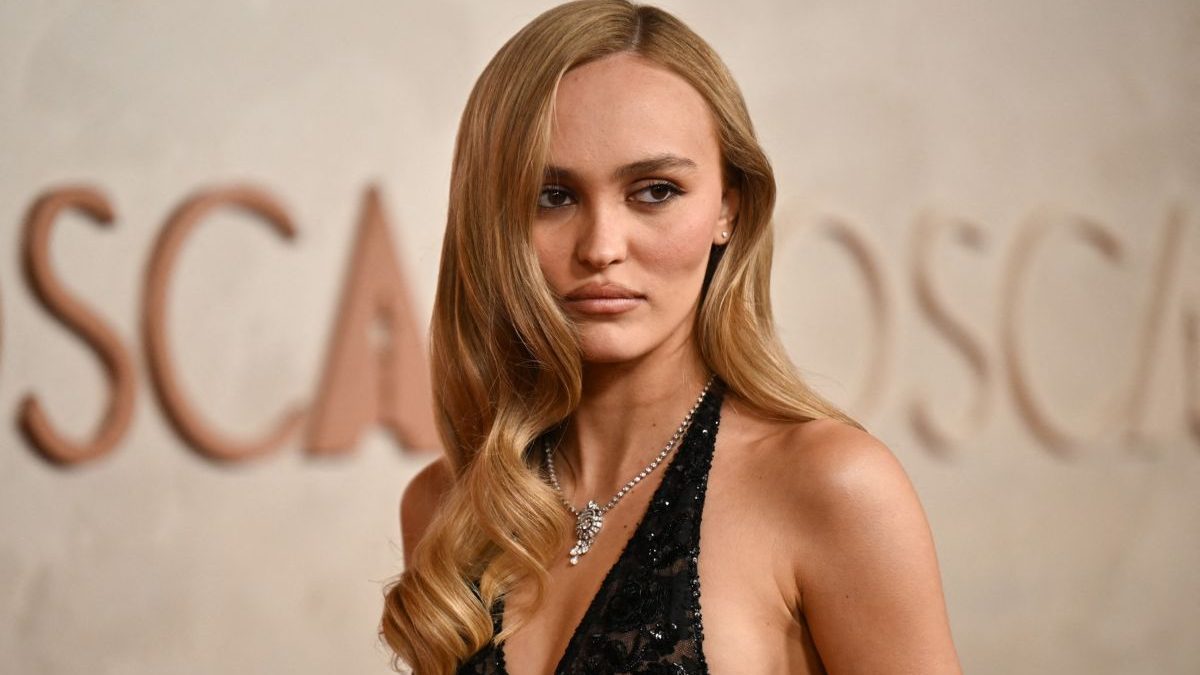
 "Lily Rose Depp. File photo, AFP")
Buster Keaton was three years old when he first performed on a vaudeville stage, being thrown across it by his father. He had so much fun that he sometimes began laughing as his father threw him, and noticed the audience laughed less when he did. So he stopped. He kept his face completely still, and the crowd lost their minds. “The more serious I turned, the bigger laugh I could get,” he told Film Quarterly in 1958. He spent the next sixty years on that discovery.
A century later, the internet is having a full argument about the Gen Z pout — that blank-eyed, lip-lifted expression currently appearing on every red carpet photograph of Lily-Rose Depp, on TikTok, on the face of whatever 22-year-old you follow without knowing why — and the argument is mostly going in circles because nobody has noticed it’s actually quite old.
The pout is not, as various thinkpieces have suggested, a symptom of generational malaise, a byproduct of doomscrolling, or the inevitable expression of a cohort that grew up under surveillance capitalism and came out the other side feeling nothing. It is a comic technique. And a very good one.
The bit
Rachel Sennott — comedian, screenwriter, I Love LA showrunner, most-cited practitioner of the pout — is, first and foremost, funny. Her whole practice is built on deadpan: she takes gauche and coquettish concepts and spins them into comedy gold every time.
As she has explained her own Instagram persona: “I think the way women are perceived on Instagram is that you have to be hot, but it also has to be a secret. I think it’s funny to go all the way.” The pout, on her face at a pre-Oscars party with all her professional dreams materialising around her, is that logic applied to a red carpet. It is a bit. The joke is the gap between the occasion and the expression — between what her life has become and what her face is doing about it.
Quick Reads
View AllSennott herself has spoken about how her humour has matured: “I think my point of view has matured as I’ve matured. And hopefully it’s got funnier and better and — more gooder, I guess. That’s the word I’d use, even though it isn’t one. Gooder.” The self-awareness is the point.
She told Josh Hutcherson, who stars in I Love LA, that the second you’re in on the joke or playing for laughs, it doesn’t work. This is precisely Keaton’s principle restated. The deadpan only functions when the performer commits to it absolutely, because the moment they acknowledge the joke they’ve killed it — and the moment they smile for the camera because they’re supposed to, the camera has won.
Aubrey Plaza understood this years before the pout became a TikTok taxonomy. April Ludgate on Parks and Recreation — blank-faced, contemptuous, constitutionally allergic to enthusiasm — became one of television’s most beloved characters not despite the withholding but because of it. The restraint was the intimacy. You felt let in precisely because so little was being let out.
The history of not trying
There is also a fashion lineage here that has nothing to do with comedy and everything to do with power.
The 1990s supermodels — Linda Evangelista, Naomi Campbell, Christy Turlington — did not smile at cameras. They looked through them. Their runway expressions were imperious, impassive, faintly bored in the way that only very beautiful and very knowing people can carry off. What they were communicating was not unhappiness. It was sovereignty. The camera needed them; not the other way around.
This is worth dwelling on because the decade that followed — the early Instagram era, the selfie boom, the rise of what became known as Instagram Face — went in the opposite direction entirely.
The dominant mode became effortful approval-seeking: beaming teeth, dramatic contour, ring-lit glow, the worked-over face of someone who needed you to think they were worth looking at. It required enormous labour in the service of appearing effortless, which is a very exhausting way to live. The pout, whatever else it is, requires considerably less.
Keaton’s expression, one critic wrote, never changed, but his eyes were “eloquent, intelligent and sad at the same time.” The same could be said of the pout at its best. The lips are neutral, the face is closed, but something is clearly happening behind it — and the camera, starved of instruction, leans in to figure out what.
This is ultimately what distinguishes the pout from its predecessor, the duck face, which was its opposite in every meaningful way. Duck face was prepared, presented, generous — the face of someone who had been told they were about to be photographed and had taken the appropriate measures. The pout is the face of someone who already knew they were being photographed, decided it was fine, and then went back to whatever they were thinking about.
Millennials performed happiness for cameras because they needed cameras to like them back. The generation behind them grew up already being watched — by algorithms, by comment sections, by the slow ambient hum of permanent visibility — and arrived at a different conclusion: that trying too hard, showing the effort, smiling with the whole face at a lens pointed at you, makes people trust you less.
As Keaton’s biographer wrote of the deadpan, it became “the grave face that never smiles, Buster Keaton’s identifying mark as a performer for the next sixty years.” The mask that started as self-protection became, in time, the most recognisable thing about him.
Whether that’s tragic or triumphant probably depends on how you feel about your face.
Treya Sinha is an Arts and Lifestyle writer. She loves literature and music and wants to have a Mary Oliver-esque affinity with the world.