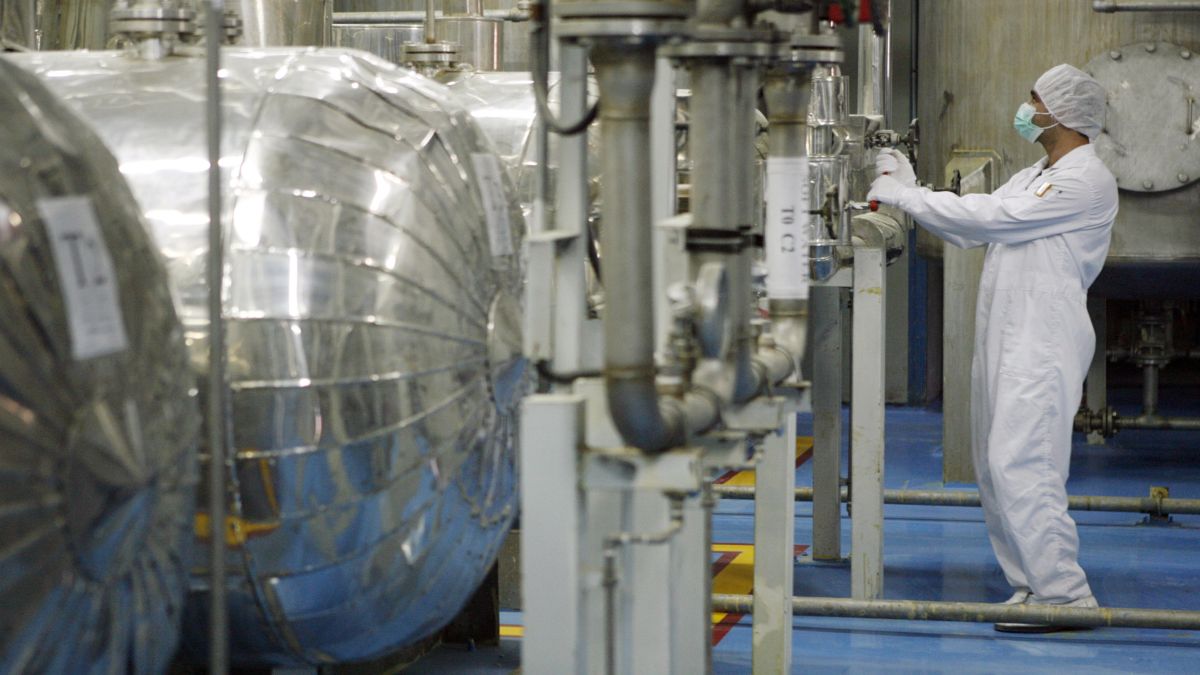
 "Inside Isfahan, the city home to Iran’s nuclear facilities, hit by US bunker busters")
The war in West Asia continues unabated as it enters its second month. Amid speculation of talks being held between the United States and Iran to end this conflict, Donald Trump shared a video of a massive explosion in Iran, which, according to media reports, took place in the city of Isfahan in the early hours of Tuesday.
While Trump didn’t share any context for the video, the visuals captured successive detonations followed by intense fires and plumes of smoke, pointing to secondary blasts likely caused by munitions stored at the site.
- Catch live updates from the Iran war here
Notably, this same site was struck during the 12-day war last year. We take a better look at the city of Isfahan and why the US has taken aim at it amid the ongoing conflict.
US drops 1,000-kg bunker busting bomb on Isfahan
According to a US official speaking to the Wall Street Journal, America hit an ammunition depot in the Iranian city of Isfahan with approximately 907-kilogramme bunker buster bombs. “A high volume of bunker busters, or penetrator munitions, was used for the strike,” the official said.
According to reports, the attack triggered a series of powerful secondary explosions that sent towering fireballs and shockwaves across the area.
Shortly later, US President Donald Trump shared what appeared to be visuals of the aftermath of the bunker busting bomb on Isfahan.
While the American leader didn’t share any further details on Truth Social, it showed a series of explosions illuminating the night sky, which the official said captured the strike in progress.
The significance of Isfahan
Located in western Iran, Isfahan is situated on the north bank of the Zayandeh River and houses a population of nearly 20 lakh. It is also home to Iran’s Badr military airbase that houses the country’s ageing fleet of American-made F-14 Tomcats – bought before the 1979 Islamic revolution.
Today, Isfahan is mainly known abroad as the site of Iran’s premier nuclear research facility. Several other nuclear sites are also in Isfahan’s province — including the underground Natanz enrichment site.
Construction of the Isfahan Nuclear Technology Centre began in 1999 and operates three small Chinese-supplied research reactors, as well as handling fuel production and other activities for Iran’s civilian nuclear programme. It is believed to employ thousands of nuclear scientists.
Quick Reads
View AllIn February 2024, Iran stated that it was building a fourth nuclear research reactor in Isfahan. Iran described the 10-megawatt reactor as a “research reactor,” saying it would have a variety of applications, including fuel and nuclear material tests and the production of industrial radioisotopes and radiopharmaceuticals.
Iran is also home to the Iran Aircraft Manufacturing Industrial Company, which specialises in aerospace production, helicopter maintenance, and military equipment. Together, these factors make Isfahan one of Iran’s most critical strategic hubs.
Previous attacks on Isfahan
While today’s attack hasn’t been confirmed, this won’t be the first time that the Iranian city has been targeted. The city was bombed by the US during the 12-day conflict between Iran and Israel in last June.
In fact, a portion of Iran’s highly enriched uranium is believed to be entombed there — with America suggesting it could seize it with ground forces. This comes after visuals shared by Airbus Defence and Space Pleiades Neo satellite showed a truck loaded with 18 blue containers going into a tunnel at the Isfahan nuclear centre on June 9. It is believed that this truck carried highly enriched uranium to the nuclear facility.
Satellite imagery suggests Iran may have moved up to 540 kg of highly enriched uranium to an underground tunnel complex in Isfahan just days before Israeli and US airstrikes in June 2025.
— Clash Report (@clashreport) March 31, 2026
A high-resolution image from June 9 shows a heavy truck carrying 18 shielded containers at… pic.twitter.com/DOjSStzeEF
Francois Diaz-Maurin, an analyst with the Bulletin of Atomic Scientists, noted that the truck carried 18 secured containers of as much as 534 kilogrammes of uranium enriched up to 60 per cent purity.
Iran war continues with no end in sight
On Day 32 of the war, Israel and the US continue their strikes on Iran, with Tehran raining down missiles and drones on the Jewish nation as well as countries across West Asia.
The strikes come as Donald Trump threatened to destroy Iran’s key oil export hub and desalination plants unless it accepts a deal, while also suggesting diplomacy was making headway. On Monday, the US president also warned that the US troops would destroy Kharg Island, through which most of Iran’s crude passes, if a peace deal is not reached. He said that US forces would destroy “all of their Electric Generating Plants, Oil Wells and Kharg Island (and possibly all desalinisation plants!).”
Meanwhile, Israeli Prime Minister Benjamin Netanyahu said the US-Israel war with Iran is “definitely beyond the halfway point”. He, however, later clarified that it was in terms of missions, not time. Netanyahu added that the war had killed “thousands” of members of Iran’s Revolutionary Guards and that his country and the US were “close to finishing the arms industry” – wiping out entire plants and the nuclear programme itself”.
With inputs from agencies

 "Iran War Live Updates: Attack on Iran’s Mahallat kills 11, injures 15, over 11 injured across central Israel")
 "Masood Azhar’s brother Tahir Anwar dies in Pakistan under mysterious circumstances, says report")
 "Another embarrassment for Pakistan? Why Islamabad may flop in its role as mediator between Iran and US")
 "8 killed, several injured in Nalanda temple stampede in Bihar; PM Modi announces compensation")
 "Iran War Live Updates: Attack on Iran’s Mahallat kills 11, injures 15, over 11 injured across central Israel")
 "Masood Azhar’s brother Tahir Anwar dies in Pakistan under mysterious circumstances, says report")
 "Another embarrassment for Pakistan? Why Islamabad may flop in its role as mediator between Iran and US")
 "8 killed, several injured in Nalanda temple stampede in Bihar; PM Modi announces compensation")