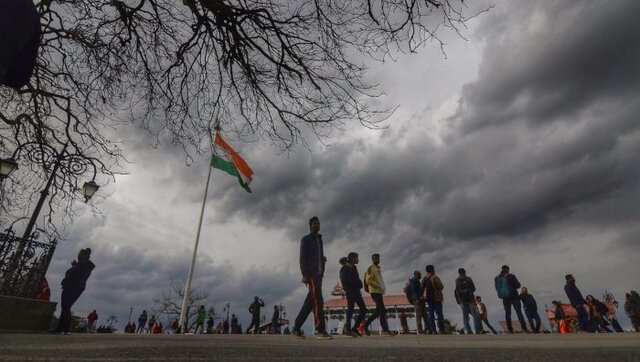
 "The Weather Report: Monsoon disappoints North India in August as September rains make meek start")
The monsoon’s performance in the month of August remained disappointing in most parts of North India as the region faced huge rainfall deficiency.
National Capital Delhi’s Safdarjung observatory recorded 41.6mm rainfall in August against the normal of 233.1mm, -82 per cent departure from normal, It has been the lowest monthly rainfall since 1955 and 3rd Lowest since 1940.
September also began on a relatively dry note for the region except for some patchy rains in the National Capital Region only Safdarjung and Lodi Road weather Observatories recorded 8.8 and 18.0mm rainfall respectively on Friday evening, the behaviour of rains was patchy and short-lived as no other station even had a trace of rain.
Overall this has been the story of the monsoon this year in the plains of North India.
The widespread rains have stayed away. Both Western and East Uttar Pradesh have received -44 per cent below normal rains since 1 June 2022 leading to drought in many parts. Both the regions have remained the worst performing in terms of rainfall departures from normal whereas Tamil Nadu, Puducherry and Karaikal is best performing regions in the country with +88 per cent rainfall departure from normal.
As the axis of the monsoon is over the foothills of the Himalayas, Northwest winds have been observed in the plains, considering dry weather for many days now, days are turning hotter with maximum temperature in the range of 35°C to 40°C in most stations of Punjab, Rajasthan, Haryana, Gujarat, Delhi and Uttar Pradesh.
On Friday, Sriganganagar in Rajasthan recorded 39.5°C maximum temperature wherein it was 39.3°c on Saturday, highest in the country during the past week.
Not only north, also India’s North East continues to face the brunt of less seasonal rains in the month of August and the streak of poor monsoon performance continues since July.
Quick Reads
View AllOne of the world’s wettest spots suffers from poor rains, Cherrapunji records the lowest ever cumulative rainfall for July and August with only 1450.4 mm during this period.
The previous three lowest combined July and August rainfall totals were:
1961 - 1841.1mm
1942 - 2042.4mm
1944 - 2319.5mm
The monsoon rains continue to bless parts of central India and the southern peninsula this season, Bengaluru observatory has received a massive 364.2 mm for the month making it the second wettest August in recorded history, The observatory was just 23 mm shy of breaking the all-time record of 387.1 mm recorded in 1998, the average monthly rains in the city is 147.0mm, excessive rains also lead to flooding in some of the major hotspots of the city in the past week.
The western ghats of the country are also performing as per standards, Karnataka ghats seasonal toppers till 31 August:
Talacauvery – 6,763mm
Agumbe – 6,384mm
Hulikal – 6,254 mm
Mastikatte – 5,729 mm
Naladi – 5,500 mm
Mani – 5,309 mm
Yedur – 5,279 mm
Subramanya – 4,750 mm
Sulkeri – 4,665 mm
Amboli in Maharashtra with 6,520mm till 31 August is the wettest station in the ghats of Maharashtra.
Overall in the past week the pan India rains have seen a significant reduction mainly due to three reasons.
1. Axis of the Monsoon shifts to the foothills of the Himalayas technically it results in a break in monsoon over large parts of central and north India as dry North West winds takes over the moisture feeding Easterlies and the features of trough remains missing.
2. No more formation of low-pressure areas in the bay of Bengal as the Madden–Julian oscillation(MJO) is not in the active phase in the Indian Ocean.
3. The Intertropical Convergence Zone(ITCZ) is inactive in India.
As per IMD data, total monsoon seasonal rains in India from 1 June till 3 September:
• India as a whole recorded a total of 759.8mm rainfall against the average of 721.1mm, a departure from normal Stands at +5 per cent, it was at +7% past Saturday, a clear downfall of pan India rains by -2 per cent over the past week.
Subdivision wise seasonal rainfall figures:
• Southern Peninsula: Actual 727.7mm against the average of 571.8mm, +27% departure from normal.
• East & North East India: Actual 910.2mm against the average of 1112.5mm, -18% departure from normal.
• North West India: Actual 485.4mm against the average of 500.2mm, -3% departure from normal.
• Central India: Actual 957.9mm against the average of 824.5mm, +16% departure from normal.
Monsoon guarantee’s another proper revival of rains in September before it starts withdrawing
It’s September when the monsoon starts withdrawal from Northwest India in the middle of the month as climatology normals suggest monsoon withdrawal begins from West Rajasthan and parts of Punjab from 17 September onwards. Since the weather is highly dry and days are turning hotter across the North India, one may think monsoon will start retreating early this year but the long-range weather outlooks suggest a different situation.
Various foreign multi-model ensembles including IMD’s extended range outlook suggest normal to above normal rains in parts of India during September which is mainly likely after the 10th of the month.
Possible reasons behind the revival of Monsoon in India after 10th September:
1. Madden Julian Oscillation (MJO) will return in the phase 3-5, favours deep convection in the Indian ocean - both bay of Bengal and Arabian Sea will be again made capable for hosting tropical weather systems.
2. As the conditions become favourable, the Bay of Bengal can easily throw 2-4 low pressure areas or depressions towards India against the normal of 1-2 during the month. The western moving systems can produce flooding rains in parts of East, Central and Western India later in the September.
3. As the Low pressure areas form in Bay of Bengal, the monsoon axis struck at the foothills of Himalayas will start shifting southwards and convective rains will pick-up in North and Central India depending on the position of the trough.
4. Western Disturbances become a watchful factor as we head later half of September the western Jet streams (Upper level winds) start to shift southwards towards Western Himalayas and North India.
In case of an approaching westerly trough the western moving low pressure can curve towards North India along with the monsoon axis, these conditions generally lead to extreme rains over the Himalayas and plains of North India.
All India Weather Forecast till 10th September:
North India
The upcoming week is expected to start on a dry note for most parts of North India.
In absence of any major weather system and shifting of monsoon trough to the Himalayas the flow of Northwest winds likely to maintained in plains of North India which are dry in nature resulting in below normal rains in Jammu, Kashmir, Punjab, Haryana, Rajasthan, Delhi and Western Uttar Pradesh where weather conditions are expected to be dry and days will remain hot as maximum temperatures can rise further to 1-2°c, parts of Western Rajasthan can even touch 40°C in next two days.
During the stay of the monsoon axis over the foothills parts of East Uttar Pradesh, Uttarakhand and Himachal Pradesh will manage to receive scattered light to moderate rains during the entire week.
The chances of full-fledged monsoon revival in North India is very low for the next week but rains are expected to increase slightly by 8/9th September as low-pressure area in the Bay of Bengal may push moist Easterlies in plains which may replace the dry westerly winds.
Expected precipitation accumulation till 10 September:
• Uttarakhand: 60mm
• Himachal Pradesh: 50mm
• Uttar Pradesh: 40mm
• Jammu and Kashmir: 30mm
• Delhi NCR: 20mm
• Haryana 10mm
• Punjab: 10mm
• Rajasthan: 10mm
Central India
Rains in the upcoming week are also likely to be convection dependent which is generally featured by many local factors such as humidity content in the air, lifting of air masses which can produce thunderclouds.
Parts of Chhattisgarh, Madhya Pradesh, and Maharashtra to experience typically scattered thunderstorms throughout the upcoming week; these rainfall activities will generally be restricted to afternoon to late evening hours.
Parts of Gujarat experience isolated rains along with hot days as rains are likely to be below normal for another one week.
Expected Precipitation accumulation till 10 September:
• Maharashtra: 80mm
• Chhattisgarh: 40mm
• Madhya Pradesh: 30mm
• Gujarat: 10mm
East and North East India
The monsoon axis remained struck over the foothills of the Himalayas for another week paving way for the moisture feeding southern winds from the bay of Bengal to reach North East India.
Over the upcoming week a Gradual increase in rainfall activities will be observed in India’s North East, Sikkim, Sub Himalayan West Bengal, Jharkhand and parts of Bihar.
Widespread heavy to very heavy rains are expected to occur in Sikkim, Arunachal Pradesh, Assam, Meghalaya, Mizoram, Nagaland, Tripura, and Manipur during the entire week.
Parts of Sub Himalayan West Bengal, Jharkhand and Bihar are likely to experience scattered to fairly widespread moderate to heavy rains during this period.
Overall North East India will try to recover some of the deficiency during the upcoming week by registering normal to above normal rains.
Expected Precipitation accumulation till 10 September:
• North East India: 220mm
• West Bengal: 120mm
• Jharkhand: 60mm
• Bihar 50mm
• Odisha: 50mm
Southern Peninsula:
As the monsoon axis remains in the foothills of the Himalayas, the wind discontinuity/Convergence will persist in the southern peninsula along with the slight activation of the off shore trough at the West coast of India, it favours the formation of convective clouds in the interiors of Andhra Pradesh, Tamil Nadu, Karnataka and Kerala.
An increase in rainfall activities has been observed in the past week and following the same trend moderate to heavy rains will continue to impact major parts of Kerala, Karnataka and the interiors of Tamil Nadu till 10 September.
As the offshore trough strengthens later in the week, very heavy rains will return in coastal and ghats of Kerala, Karnataka and Goa during 7 to 10 September.
Expected precipitation accumulation till 10 September:
• Kerala: 160mm
• Karnataka: 120mm
• Goa: 100mm
• Tamil Nadu: 90mm
• Telangana: 60mm
• Andhra Pradesh: 50mm
The author, better known as the Rohtak Weatherman, interprets and explains complex weather patterns. His impact-based forecasts @navdeepdahiya55 are very popular in north India.
Read all the Latest News, Trending News,
Cricket News, Bollywood News,
India News and Entertainment News here. Follow us on
Facebook,
Twitter and
Instagram.

 "'Indian food, our pride': $200k settlement in Palak Paneer case a moral victory against racism in the west")
 "India’s air dominance in Operation Sindoor forced Pakistan to seek ceasefire, European report says")
 "How Pakistan’s support may have led Bangladesh towards a very costly mistake")
 "India vs New Zealand Live Score 3rd T20: Samson bowled on very first ball by Henry")
 "'Indian food, our pride': $200k settlement in Palak Paneer case a moral victory against racism in the west")
 "India’s air dominance in Operation Sindoor forced Pakistan to seek ceasefire, European report says")
 "How Pakistan’s support may have led Bangladesh towards a very costly mistake")
 "India vs New Zealand Live Score 3rd T20: Samson bowled on very first ball by Henry")