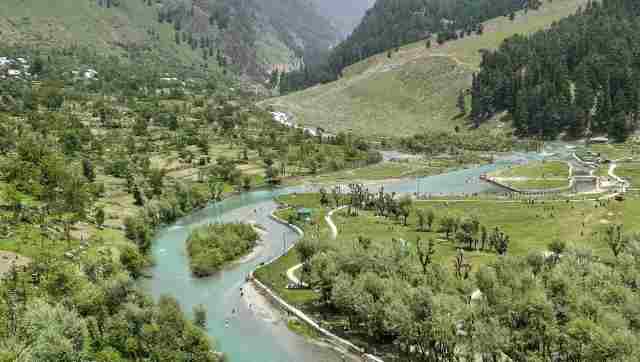
 "The Kashmir Files: Of overcrowded hill stations, impending water crisis, and growing garbage & pollution levels")
Hanging between the assault rifle and gigantic mountains lies a paradise — Kashmir. I reached there, for the first time, a day after Eid and headed straight to the mountainous region of Uri. My mission was to walk for the next 14 days, alongside the Jhelum and explore its springs, tributaries and people.
Our journey was alongside the Jhelum towards Baramulla, and then Uri. As we left the Kashmir plains, Aslam Khan, my driver, began talking: “All these areas were once filled with water. There is a tale of an ancient demon (Jalodbhava) who has stopped the water, all these mountains were underwater, even the river Jhelum was stopped by him, but then with the help of saints and Vishnu, the waters were released and the demon was trapped in a mountain.”
As the road curved, we started to gain height, the roaring river called out to us. By nightfall, we were at Bandi, a few kilometres before Uri. Our guesthouse overlooked the massive hydroelectric project, and placid river waters. I was instantly reminded of the Aslam story — water-stopping demon Jalodbhava.
Next morning, we reached our first destination Kamal Kote, a predominantly Shia village stone’s throw away from Pakistan-occupied Kashmir. The road to the village was shaded by green walnut trees and wild pomegranate flowers, and mountains were glittering with white snow peaks. Unperturbed, the locals were busy tending to their fields. It was a maize-sowing season, and rains had already reached the mountains across the Jhelum.
We — a motley bunch of six people — were following a rivulet (nala), and at the edge of town met Sayid Rehmat Husain Shah, a former serviceman. Rehmat grew up in the village, but then travelled across the country with the Indian Army. On his return, he found things quite different in his village. “Parthi nala is used for irrigation and the Cham for drinking, but since the earthquake (2005) water sources have reduced. Plus, there is no snow at all now, and the rainfall is also less now.” We hiked to the glacial waterfall with Rehmat and saw for ourselves plastic wrappers, broken water channels.
Quick Reads
View All“People have shifted from paddy to maize in our village. Forest fires are also very common now: Pakistani shillings, slash and burn for grass cutting, and timber mining are all responsible for fires. The direct result of lesser trees is about 20 per cent less water,” Rehmat explained.
The initial signs were not good.
On Day 2 we scaled about 1,800m to reach Namla, C block, Uri, and started our hike towards the local Cham that formed the Khungri Nala_._ This rivulet, although a mere teardrop into the Jhelum, supported over 14,000 people residing in the block and provided drinking water to Uri.
The nala was guarded by thousands of ferns, pines and willows. And accompanying me on this scenic trip was Fayaz, a local English teacher with a passion for Urdu poetry. “Our area is really affected by climate change, as water in the Cham has drastically reduced. More areas within this block are also experiencing water problems.”
Our conversations continued, and we arrived at the destination — a 150ft waterfall. I filled water and sat admiring the valley below; it really felt like heaven. But Fayaz reminded me all this could change very soon.
After a while, it was time to begin the 15 km march to Bandi. We stopped at a local school in Khabna to interact with the teachers and understand their perspective. “Farming is the major occupation in the area, with shrinking water, our area could be in trouble,” said Naseer, headmaster of the school.
In his lifetime, Naseer had seen the massive changes in snowfall and rain. After tea, we continued our walk along the rivulet. Oftentimes we saw defunct micro-hydel projects, some overturned bridges and fast mounting plastic trash. After almost six hours of walking, we were at the juncture of Haji Peer Nala and Khungri Nala; the sun was orangish yellow, and our feet were tired.
Day 3 took us alongside the Jhelum into the Bijhama area. We saw fertile land. The only thing that stood out was a JCB eating into a gypsum mountain. One wondered how legal this operation was? But before that question, we had to walk to the last Indian point, where Gujjar Nala entered Kashmir. It was a fast stream, bouncing off white boulders. This was also the territory of ‘Markhor’, and walking inside the Lachipora wildlife areas.
Speaking with locals, it became clear that post Article 370, some illegal mines were shut, and since decreasing militancy, wildlife areas were conserved and timber mining had also reduced. The active mines did pollute the rivulet, and locals expressed deep anguish, as many of the elderly and children were reporting lung and kidney troubles, due to the gypsum-mixed water.
Rajendra Singh, the waterman of India, also joined our team, and assessed the damages. For the next two days, we travelled from village to village and even visited the Kaman Post and saw the Aman Setu Bridge. There were nine Pakistani bunkers overlooking us. My mind, quietly, was checking out for snipers.
After the days in the Uri area were coming to an end, I asked Rajendra Singh how saw the water situation in the region? “Uri could have drinking water problems in the next seven years. If younger generations are not made aware of the problem and given solutions, this area may suffer for water,” he said.
But the trip wasn’t only about water: Often during the river walks, people would ask if I was Hindu or Muslim? It felt weird being asked that question, because what I said next would change the conversation.
On my last evening in Uri, I sat with Kashmiri Pandit policemen, hoping to catch his views. “My parents fled in 1990, when I was a few months old. I have only returned after 30 years. Although the Pahadi culture of Uri is very different from Kashmir, militancy is a major threat,” he said.
Our conversation naturally moved towards The Kashmir Files: “They cut scenes from the film, the reality was much worse,” he remarked.
To end my trip, I moved from the west to south-east towards Pahalgam, to study the Lidar river. The river was humming a new tune, “zze-za-zee”, the melting caps renewing her youth. An occasional plastic packet flowed by. A little disturbed, I looked up to the gorgeous green peaks. My walk along the Lidar was on. Lidar is Jhelum’s tributary, and major tourist destination Pahalgam was on it. My task was simple: Walk from Pahalgam to Betaab valley and experience the river. And perhaps, drink from the river!
But Moonis Reishi, a Pahalgam cottage owner, warned against it. “We don’t drink from the river anymore, because of the tourist influx. The water is not clean anymore. Otherwise, no one would have imagined using RO in this place,” he said.
Moonis was right, lakhs of people visit Pahalgam each month and they bring with them trash. The proof of his statement was quite visible. I chose Sunday for a walk: Pahalgam was overfilled and the road to Beetab was jammed with cars. But I edged on. I also walked to the local landfill and sewage treatment plant, fortunately they both were functional.
Sixty kilometres, 14 days and finally my Kashmir tour was over. Before departing, I wanted to steal a picture in my mind. I walked to the Lidar in the dark, saw the Buddha Purnima moon lighting up the skies, the pine trees humming in that serene milieu, and our silvery river roaring magnificently!
The writer is an independent agri-policy analyst and the former director, Policy and Outreach, National Seed Association of India.
Read all the Latest News, Trending News,
Cricket News, Bollywood News,
India News and Entertainment News here. Follow us on
Facebook,
Twitter and
Instagram.

 "India–EU FTA to benefit Rs 6.4 lakh crore exports across key states and sectors, says Piyush Goyal")
 "Will reset in Indo-Canada ties be complete with Carney's visit?")
 "Zelenskyy sets 2027 target for Ukraine’s EU accession, stresses security guarantees")
 "How Taliban's new criminal code legalises slavery, grants clerics immunity")
 "India–EU FTA to benefit Rs 6.4 lakh crore exports across key states and sectors, says Piyush Goyal")
 "Will reset in Indo-Canada ties be complete with Carney's visit?")
 "Zelenskyy sets 2027 target for Ukraine’s EU accession, stresses security guarantees")
 "How Taliban's new criminal code legalises slavery, grants clerics immunity")