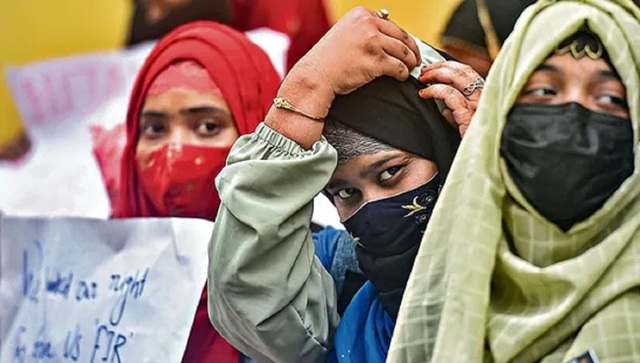
 "Right Word | Making veil a symbol of religious identity won’t do any good to Muslim women")
History would probably not judge those kindly who are promoting the use of veil by Muslim women in India as a symbol of their religious freedom and empowerment. There have been many factors that have affected the progress and emancipation of Muslim women in India since medieval times. Purdah or veil is one of them.
According to the 2011 Census, Muslim women lag far behind in education with almost half of them not even getting basic literacy. At 51.9 per cent, the literacy rate for Muslim women was lowest as compared to all other communities in the country. This is an outcome of the way Muslim women have been treated within their own community first during the medieval era and then in the colonial as well as post-colonial era. This is also the real problem that needs to be addressed if we want millions of Muslim women to get educated, work in jobs and live their lives according to their will.
Status of Muslim women in medieval era
Sudha Sharma has underlined the damage done to Muslim women by purdah in her authoritative work, The Status of Muslim Women in Medieval India (Sage; 2016; Pp164-65), “Purdah as an institution and in the form it was adopted by the Muslim society did a great harm to the Mohammedan women and their standing in the society. The conservatives might support its observance as a part of the social need of the time. But the very fact that it curtailed women’s freedom of growth and advancement and made her subservient to the will of man was a great blow to her independent status in the society. It segregated the whole gamut of social life into two exclusive spheres: Outdoor and indoor… Having been denied the company of men or the exposure to a wider horizon, superstitions, taboos and prejudices became a part of her life. In the long run her development was obstructed and she became totally dependent on man for meeting even her basic needs… With the observance of purdah, Muslim women were destined to a virtual life of prisoners, suffering from feeble health, dulled senses, ignorance and prejudices.”
Struggle to shed purdah in colonial era
There weren’t many Muslim leaders who favoured doing away with purdah in the colonial era and that was one of the key reasons that held back the progress of Muslim women in India. But there were some exceptions and one of them was a remarkable Muslim intellectual and educationist Iqbalunnisa Hussain.
Hussain understood way back in 1940 how purdah was affecting socio-economic growth of Muslim women. But first a little bit about Hussain herself to understand the context and significance of her arguments on ‘purdah’.
Quick Reads
View AllAccording to the brief introduction available in her book, “Hussain was born in Bangalore in 1897. She was married at the age of 15 to Syed Ahmed Hussain, an official in the Mysore government who encouraged her to acquire an education. She joined a school in Mysore and later the Maharani’s College from where she obtained her BA degree and a gold medal by correspondence in 1930. In 1933, she travelled to the UK for her Masters in Education at Leeds University, thus becoming one of the few middle class Muslim women from India to obtain a degree from the UK.
She represented India at the Twelfth International Women Congress at Istanbul in September 1935 and was an active member of the All-India Women’s Conferences. In Bangalore she founded a school where she encouraged Muslim girls to acquire an education while also providing training in rug making, carpet weaving, embroidery, cutting and sewing. Her students participated in the Girl Guides, were good debaters, and keen performers in dramas and plays. She authored several books including Changing India: A Muslim Woman Speaks and Purdah and Polygamy: Life in an Indian Muslim Household.”
What Hussain wrote in her seminal work, Changing India: A Muslim Woman Speaks (Hosali Press, Bangalore; 1940; Pp45-49), needs to be read again especially by proponents of purdah for Muslim women. “The disadvantages of the purdah system were not so conspicuous in olden days as they are now. These are educational, social, economical, and physical. It has made the education of our girls difficult. The percentage of educated Muslim women in comparison to those of other communities is very low… Socially, Muslim purdah women are not taken for civilised people. They have very few opportunities to mix with women of other communities who are more civilised. Their experiences of the world are next to nothing.”
She further added, “Seclusion has undermined the health of Muslim women… Eighty per cent of the girls of schoolgoing age suffer from some disease or other which can easily be cured by sunlight, fresh air and experience… Development of personality is acquired by a life of contact with others in daily experiences.”
There was a debate about the abolition of purdah at that time also. Hussain had an interesting take on it. “In such circumstances, the only way to abolish the purdah system is to educate the masses, make them realise its disadvantages and so eradicate the social evils by imparting true education which will develop their moral courage.”
Global movement to shed hijab
Masih Alinejad, an Iranian-American, is a journalist and activist from a small village in Iran. When she posted a photograph of herself without her veil or hijab, on her Facebook page, she sparked a social media liberation movement, ‘My Stealthy Freedom’. Her memoir The Wind in my Hair, published in 2018, says: “With the creation of ‘My Stealthy Freedom’, Masih has gained over one million supporters around the world and inspired Islamic women everywhere to take a stand for their basic human rights.”
Talking about hijab, Alinejad, recounted in her memoir (Pp 220), “Throughout my life I had been told that my virtue, my chastity, my self-worth, all were wrapped in my head scarf. I was brainwashed to believe that a piece of cloth over my head would protect me from the lusty desires of men.”
She further added (Pp 370-371), “All the females in my family, my mother, my sister, my aunties, they all wear the hijab. All the females that I know have worn the hijab from the age of seven, and I did, too. My dream is to be with my mother in France, in Belgium, walking shoulder to shoulder, without her getting bad looks or being judged because of her hijab.”
There is a lesson for all those who are pitching for making hijab a symbol of freedom of practicing religion in India. In Alinejad’s words (pp 308):
“Whenever I’m running free and my hair is dancing in the wind I remember that I come from a country where for thirty-odd years my hair has been taken hostage by those in power in the Islamic republic… I come from a country where for thirty-odd years no one has been able to free their hair from the hands of the hostage takers, who keep saying, ‘The time is not right.’”
The time is right in India to empower Muslim women by focusing on real issues that would propel their all-round growth rather than creating narratives around promoting the veil which has stymied their growth so far.
The writer, an author and columnist, has written several books. Views expressed are personal.
Read all the Latest News, Trending News, Cricket News, Bollywood News,
India News and Entertainment News here. Follow us on
Facebook,
Twitter and
Instagram.


 "Jaishankar meets Sergio Gor ahead of US visit, says discussed 'many dimensions of our partnership'")
 "As Trump shakes up Nato, Europe aims to go self-sufficient in weapon production")
 "EU to list Iran’s Revolutionary Guards as terrorist group alongside al-Qaeda and Hamas")
 "With new security pact, India and EU eye win-win defence ties as US, China rival in arms race")
 "Jaishankar meets Sergio Gor ahead of US visit, says discussed 'many dimensions of our partnership'")
 "As Trump shakes up Nato, Europe aims to go self-sufficient in weapon production")
 "EU to list Iran’s Revolutionary Guards as terrorist group alongside al-Qaeda and Hamas")
 "With new security pact, India and EU eye win-win defence ties as US, China rival in arms race")