

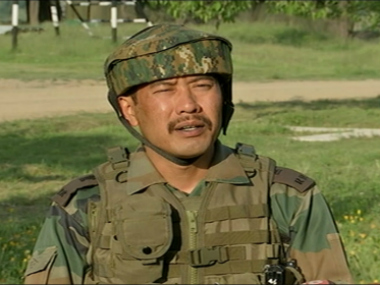
 "Likening Major Gogoi's actions in Kashmir to General Dyer's in Punjab misses structural violence for solo acts of brutality")
Let me begin by stating that Professor Partha Chatterjee’s recently published essay, drawing similarities between Major Leetul Gogoi’s “human shield” incident in Kashmir and Brigadier-General Reginald Dyer actions at Jallianwala Bagh, is a remarkable meditation on the historical politics of violence, even as it ignores the critical question of complicity implicit in the making of imperialism. As critique ceases to be critique and disagreement becomes merely ideological, let me also take this opportunity to declare my protest against the theatrical treatment of the essay on national television and the vociferous branding of its author as “anti-national”. [caption id=“attachment_3474242” align=“alignleft” width=“380”]  Major Leetul Gogoi. Image courtesy: CNN-News18[/caption] My disagreement with the essay is primarily intellectual, but also potently ideological. What is attempted in this piece, therefore, is a qualification against the imagination of colonial violence as personalised and episodic — in other words, the configuration of violence, whether colonial or of the Indian state, in the manner of “moments” that present themselves rarely and regrettably without unsettling the cardinal core of their structures. Chatterjee, in his distinctive eloquence, argues that a careful and detached reflection will show chilling similarities between justifications advanced for the actions of the British Indian Army in 1919 and those being offered today, nearly a century later, in defence of the army’s acts in Kashmir. It is difficult to disagree with Chatterjee here, but also difficult to miss the shrinking of the discursive field in that the acts of the British Indian Army in 1919 and that of the Indian Army in 2017 become so epochal that only sparse imagination is possible both within and between them. This weight of chronology is significant, as both Dyer and Gogoi acted in “innovative” ways for the establishment of temporarily disquieted order and restoration of political rule. The tactical strength and parallel brutality of their innovative ways render the two worthy of special consideration — this consideration, it is clear, locates the violence in their individual dispositions and idiosyncrasies, not in the structures for whose maintenance they employ their so-called ways. In this framing of history, colonial violence is the work of memory around individual events, such as the massacre that Dyer orchestrated, remembered now by “every schoolchild in India (who) knows the momentous effect this incident had on the course of nationalist politics” in the subcontinent. Yet, to see colonial violence in the momentary affairs of individuals is a slide unto the erasure of its sheer pervasiveness, its pernicious quotidian nature, both in British India and contemporary Kashmir. Indeed, we would do well to remember that although lauded by the imperial metropolis in Britain, Dyer was condemned by the British government in India and eventually dismissed. British dignitaries, notably Winston Churchill, carefully distanced themselves from Dyer’s actions in Amritsar, marking the massacre as a colonial excess and valourising the empire as intrinsically glorious. Official condemnation, writes historian Kim Wagner, ought not to be mistaken “for an outright disavowal of colonial violence as such, but rather an attempt to maintain the conceit of rule of law”. Major Gogoi may have received official commendation, but to let the framing of the “chilling” moment of strapping Farooq Ahmad Dar to the bonnet of an army jeep remain uncontested silences the performative ubiquity of violence in the Valley and cloaks state repression in the unwieldy guise of exceptionalism. Dyer and Gogoi may have both employed exceptional ways, but they ultimately did the unexceptional ideological work of violence. In the course of historiographical turns, Wagner and Elizabeth Kolsky have illustrated that “the history of violence in British India cannot be understood by traversing from one cataclysmic event to the next as the micro-moments betwixt and between those macro-events are where the violence central to the workings of empire can be found” (Kolsky, 2011). Wagner has suggested that far from being a gathering of apolitical, even pre-political, civilians celebrating the baisakh festival, the gathering at Jallianwala Bagh was a political meeting of the Punjabi population disillusioned by repressive British measures in the interwar period. “Where popular depictions show a peaceful crowd of locals quietly listening to a political speech,” writes Wagner, “Dyer instead perceived a defiant and murderous mob, which had only days before run rampant through Amritsar and which still had the blood of Englishmen on its hands.” Dyer’s act of political violence was thus both fairly conterminous in the “long century (of colonial violence) from the 1850s to the 1950s” and not simply a response to anti-colonial resistance, making it but essential to imagine both the mutiny of 1857 and the Amritsar massacre on a wider historical and political canvas. “There are times when one looks in the mirror,” begins Chatterjee movingly, “And is shocked to see a face one doesn’t recognise — the repulsive face of a nasty stranger. Most Indians will find it hard to believe that as a nation state, we have just arrived at our own General Dyer moment.” If it is Major Gogoi who resurrects in contemporary Kashmir the spirit of the infamous General Dyer, how do we negotiate the Dyer who never left? What of the regime of the Armed Forces Special Powers Act (AFSPA), quotidian human rights violations, extrajudicial killings, enforced disappearances, rape, torture, and the multifarious forms of everyday humiliation? Is this repulsive face really the face of a stranger one doesn’t recognise, or have we made ourselves familiar, even laudatory, in the recognition of its repulsion? The stranger is no stranger and the reaching of this epochal moment, however ephemeral, represents no difficulty of acceptance by most Indians. Dyer and Gogoi, after all, are caricatures of a violence that prefigures their innovative ways — in them is the repulsive history of a nasty friend who recognises himself, with them runs the tardy trajectory of violence and its many happy witnesses. Not only do we accept that we are as Dyer was, but we take in it the pride of postcolonial worship.
If Major Gogoi resurrects in Kashmir the spirit of General Dyer, how do we negotiate the regime of the AFSPA, human rights violations, extrajudicial killings, enforced disappearances, rape, torture, and everyday humiliation?
Advertisement
End of Article


 "US ready to ‘impose costs’ on Russia if war in Ukraine drags on, says Hegseth")
 "US tells Hamas to stop violence against Gaza civilians and disarm 'without delay'")
 "China seizes 60,000 maps mislabelling Taiwan, omitting South China Sea islands")
 "Syria’s Sharaa pledges to honor Russia ties, seeks economic and military support in Kremlin visit")
 "US ready to ‘impose costs’ on Russia if war in Ukraine drags on, says Hegseth")
 "US tells Hamas to stop violence against Gaza civilians and disarm 'without delay'")
 "China seizes 60,000 maps mislabelling Taiwan, omitting South China Sea islands")
 "Syria’s Sharaa pledges to honor Russia ties, seeks economic and military support in Kremlin visit")



](https://images.firstpost.com/wp-content/uploads/2017/05/Gogoi.jpg)